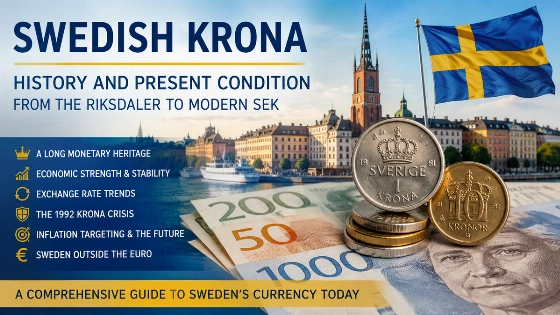
The Swedish krona grew out of centuries of copper, silver, paper money and riksdaler reforms before becoming Sweden’s national currency in 1873. This detailed guide follows SEK through the Scandinavian Monetary Union, the 1992 currency crisis, inflation targeting, the 2003 euro referendum and the increasingly digital Swedish payment system of 2026.
The Swedish krona is the product of centuries of monetary experimentation, from copper plate money and Europe’s first banknotes to the riksdaler, the Scandinavian Monetary Union and the modern floating SEK. This updated guide explains how Sweden created the krona, why its fixed exchange-rate systems repeatedly changed, what drives its value today and how the currency fits into one of the world’s most digitalised payment systems.
The original version of this page described the condition of the Swedish krona in March 2011. The historical URL has been retained, but the article has been comprehensively rewritten and updated for 2026 using material from Sveriges Riksbank, Statistics Sweden, the European Commission, the European Central Bank, the Swedish Election Authority, the International Monetary Fund and the Bank for International Settlements.
Swedish Krona: Essential Facts
- Official currency: Swedish krona
- Swedish name: Svensk krona
- Plural: Kronor
- International currency code: SEK
- Common symbol: kr
- Subdivision: 1 krona = 100 öre
- Lowest physical denomination: 1 krona
- Central bank: Sveriges Riksbank
- Currency introduced: 1873
- Current exchange-rate regime: Floating exchange rate
- Inflation target: 2 per cent annual CPIF inflation
- Euro-area status: Sweden has not adopted the euro and the krona does not participate in ERM II
The Krona in Seven Stages
- Copper and silver money: Sweden used multiple metal standards, unusually large copper coins and a range of daler units.
- Early paper money: Stockholms Banco issued Europe’s first generally circulating banknotes in 1661.
- The riksdaler: Reforms gradually reduced the number of competing units and introduced decimal accounting.
- The krona: Sweden adopted the krona and öre in 1873 as part of a gold-based Scandinavian currency system.
- Pegs and devaluations: The twentieth century brought gold-standard suspensions, currency baskets, devaluations and fixed exchange-rate policies.
- The floating SEK: Sweden abandoned its fixed rate on 19 November 1992 and adopted inflation targeting.
- Digital payments: The krona remains legal tender in cash while most everyday payments increasingly take place through cards, bank accounts and mobile services.
Before the Krona: Copper, Silver and the Daler
Swedish monetary history did not begin with the krona. For centuries, the country used a complicated mixture of silver and copper coins, foreign money, banknotes and accounting units. The value of money often depended on the metal from which it was made, the weight of the coin and the particular standard used in a contract.
Sweden’s large copper resources had an unusual effect on its currency. During the seventeenth century, the authorities issued heavy copper plate money intended to represent substantial values while preserving a relationship between the face value and the metal content. Some pieces were so large and cumbersome that ordinary payments could become physically difficult.
This inconvenience helped create demand for a more portable payment instrument. In 1661, Stockholms Banco, founded by Johan Palmstruch, began issuing credit notes. Sveriges Riksbank describes these as the first real banknotes in Europe. They were convenient because people no longer had to move heavy copper money for every transaction.
The innovation also demonstrated a central problem of paper currency. Stockholms Banco issued more notes than it could reliably redeem. Confidence collapsed, the bank failed and the notes were withdrawn. The episode showed that paper can function as money only when the issuing institution is trusted and manages the supply responsibly.
The Founding of Sveriges Riksbank
In 1668, Sweden established Riksens Ständers Bank from the ruins of Stockholms Banco. The institution later became Sveriges Riksbank and is generally described as the world’s oldest central bank.
The bank’s role changed substantially over time. It was not originally a modern central bank with a policy rate, an inflation target and a monopoly over banknote issuance. Nevertheless, the defence of the value of money was part of its purpose from an early stage.
Sweden continued to experience monetary complexity. Different versions of the daler and riksdaler could coexist, while banknotes and coins did not always trade at straightforward or stable relationships. Commercial banks were also permitted to issue notes during part of the nineteenth century.
The Riksdaler and Decimalisation
A major reform in 1776 reduced the number of recognised coin types and made the riksdaler the principal monetary unit. The reform also restored a silver standard, under which Riksbank notes could be redeemed for silver at a predetermined value.
Further simplification came in 1855. Sweden introduced the riksdaler riksmynt, divided into 100 öre. This was an important step towards a modern decimal currency, although the name krona had not yet been adopted.
The decimal structure survived the later change of name. When the krona replaced the riksdaler riksmynt, the new unit continued to be divided into 100 öre.
Why Sweden Introduced the Krona in 1873
Sweden introduced the krona in 1873 as part of a wider monetary transformation in Scandinavia. The name means “crown” and the plural form is kronor.
The reform was tied to the gold standard. Sveriges Riksbank states that one krona was defined as 0.403225 grams of gold. A currency defined through a fixed gold content could maintain stable exchange relationships with other currencies operating under compatible gold standards.
The krona replaced the riksdaler riksmynt at an equal numerical value. One riksdaler riksmynt became one krona. This avoided the need for a dramatic redenomination of everyday prices and accounts.
The Scandinavian Monetary Union
Sweden and Denmark formed the Scandinavian Monetary Union in 1873, and Norway joined in 1875. Each country retained its own national currency and banknotes, but the Swedish krona, Danish krone and Norwegian krone were defined according to the same gold standard and were accepted across the union at equal value.
The arrangement made trade and travel easier because the three currencies operated as equivalent units. A Swedish krona and a Danish or Norwegian krone represented the same defined gold value even though they were issued by different national authorities.
The union did not create a single Scandinavian central bank or one common set of banknotes. It was a coordinated monetary system rather than a complete political or fiscal union.
The outbreak of the First World War disrupted gold convertibility and weakened the practical foundations of the union. Although the formal arrangements did not disappear immediately, the currencies ceased to function as reliably interchangeable units. Sweden, Denmark and Norway retained the related names krona and krone after the union ended.
The Gold Standard and Its Suspension
The gold standard gave the krona a fixed metallic definition, but it also restricted domestic monetary policy. Maintaining convertibility required the authorities to give priority to the gold value of the currency, even when economic conditions created pressure for a different policy.
Sweden suspended gold convertibility during the First World War. An attempt was later made to restore the pre-war system, but the international gold standard proved increasingly difficult to maintain.
In September 1931, Sweden left the gold standard. The decision came during the international financial and economic crisis of the early 1930s. The krona subsequently operated under other forms of exchange-rate management rather than returning permanently to its nineteenth-century gold definition.
From War to Bretton Woods
During and after the Second World War, Sweden managed the krona through fixed or closely controlled exchange-rate arrangements. In the post-war Bretton Woods system, participating currencies were linked to the US dollar, while the dollar was officially convertible into gold for foreign monetary authorities.
Fixed exchange rates were intended to support trade and financial stability. They also meant that domestic policy had to take account of the exchange-rate commitment. If inflation in Sweden rose faster than in trading partners, Swedish exports could become less competitive unless productivity increased or the exchange rate was adjusted.
When the Bretton Woods system broke down in the early 1970s, Sweden experimented with new currency pegs and baskets. The krona was linked at different times to arrangements designed to stabilise it against the currencies of Sweden’s main trading partners.
Inflation, Devaluations and the Export Economy
Sweden is a relatively small and open economy. Exports, imports and international investment therefore have a strong influence on the currency. Industrial production, engineering, vehicles, pharmaceuticals, forestry products, services and technology connect Swedish incomes and company earnings to economic conditions abroad.
During the 1970s and 1980s, Sweden experienced repeated problems with inflation, wage growth and declining cost competitiveness. Governments responded with several devaluations of the krona. A devaluation reduces the official value of a currency under a fixed exchange-rate system. It can make exports cheaper in foreign-currency terms, but it also increases the domestic cost of imports.
Devaluation can offer temporary relief to exporters, but it does not permanently solve weak productivity or excessive domestic inflation. If prices and wages adjust upwards after a devaluation, the competitive benefit may disappear.
In 1982, Sweden implemented a particularly large devaluation. The intention was to improve industrial competitiveness and support an economic recovery. The episode became one of the most important turning points in the pre-1992 history of the modern krona.
Financial Deregulation and the Crisis of the Early 1990s
Sweden deregulated important parts of its credit market during the 1980s. Lending and property prices expanded, while households and companies accumulated debt. When economic conditions deteriorated, property values fell and the banking system came under severe pressure.
At the same time, Sweden was trying to maintain a fixed exchange rate. In 1991, the krona was unilaterally linked to the European Currency Unit, the basket that preceded the euro. The peg was intended to strengthen confidence and reinforce the commitment to low inflation.
Markets increasingly doubted whether the rate could be defended. Capital moved out of the krona, forcing the Riksbank to raise interest rates. On 16 September 1992, the marginal lending rate was raised to 500 per cent in an extraordinary attempt to stop the outflow.
The defence ultimately failed. On 19 November 1992, Sweden abandoned the fixed exchange rate and allowed the krona to float. The currency depreciated rapidly, but the change removed the requirement to maintain a predetermined external value.
The Floating Krona and Inflation Targeting
Since November 1992, Sweden has maintained a floating exchange rate. This means that the market value of the krona can change in response to supply and demand rather than being fixed at a particular rate against the euro, dollar or another currency.
A floating currency does not mean that the central bank is indifferent to the exchange rate. A weaker krona can raise import prices and inflation, while a stronger krona can reduce imported inflation and affect exporters. The Riksbank therefore considers exchange-rate movements when assessing the inflation outlook.
After the fixed rate was abandoned, Sweden adopted a direct inflation target. In 1993, the Riksbank announced a target of 2 per cent inflation. The present target is 2 per cent annual inflation measured by the Consumer Price Index with a Fixed interest rate, known as CPIF.
The policy rate is the Riksbank’s main monetary-policy instrument. Changes in the rate influence borrowing costs, saving, demand, inflation expectations and the relative attractiveness of krona-denominated assets.
Central-Bank Independence
Sweden strengthened the formal independence of the Riksbank during the institutional reforms of the 1990s. Greater independence was intended to make the commitment to price stability more credible and reduce the risk that short-term political pressures would lead to persistently high inflation.
Independence does not mean that the Riksbank operates without a legal mandate or public accountability. Its objectives and powers are defined in law, and monetary-policy decisions are explained through reports, forecasts, minutes and public communication.
Sweden, the European Union and the Euro
Sweden joined the European Union in 1995 but did not adopt the euro when the common currency was introduced. Sweden does not have Denmark’s negotiated treaty opt-out. Under the European Union framework, Sweden is expected to adopt the euro after meeting the required conditions.
In practice, Sweden has not entered the Exchange Rate Mechanism II, commonly called ERM II. Participation in ERM II is one of the steps required before euro adoption. The European Commission states that Sweden has no target date for joining the euro area.
On 14 September 2003, Sweden held a referendum on introducing the euro. The official result was:
- No: 55.9 per cent
- Yes: 42.0 per cent
- Blank votes: 2.1 per cent
- Turnout: 82.6 per cent
The result preserved the krona. Since then, no new national referendum has set a date for euro adoption, and the SEK continues to float independently against the euro.
What Determines the Value of the Swedish Krona?
The krona’s exchange rate is not determined by one statistic. It reflects a changing combination of Swedish and international conditions.
- Interest-rate expectations: Markets compare expected Riksbank policy with the European Central Bank, the US Federal Reserve and other central banks.
- Inflation: Persistent differences in inflation can affect purchasing power, interest rates and investor confidence.
- Swedish growth: Stronger output, investment and productivity can support demand for Swedish assets.
- Global risk sentiment: The krona can weaken when investors seek larger and more liquid currencies during periods of international stress.
- Trade and exports: Demand for Swedish goods and services influences company earnings and foreign-currency flows.
- Energy and commodity prices: Changes in imported costs can affect inflation, trade and monetary policy.
- Housing and household debt: Sweden’s highly indebted households can make consumption and the economy sensitive to interest-rate changes.
- Financial-market liquidity: SEK is actively traded, but its market is smaller than those of the dollar, euro, yen or pound.
- Fiscal credibility and institutions: Confidence in Sweden’s public finances, regulatory framework and central bank can influence long-term currency assessments.
Is the Krona a Strong or Weak Currency?
Calling a currency “strong” or “weak” can be misleading. A high exchange rate does not automatically mean that an economy is healthy, and a low rate does not automatically mean that it is failing.
A weaker krona can help exporters because foreign buyers need fewer euros or dollars to purchase Swedish goods. It can also increase the krona value of revenue earned abroad. At the same time, it makes imported products, fuel, components, travel and foreign services more expensive for Swedish households and businesses.
A stronger krona can reduce imported inflation and make foreign travel or imported goods cheaper. However, rapid appreciation may place pressure on companies competing internationally.
The most important question is therefore not whether the krona is simply high or low, but whether its movement is orderly and consistent with sustainable inflation, trade and financial conditions.
The Krona in the Global Foreign-Exchange Market
The Swedish krona is actively traded internationally because Sweden has open financial markets, substantial cross-border investment and a large export sector relative to the size of its economy.
The old version of this article described the krona as the ninth most traded currency. That ranking is no longer current. The Bank for International Settlements’ 2025 turnover table lists SEK after the South Korean won and before the Mexican peso, placing it thirteenth in the table’s currency ranking.
Foreign-exchange turnover is not the same as international reserve status. A currency may be heavily traded for investment, hedging and financing without becoming a major reserve currency used by central banks around the world.
The Present Condition of the Swedish Krona in 2026
The krona remains a freely floating currency managed within a credible inflation-targeting framework. It is not pegged to the euro, and Sweden is not participating in ERM II.
As of the Riksbank’s June 2026 decision, the policy rate was 1.75 per cent, effective from 24 June 2026. The Riksbank’s inflation target was 2 per cent, while annual CPIF inflation for June 2026 was reported at 1.3 per cent.
The Riksbank described inflation as low and economic activity as somewhat weaker than normal, while also warning that external supply disruptions had increased the risk of higher future inflation. This combination illustrates why the krona can respond in different directions to the same news: weaker growth may support lower interest rates, while imported inflation or energy shocks may create pressure for tighter policy.
The European Central Bank’s reference rate on 28 July 2026 was approximately 11.06 Swedish kronor per euro. This was a daily reference value rather than a guaranteed transaction rate. Actual consumer, card, bank and money-transfer rates may include margins and fees.
The IMF’s 2026 assessment described Sweden as entering a period of heightened global uncertainty from a position supported by strong institutions, credible policy frameworks and substantial economic buffers. It also identified vulnerabilities connected with household debt, real estate exposure and reliance on market-based funding.
Why Exact Exchange-Rate Snapshots Need Context
The original article listed yearly dollar exchange rates and presented one value for March 2011. Historical snapshots can be useful, but they should not be interpreted as permanent measures of a currency’s condition.
Exchange rates can change every trading day. The rate shown by a central bank or financial-data service may also differ from the amount received by a traveller or business because retail transactions can include:
- Bid-ask spreads;
- Bank exchange-rate margins;
- Card-network conversion rates;
- Foreign transaction fees;
- ATM operator fees;
- Dynamic currency conversion charges;
- Transfer-provider fees.
For this reason, readers should use an up-to-date official reference rate for comparison and then check the full amount quoted by the actual provider.
Current Swedish Banknotes
Sveriges Riksbank is responsible for issuing Swedish banknotes. The valid regular denominations are:
- 20 kronor;
- 50 kronor;
- 100 kronor;
- 200 kronor;
- 500 kronor;
- 1,000 kronor.
The current series uses portraits and cultural or geographical motifs connected with Sweden. Security features include colour-shifting images, watermarks, security threads, see-through elements, intaglio printing, ultraviolet features and microtext.
Sweden carried out an extensive banknote and coin changeover between 2015 and 2017. Several earlier notes are no longer legal tender, although the Riksbank may redeem invalid Swedish banknotes subject to its rules and administrative fee.
Current Swedish Coins
The valid regular coins are:
- 1 krona;
- 2 kronor;
- 5 kronor;
- 10 kronor.
The 1-, 2- and 5-krona coins in the current series became valid in October 2016. The present 10-krona type and earlier valid versions remain in circulation under the Riksbank’s rules.
What Happened to the Öre?
One krona is still divided mathematically into 100 öre, but no öre coins remain legal tender. The final physical öre denomination, the 50-öre coin, ceased to be valid after 30 September 2010.
The öre continues to exist as an accounting unit. Electronic payments can therefore include amounts such as 99.50 kronor, while the final total of a cash payment is rounded to the nearest whole krona.
Sweden’s Move Towards Digital Payments
Sweden is one of the world’s most digitalised payment markets. Cards, bank transfers and the Swish mobile payment service are used extensively, while the share of purchases made with physical cash has fallen sharply.
In the Riksbank’s survey covering payment habits in 2025, 91 per cent of respondents said they had used Swish during the previous month. For the most recent purchase in a physical store, only 5 per cent reported paying with cash, compared with 40 per cent fifteen years earlier.
Low cash use does not mean that banknotes and coins have disappeared or become irrelevant. The Riksbank emphasises the importance of cash for inclusion, preparedness and payments during technical disruptions or emergencies.
In its Payments Report 2026, the Riksbank recommended that households maintain access to several payment methods and suggested approximately 1,000 kronor in cash per adult as a preparedness benchmark.
The e-Krona
The e-krona is a proposed digital form of central-bank money for public use. It would not be a cryptocurrency and would not replace the krona with a new unit. One e-krona would be denominated in the same Swedish kronor used by bank accounts, notes and coins.
Sweden has not yet issued an e-krona. The Riksbank has conducted technical and policy work, but a decision to introduce one would require political and legal steps.
In 2026, the Riksbank recommended that the Swedish parliament and government establish an inquiry into the legislative changes that would be required. The aim is to preserve the ability to introduce an e-krona within a reasonable period if a future political decision authorises it.
Timeline of the Swedish Krona
- 1522: Sweden issues early öre silver coins.
- 1661: Stockholms Banco issues the first real banknotes in Europe.
- 1668: Riksens Ständers Bank, the predecessor of Sveriges Riksbank, is founded.
- 1776–1777: A major reform makes the riksdaler the principal coin and restores the silver standard.
- 1835: Sweden introduces banknotes with a more modern appearance.
- 1855: The riksdaler riksmynt is divided into 100 öre.
- 1867: The central bank receives the name Sveriges Riksbank.
- 1873: Sweden introduces the krona under the gold standard.
- 1873–1875: Sweden, Denmark and Norway establish the Scandinavian Monetary Union.
- 1914: The First World War disrupts gold convertibility and the monetary union’s operation.
- 1931: Sweden leaves the gold standard.
- 1982: The krona is sharply devalued to improve competitiveness.
- 1991: Sweden links the krona to the European Currency Unit.
- 16 September 1992: The Riksbank raises the marginal rate to 500 per cent while defending the fixed exchange rate.
- 19 November 1992: Sweden allows the krona to float.
- 1993: The Riksbank announces a 2 per cent inflation target.
- 1995: Sweden joins the European Union while retaining the krona.
- 14 September 2003: Swedish voters reject euro adoption in a referendum.
- 30 September 2010: The 50-öre coin ceases to be legal tender.
- 2015–2017: Sweden introduces a new banknote and coin series.
- 2026: The krona remains floating, the Riksbank targets 2 per cent CPIF inflation and policy work continues on payment resilience and a possible future e-krona.
Outlook for the Swedish Krona
The krona’s future path cannot be predicted from Sweden’s economic strength alone. The exchange rate will depend on the interaction between domestic inflation, Riksbank policy, European and global growth, energy prices, financial risk sentiment and international interest-rate expectations.
Factors that could support the krona include stronger Swedish productivity, improving economic growth, stable public finances, well-anchored inflation expectations and higher relative returns on Swedish assets.
Factors that could weaken it include a global shift away from smaller currencies, weaker European demand, persistent financial-market stress, declining Swedish interest-rate expectations, renewed housing or banking concerns, and adverse energy or trade shocks.
Sweden’s institutional framework remains an important source of resilience. The country has an independent central bank, a floating exchange rate, a formal inflation target and established fiscal and financial-stability institutions. These arrangements do not prevent volatility, but they provide mechanisms for responding to shocks without defending an unsustainable fixed rate.
Conclusion
The Swedish krona has survived the end of the Scandinavian Monetary Union, two world wars, the collapse of the gold standard, repeated devaluations, the banking crisis of the early 1990s, the abandonment of a fixed exchange rate and Sweden’s decision not to adopt the euro.
Its present condition is best understood as that of a floating currency issued by one of the world’s oldest central banks and used in a highly open, financially integrated and increasingly digital economy.
The krona may strengthen or weaken substantially against the euro and dollar over different periods, but daily exchange-rate movements are only one part of its story. Monetary credibility, inflation control, financial resilience, trade competitiveness and the ability to maintain accessible payments are equally important measures of the currency’s long-term condition.
- Central Banks
- Exchange-Rate Regimes
- Banknotes and Coins
- Currency History
- Individual Currency Histories
- Future of Money
- Sweden
- World Currencies
- Swedish krona (SEK)
- European Currency Unit
- Currency Appreciation
- Currency Depreciation
- Managed Float
- Legal Tender
- Banknote Series
- International Monetary Fund
- Bank for International Settlements