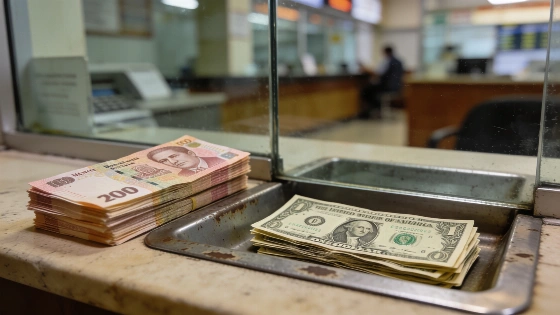
UBS projects a stronger Mexican peso by September 2027, while Crédit Agricole expects the currency to weaken. The banks' opposing forecasts expose deep uncertainty around Mexico's exchange rate outlook.
UBS and Crédit Agricole have drawn a sharp line in the sand over where the Mexican peso heads by 2027. Their latest forecasts for the USD/MXN exchange rate land on opposite sides of the spectrum, with each bank betting on a different outcome for Mexico's currency.
UBS pins its September 2027 target at 17.20 pesos per dollar, signaling a 4.7% gain for the peso from current levels near 18. Crédit Agricole, meanwhile, puts the rate at 18.75, which would mean a 4% slide for the peso. The gap between these projections comes down to how each bank reads Mexico's growth prospects and the shifting global appetite for emerging-market currencies.
UBS is holding onto optimism. The bank's analysts argue that, even as the gap between US and Mexican interest rates narrows, the peso still draws investors chasing higher yields. Mexico's central bank, Banxico, has kept its overnight rate at 6.50% for three straight meetings. That yield edge, though slimmer now at 250 basis points over US rates, continues to pull in international capital. El Financiero notes this is a historic low for the spread. The Federal Reserve's next moves remain a wild card for the peso, since any shift in US rates can quickly redirect global flows.
UBS does not ignore the risks. A US slowdown or renewed trade friction under the US-Mexico-Canada agreement could sap the peso's strength. The two economies are tightly linked: strong US growth lifts Mexican exports, but higher US rates can lure money away from Mexico.
Crédit Agricole takes a more guarded approach. Its Latin American currency outlook singles out the Mexican and Colombian pesos as likely laggards, even as it expects the US dollar to lose ground against some other emerging-market currencies. Crédit Agricole's weaker peso call rests on a muted growth forecast for Mexico-just 1.2% in 2027, compared to UBS's 2%. Citi's October 2026 survey of private analysts shows the consensus shifting toward a weaker peso, with the median end-2027 USD/MXN forecast rising from 18.00 to 18.50. The range now runs from 17.00 to 19.80, clustering closer to Crédit Agricole's scenario than UBS's. Bloomberg Línea tracks these shifts in analyst sentiment.
The difference between a USD/MXN rate of 17.20 and 18.75 is not academic. A lower rate means each dollar buys fewer pesos, boosting the peso's value. For investors, businesses, and travelers, these moves hit import costs, international transfers, and the value of peso assets.
UBS recently tweaked its short-term peso outlook, raising its near-term USD/MXN projection but sticking to its longer-term recovery call. The bank argues that, despite a shrinking rate gap, global conditions still favor the peso's carry trade appeal. Crédit Agricole is less convinced, warning that Mexico's relative attractiveness could fade as global trends shift. Their published figures put the current USD/MXN rate near 18. UBS's 17.20 target for September 2027 would mean a 4.7% peso gain, while Crédit Agricole's 18.75 would mark a 4% drop. These calls rest on each bank's take on Mexico's growth, rates, and the broader emerging-market backdrop. Mexico's finance ministry, in its official 2027 budget, projects an average exchange rate of 17.9 pesos per dollar, GDP growth between 1.5% and 2.5%, and inflation at 3.0%. These numbers remain subject to revision as new data rolls in.
Forecasting currencies is a messy business, especially over several years. Outcomes hinge on domestic growth, central-bank policy, global investor mood, and outside shocks. For the peso, the tug-of-war between US and Mexican rates is crucial. When Mexico's rates top those in the US, the peso can attract yield-seeking investors. If US rates climb or Mexico's growth falters, that edge can vanish fast. The Bank for International Settlements regularly flags how sensitive emerging-market currencies are to global rate cycles and risk appetite.
Market-driven moves and official policy shifts are not the same thing. In Mexico's floating exchange-rate system, the peso's value is set by supply and demand, not by government decree. Forecasts are scenarios, not promises. Banxico's monetary policy statements and inflation reports offer ongoing guidance and are available on the Banxico official website.
For anyone exposed to the peso, these split forecasts mean keeping a close eye on both local and global developments. Exchange-rate swings affect import costs, remittance values, and the competitiveness of Mexican exports. While UBS and Crédit Agricole lay out their cases, the peso's path will depend on a shifting mix of economic and political forces. Inflation in Mexico edged up to 3.45% year-on-year in September 2026, with core inflation at 3.75%. Both remain above Banxico's 3% target. The median analyst forecast for end-2027 inflation is 3.83%, pointing to persistent price pressures that could shape future rate decisions.
Carry trades remain a staple in currency markets, especially for emerging-market bets like the peso. Investors borrow in low-rate currencies and invest in higher-yielding ones, hoping to pocket the difference. If the higher-yielding currency drops, though, exchange-rate losses can erase those gains. The success of carry trades depends on steady financial conditions and predictable policy. For Mexico, the balance between its policy rate, growth, and external risks will keep shaping the peso's draw for global investors.