
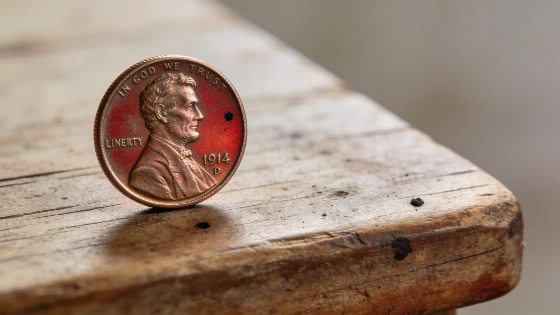
The 1914 D Lincoln cent is far scarcer in pristine Red Mint State than its famous 1909 S VDB cousin. Its journey from everyday change to numismatic legend reveals how survival, not mintage, determines true rarity
Two Lincoln cents stand at the top of American coin collecting, but only one became a true Mint State rarity because almost nobody bothered to save it. The 1914 D Lincoln cent, struck in Denver, now commands staggering prices in top grades-not because of its original mintage, but because it quietly slipped through the cracks of history while collectors chased a different prize.
Today, the 1914 D is the coin that advanced collectors dread. In full Red Mint State, it is not just scarce-it is nearly unattainable. PCGS has certified only 279 examples with the coveted RD (Red) designation, compared to 2,573 for the 1909 S VDB. At the highest grade, MS66 RD, the gap widens to just eight 1914 D coins versus 288 for the 1909 S VDB. The numbers are not close, and neither are the prices: a PCGS MS66+ RD 1914 D sold for $158,625 in 2018, with another bringing $128,100 in 2026. Even a step down, MS66 RD coins have fetched over $100,000. The market has spoken-this is the Lincoln cent that tests both patience and budget.
The Coin That Got Spent
What made the 1914 D so elusive in Mint State? The answer is timing and attention. When the Lincoln cent debuted in 1909, it was an instant sensation. President Theodore Roosevelt had pushed for Victor David Brenner's portrait of Abraham Lincoln, making him the first U.S. president on a circulating coin. But controversy erupted over Brenner's V.D.B. initials, which appeared prominently on the reverse. The U.S. Mint quickly removed them, leaving San Francisco's 1909 S VDB with a tiny mintage of 484,000. Collectors, speculators, and the public immediately recognized its significance and hoarded the coin from the start.
Five years later, Denver quietly produced 1,193,000 Lincoln cents in 1914. There was no controversy, no headlines, and no reason for anyone to set them aside. Americans spent them as ordinary change. By the time coin collecting exploded in the 1930s-thanks to the rise of inexpensive coin boards-most 1914 D cents had already endured years of circulation. The result: worn examples are available, but original Mint State coins with full Red color are vanishingly rare.
Survival Not Mintage Defines Rarity
Numismatics is full of surprises, but the 1914 D Lincoln cent is a case study in how survival, not mintage, determines true rarity. While the 1909 S VDB had fewer coins struck, its fame ensured that many survived in pristine condition. The 1914 D, with more than twice the mintage, was simply used up. PCGS data as of September 2026 shows that for every full Red 1914 D, there are more than nine 1909 S VDBs in the same condition. At the very top, only two 1914 D coins have achieved MS66+ RD, both now legendary among collectors.
Occasional hoards have surfaced-one account describes a group of about 700 Mint State 1914 D cents remaining together into the early 1950s, while another mentions a New England dealer holding 10 rolls (about 500 coins) as late as 1943. Even so, these discoveries only slightly increased the Mint State population. Another small group of two original rolls appeared in the 1970s, but tropical storage left many with spotting and Red-Brown color. The bottom line: the supply of fresh, original Red coins was never large, and time has only made them scarcer.
Color and Condition Raise the Stakes
For copper coins, color is everything. Grading services classify Lincoln cents as Red (RD), Red-Brown (RB), or Brown (BN) based on how much original red luster remains. To earn the RD designation, a coin must retain at least 85% of its original color. The 1914 D is notorious for losing its red quickly, and carbon spotting is common even on uncirculated examples. Strike quality is another hurdle-many show moderate die erosion or weak details, especially around Lincoln's coat lapel. The combination of wear, color loss, and strike issues means that a true Red, sharply struck, uncirculated 1914 D is a numismatic unicorn.
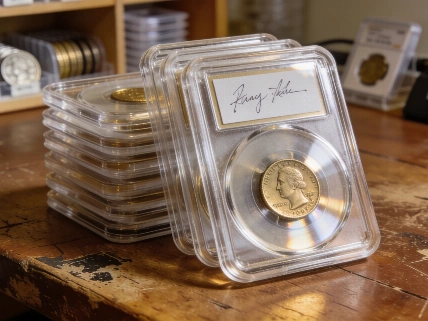
Prices reflect this reality. As of September 2026, the PCGS Price Guide lists a Brown 1914 D at $120 in Poor-1, $185 in Good-4, and $375 in Very Fine-20. Mint State Brown starts at $2,900, while Red examples begin around $3,100 at MS61 and soar to $85,000 at MS66 RD. The two known MS66+ RD coins are valued at $165,000 each. Even heavily circulated pieces command a premium, and the risk of counterfeits is high-NGC ranks the 1914 D among the most commonly faked U.S. coins, with altered dates and added mintmarks a constant threat. For high-value coins, third-party authentication is essential.
Rarity in Numbers
The hard data tells the story. According to the PCGS Population Report updated September 9, 2026, the 1909 S VDB (mintage 484,000) has 2,573 RD-certified coins, while the 1914 D (mintage 1,193,000) has only 279. At MS66 RD, the 1909 S VDB boasts 288 coins, while the 1914 D has just eight. No 1914 D has graded higher than MS66+ RD. These figures do not represent absolute survival, as coins can be resubmitted and raw examples exist, but the scale of the difference is undeniable. The 1914 D is not just another hole in a penny album-it is the defining challenge for anyone building a top-tier Lincoln cent set.
For collectors who want to understand how a coin's fate can change with public attention, the 1914 D is a lesson in missed opportunity. The 1909 S VDB became famous overnight and was saved in quantity. The 1914 D was ignored, spent, and nearly lost to history. Only a handful of lucky finds and the discipline of a few early savers kept any Mint State examples alive. The result is a market where the 1914 D, not the 1909 S VDB, is the true Mint State key.
Counterfeits and Authentication Risks
With high prices come high risks. The 1914 D is a favorite target for counterfeiters, who have produced both full fakes and altered coins-most commonly by adding a Denver mintmark to a genuine 1914 Philadelphia cent or modifying a 1944 D. The latter can be detected by date spacing and the presence of Brenner's V.D.B. initials, which did not appear on Lincoln's shoulder until 1918. For any 1914 D worth serious money, professional authentication is not optional.
Collectors who want to avoid costly mistakes should be aware that even experienced buyers have been fooled. The financial gap between a common 1914 cent and a genuine 1914 D can reach tens of thousands of dollars. As with the reported earlier Roosevelt dime error, authentication and provenance are now as important as the coin itself.
What Defines a Key Date?
For more than a century, the 1909 S VDB has been the face of Lincoln cent collecting. Its low mintage and famous controversy gave it instant status. But for those building a Mint State set, the 1914 D is the real test. NGC and Stack's Bowers both recognize it as the rarest regular-issue Lincoln cent in Mint State, excluding varieties and errors. The numbers back this up: fewer survive in top condition than either the 1909 S VDB or the 1931 S.
For collectors, the lesson is clear. Mintage is only the starting point. Survival, timing, and public attention decide which coins become legends. The 1914 D Lincoln cent was spent, forgotten, and nearly lost-until collectors realized just how few survived in the condition that matters most. That is why, in the world of American pennies, the 1914 D now stands alone as the ultimate Mint State challenge.
Understanding the difference between mintage and survival is essential for anyone interested in coin collecting. Mintage refers to the number of coins originally produced, but survival depends on how many remain in collectible condition. Factors such as public awareness, hoarding, circulation patterns, and even environmental storage can dramatically affect which coins become true rarities. The 1914 D Lincoln cent is a textbook example: despite a higher mintage, it is far scarcer in top grades than its more famous cousin, proving that what survives-not what was made-ultimately shapes the market.