
A missing mintmark on the 1982 Roosevelt dime created one of the most significant U.S. coin errors of the late 20th century, with thousands entering circulation before collectors recognized its importance and scarcity
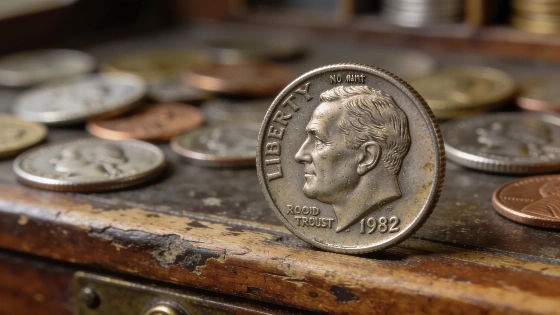
In 1982, a small but consequential error at the United States Mint resulted in the release of a Roosevelt dime without its expected "P" mintmark. Unlike most rare coins, which are often discovered decades after their production, the 1982 No-P Roosevelt dime entered everyday circulation at a time when millions of Americans were still using coins for daily transactions. This error, rooted in a change to mintmark policy just two years earlier, has since become one of the most recognized modern U.S. coin mistakes.
The significance of the 1982 No-P dime lies in its timing and the nature of the error. After 1980, all dimes struck in Philadelphia were supposed to carry a "P" mintmark above the date. The absence of this mark on a 1982 coin was not only unexpected but, according to official policy, should have been impossible. Yet, due to a breakdown in the die preparation process, at least one working die was put into service without the mintmark, resulting in thousands of error coins entering circulation unnoticed.
Mintmark Policy Shift and the Error's Origin
For most of the 20th century, coins produced at the Philadelphia Mint did not display a mintmark, while those from Denver and San Francisco bore "D" and "S" respectively. This changed in 1980, when the Mint began adding a "P" to all Philadelphia coins except cents. The new policy was intended to make coin origins more transparent, but it also meant that any Philadelphia dime dated 1980 or later without a mintmark would be an anomaly.
The 1982 No-P dime was the result of a manual error. At the time, mintmarks were still punched into each working die by hand. In this case, a die intended for Philadelphia production was never given its "P" mark but was nonetheless used to strike coins. Every dime produced from this die lacked the mintmark, making them visually similar to pre-1980 Philadelphia dimes but with the unmistakable 1982 date.
Discovery and Circulation Patterns
The first confirmed examples of the 1982 No-P dime surfaced in late 1982 in Sandusky, Ohio, particularly around the Cedar Point amusement park. The high volume of coins handled in such venues likely accelerated the discovery, as employees and collectors noticed the unusual dimes appearing in change. Reports of additional finds soon followed from nearby regions, suggesting a geographically limited release rather than a nationwide distribution.
As word spread, collectors began searching rolls of dimes, and the error's reputation grew. The clustering of discoveries in the Midwest supports the theory that the coins were released in a single batch, likely from a single die, which also explains the variety's scarcity and consistency.
Authentication and Market Value
Authenticating a genuine 1982 No-P dime is relatively straightforward. The coin must be dated 1982, with no trace of a mintmark above the date-no outline, shadow, or evidence of removal. Altered coins, where the "P" has been scratched away, are common but can be detected under magnification. Genuine examples also match the die characteristics of other 1982 Philadelphia dimes.
Numismatic references recognize two main strike types: Strong and Weak. Both lack the mintmark, but Strong No-P dimes display crisp design details, while Weak examples show flattened features. Collectors generally prefer the Strong variety, though both are considered legitimate.
According to submission data from major grading services, the 1982 No-P dime is the most frequently certified clad Roosevelt dime variety, apart from the 1996-W dime, which was never intended for circulation. While thousands of No-P dimes may exist, high-grade examples are much scarcer. Circulated coins in Extra Fine condition typically trade around $30, while uncirculated pieces in Gem condition can command $300 or more, with prices rising for coins in the highest grades.
Facts and Figures
The U.S. Mint has never published official mintage figures for the 1982 No-P error. However, data from grading services such as PCGS and NGC indicate that several thousand examples have been certified, with the majority found in circulated grades. The error's survival rate in Mint State is significantly lower, contributing to its collector value. For comparison, the 1996-W dime, a non-circulating issue, has a known mintage of 1,457,000, while the population of 1982 No-P dimes remains uncertain but is widely believed to be much smaller.
Lasting Impact and Collector Interest
More than forty years after its discovery, the 1982 No-P Roosevelt dime remains a cornerstone of modern U.S. coin collecting. Its appeal is rooted in its clear error, direct connection to Mint procedures, and the fact that it was discovered in everyday commerce rather than in a vault or proof set. The coin's story demonstrates how even in the era of modern minting technology, human error can produce lasting rarities.
The 1982 No-P dime's status as a modern error has also influenced how collectors approach other U.S. coin series. For example, the market for high-grade modern coins has grown, with collectors seeking out both intentional and accidental varieties. This trend is reflected in the attention given to other notable U.S. coin issues, such as the 1939 Proof Walking Liberty Half Dollar, which set a grading record and highlighted the ongoing demand for rare and well-preserved coins (see coverage of the 1939 Proof Walking Liberty Half Dollar record).
The 1982 No-P Roosevelt dime stands as a reminder that even small changes in minting policy or procedure can have unexpected consequences for collectors and the broader currency landscape.
Understanding the process of adding mintmarks to U.S. coins provides insight into how such errors can occur. Until the late 20th century, mintmarks were applied manually to each working die, introducing the possibility of human oversight. The transition to automated die production has reduced the frequency of such mistakes, but the 1982 No-P dime illustrates how a single missed step can create a lasting legacy in the world of coins. For collectors and historians, these errors offer a tangible link to the evolving practices of the U.S. Mint and the ongoing story of American currency.