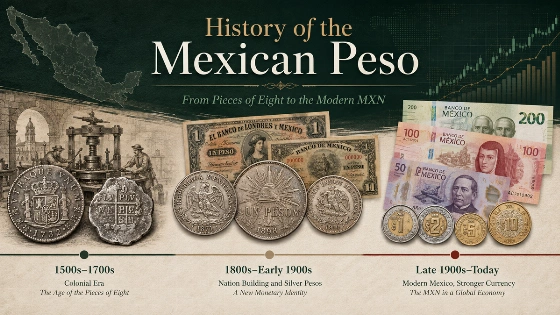
The Mexican peso grew out of the silver pieces of eight minted in New Spain and used across the Americas, Europe and Asia. This detailed history follows the currency from pre-Hispanic exchange and the first mint in the Americas through independence, the 1982 debt crisis, the 1993 nuevo peso redenomination and today’s floating MXN.
From pre-Hispanic cacao and copper money to the silver pieces of eight that circulated across the world, the Mexican peso has one of the longest and most influential histories of any currency in the Americas.
The modern Mexican peso is the result of several distinct monetary traditions. It inherited its name from units of weight used during the Spanish colonial period, its international reputation from the silver dollars struck in Mexico, its decimal structure from nineteenth-century reforms, and its present form from the 1993 redenomination that removed three zeros from the old currency.
Today the peso is issued by Banco de México, identified internationally by the code MXN, and divided into 100 centavos. Its history, however, begins centuries before either the central bank or the modern Mexican state existed.
Mexican Peso: Essential Facts
- Official currency: Mexican peso
- Spanish name: peso mexicano
- International currency code: MXN
- Currency symbol: $
- Subdivision: 1 peso = 100 centavos
- Issuing authority: Banco de México
- National mint: Casa de Moneda de México
- Current monetary unit introduced: 1 January 1993
- Redenomination rate: 1 new peso = 1,000 old pesos
- Temporary name used from 1993: nuevo peso
- Return to the name peso: 1 January 1996
- Current exchange-rate system: floating exchange rate
Mexican Money in Ten Stages
- Pre-Hispanic exchange: cacao beans, cotton cloth, copper objects, jade and measured quantities of precious metals were used as stores of value and means of payment.
- Early colonial money: Spanish settlers used imported coins, indigenous media of exchange and locally measured gold-silver units.
- Mexico City Mint: founded in 1535 as the first mint in the Americas, it began striking coins in 1536.
- Pieces of eight: Mexican silver eight-real coins became a major international trade currency.
- Independent coinage: insurgents, royalists and the new Mexican republic issued competing forms of money.
- Decimal peso: nineteenth-century reforms gradually established the peso as a unit divided into 100 centavos.
- National monetary reform: the 1905 reform reorganised the system and placed Mexico on a gold-based standard.
- Central banking: Banco de México opened in 1925 and became the sole issuer of national banknotes.
- Inflation and redenomination: the crises of the 1970s and 1980s led to increasingly large denominations and the 1993 nuevo peso.
- Modern MXN: since the 1994–1995 crisis, the peso has operated under a floating exchange-rate regime.
Money in Mexico Before the Peso
Before the Spanish conquest, the societies of Mesoamerica did not use a single national coinage. Trade was conducted through barter and through objects that were widely recognised as having value. The exact combinations varied by place, period and type of transaction.
Among the best-known forms of pre-Hispanic money were cacao beans. They were portable, divisible and useful beyond their monetary role, which made them suitable for everyday purchases. Cotton cloth and standardised mantles could represent larger values, while jade beads, gold dust and copper objects were also used in particular regions and markets.
Small copper implements shaped like axes or blades are often described as axe money. Their purpose was not identical in every context, but they show how metal objects could act as both commodities and units of exchange. Banco de México’s historical materials also describe indigenous media including cacao, cotton blankets, jade beads, tubes containing gold dust and copper pieces.
These systems did not disappear immediately after the conquest. Spanish coins were initially scarce, and indigenous forms of payment continued to circulate alongside imported European money. Cacao remained in use in some parts of southern Mexico for centuries.
The Meaning of the Word Peso
The Spanish word peso means weight. Long before it became the formal name of a coin and national currency, it was used to describe a measured quantity of precious metal.
During the early colonial period, settlers sometimes used discs made from an alloy of gold and copper. These pieces became known as pesos de tepuzque. Their value was associated with weight rather than with the guaranteed face value of a modern coin.
This connection between weight and money was common in the early modern world. Silver and gold were accepted because of how much metal they contained and how pure that metal was. Over time, the word peso shifted from describing a weight of valuable material to identifying a specific monetary unit.
The Mexico City Mint and the First Colonial Coins
The discovery and exploitation of major silver deposits transformed the economy of New Spain. Expanding commerce created an urgent need for a reliable coin supply, and in 1535 the Spanish Crown authorised the establishment of the Casa de Moneda de México in Mexico City.
The mint was the first official mint founded in the Americas. Its earliest coins were produced in 1536 under the authority of Charles I of Spain and Queen Joanna. They are commonly known as Carlos y Juana coins because the rulers’ names appeared in the inscriptions.
These early issues were struck by hand. Silver denominations included fractions and multiples of the real, while lower-value copper coins were also attempted. The Mexican mint mark, traditionally represented by an M with a small circle or other distinguishing element, became an internationally recognised sign of origin.
The establishment of the mint did more than solve a local shortage. It created the institutional foundation for a coinage that would eventually circulate across the Americas, Europe and Asia.
From Hammered Cobs to the Piece of Eight
For much of the colonial period, the most important silver denomination was the eight-real coin. In English it became known as the Spanish dollar, piece of eight or eight reales.
Earlier examples were often irregular hammered coins known as cobs or macuquinas. The metal was cut and struck manually, producing pieces whose shapes were less uniform than later machine-made coins. Despite their appearance, their silver content made them useful in international trade.
From the eighteenth century, improved minting technology produced more regular round coins. The famous pillar dollar displayed the Pillars of Hercules and ocean imagery, symbolising Spain’s overseas empire. Later issues carried royal portraits.
The reliability of Mexican silver gave these coins an influence far beyond New Spain. They travelled through Atlantic and Pacific trade networks and were accepted in ports and markets where local coin supplies were inadequate or less trusted.
Why Mexican Silver Became a Global Currency
Mexico possessed rich silver deposits and an established minting system. The combination of large production, recognisable designs and relatively consistent metal content made Mexican coins attractive to merchants.
Silver struck in Mexico moved east through the Atlantic economy and west through the Manila galleon trade. It paid for Asian products, helped finance European commerce and circulated throughout the Americas.
In China and other parts of East and Southeast Asia, Spanish-American and later Mexican silver dollars were accepted by weight and reputation. Merchants sometimes stamped the coins with small marks after testing them. These chop marks recorded commercial acceptance rather than changing the formal issuer of the coin.
The Mexican peso therefore developed an international role long before Mexico had a modern central bank. Its influence came from silver production, trade networks and confidence in the coin itself.
The Mexican Peso and the Origins of the Dollar
The relationship between the Mexican peso and the United States dollar is often described too simply. The modern US dollar was not copied from a single independent Mexican coin. It developed from the broader Spanish-American dollar tradition, of which coins struck in Mexico were among the most important examples.
Spanish milled dollars were familiar in Britain’s North American colonies. When the United States created a national monetary system in 1792, Congress based the dollar on the widely recognised Spanish silver dollar and adopted a decimal system of 100 cents.
Foreign silver coins continued to circulate because the early United States Mint could not immediately provide enough domestic coinage. Mexican coins issued after independence joined the Spanish and other foreign coins already in circulation. US legislation finally removed the legal-tender status of foreign coins in 1857.
The origin of the dollar sign is debated. Some explanations connect it with an abbreviation for the Spanish-American peso, while others associate it with designs found on pillar dollars. It is safer to say that the symbol emerged within the commercial world shaped by Spanish-American money rather than to attribute it to one proven design event.
Currency During the War of Independence
The Mexican War of Independence began in 1810 and disrupted mining, transport and official minting. Coin shortages forced both royalist and insurgent authorities to create emergency money.
Existing silver coins were countermarked, local mints produced provisional issues, and revolutionary forces struck coins using whatever metal and equipment were available. Some issues were intended to represent a promise of later payment rather than the full metallic value stated on the piece.
José María Morelos authorised some of the most famous insurgent coins. They often used copper and carried designs or inscriptions associated with the independence movement. Their value depended heavily on confidence in the political cause and the expectation that they might eventually be redeemed.
This period demonstrated a recurring monetary problem: when political authority fragments, the currency system fragments with it. Mexico entered independence with damaged mines, disrupted commerce and multiple forms of money in circulation.
The Peso After Independence
Mexico achieved independence in 1821. The new state inherited the colonial real system, the Mexico City Mint and a strong international market for Mexican silver.
The early empire and republic changed the symbols displayed on the coinage. Royal portraits and Spanish arms gave way to Mexican national imagery, especially the eagle and serpent. The republican eight-real coin became widely known internationally as the Mexican dollar or Mexican peso.
One of the best-known republican designs placed the national eagle on one side and a liberty cap with radiating light on the other. These coins continued to be exported and accepted abroad because their silver content and long-established monetary role were familiar to merchants.
Mexico also operated regional mints. Different mint marks identified where a coin had been produced. Although the national designs provided a degree of uniformity, political instability and regional power continued to complicate monetary administration.
Decimalisation and the First Coins Denominated in Pesos
The colonial monetary system was not originally decimal. The peso or eight-real unit was divided according to the real system, which was convenient for halving but did not match the increasingly influential decimal systems adopted elsewhere.
The Mexican government ordered a move towards decimal currency in 1857, and the reform was reaffirmed in 1861. Civil war, foreign intervention and political instability prevented immediate and complete implementation.
During the Second Mexican Empire under Maximilian, coins were issued under a decimal structure and the first Mexican pieces explicitly denominated as one peso appeared. The peso was divided into 100 centavos.
After the restoration of the republic, Mexico continued decimal coinage. The balance-scale design became especially prominent, combining the word LEY, a sword and scales as symbols of legislation, executive authority and justice.
The transition was gradual rather than instantaneous. Older eight-real coins and newer peso-denominated coins belonged to closely related silver traditions and could circulate alongside one another.
The Monetary Reform of 1905
By the beginning of the twentieth century, changes in the world price of silver created difficulties for countries whose currencies were closely tied to that metal. Mexico responded with the monetary reform of 1905.
The reform reduced the system’s dependence on the fluctuating value of silver and established a gold-based monetary framework. Silver coins continued to circulate, but their legal value was no longer determined solely by the market value of the metal they contained.
The reform also established the inscription Estados Unidos Mexicanos around the national coat of arms, a convention that remains familiar on Mexican coinage.
Mexico continued to issue important gold and silver pieces, including the centenario gold coin first produced in 1921 to commemorate the centenary of independence. Such coins later became important bullion and savings products even when they were no longer ordinary everyday money.
The Mexican Revolution and Monetary Fragmentation
The Mexican Revolution, beginning in 1910, again divided political authority and disrupted the monetary system. Metal coins disappeared from circulation as people hoarded money whose intrinsic value seemed more reliable than rapidly changing paper claims.
Competing armies, state governments, banks, companies and local authorities issued notes, vouchers, cardboard money and coins. The quality and acceptance of these issues varied enormously.
Some revolutionary currencies are remembered for their political messages as much as for their monetary role. The famous Muera Huerta coin from Durango openly condemned Victoriano Huerta, while Zapatista issues used revolutionary slogans.
The multiplication of issuers weakened confidence in paper money. Restoring a unified currency after the conflict required a central institution capable of providing a national note issue and regulating the monetary system.
The Creation of Banco de México
The Mexican Constitution of 1917 established the principle that banknote issuance should be a state function exercised through a single central bank. Banco de México opened in 1925.
The new institution was intended to end the disorder created by multiple private and revolutionary note issues, provide currency to the economy, support the banking system and rebuild confidence in paper money.
Early Banco de México notes were printed by the American Bank Note Company in New York. Mexican authorities selected the denominations, themes and national figures, while the specialist printer prepared the engravings and manufactured the notes.
Banco de México’s own banknote factory began operating in 1969. This allowed the country to design and produce its notes domestically and introduced new generations of banknotes adapted to changing security and circulation requirements.
From Post-Revolutionary Stabilisation to the Fixed Exchange Rate
During the middle decades of the twentieth century, Mexico experienced long periods of economic growth and a comparatively stable nominal exchange rate. From April 1954 until the end of August 1976, the official rate was maintained at 12.50 old pesos per US dollar.
This long fixed-rate period became associated with the era often called the Mexican Miracle. Industrialisation, urbanisation and expanding domestic production transformed the economy.
The fixed rate did not mean that the peso was immune to pressure. Maintaining a peg required consistency between public spending, credit creation, inflation, foreign reserves and external competitiveness. When those conditions weakened, the fixed rate became increasingly difficult to defend.
The 1976 Devaluation
Expansionary fiscal and monetary policies, rising inflation and balance-of-payments pressure ended the long 12.50-peso exchange rate in 1976. The devaluation was a major psychological break because many Mexicans had known only the fixed rate.
Oil discoveries initially offered the possibility of renewed growth and greater public revenue. The government and public sector borrowed heavily, expecting future petroleum earnings to support repayment.
This strategy left the country vulnerable to changes in oil prices, world interest rates, access to foreign credit and investor confidence. The problem was not simply the existence of oil or foreign borrowing, but the scale of debt and the policies built around optimistic assumptions.
The 1982 Debt Crisis
By 1982, Mexico faced falling reserves, capital flight, high fiscal deficits and difficulty refinancing external debt. The peso was sharply devalued in February and again in August.
In August 1982, Mexico informed commercial bank creditors that it could not fully meet scheduled debt-service payments and requested a temporary moratorium on principal. The announcement is widely treated as the beginning of the international developing-country debt crisis of the 1980s.
The government introduced exchange controls and nationalised the commercial banking system. Inflation accelerated, economic activity weakened and the peso lost purchasing power.
The crisis was not produced by one event alone. It reflected expansionary domestic policies, an overvalued exchange rate, rising international interest rates, changing oil conditions, heavy external borrowing and the sudden reduction of private financing.
Inflation and the Growth of Banknote Denominations
Persistent inflation during the 1970s and 1980s changed the practical meaning of the peso. Prices, wages and accounting amounts required increasingly large numbers.
Banco de México introduced banknotes in denominations that would once have seemed extraordinary. The old-unit series eventually included notes of 1,000, 2,000, 5,000, 10,000, 20,000, 50,000 and 100,000 pesos.
These notes did not represent sudden increases in real wealth. They were a response to the declining purchasing power of the old monetary unit. Everyday calculations became cumbersome, accounting systems had to handle many zeros, and low denominations became economically irrelevant.
A redenomination could simplify prices and payments, but removing zeros alone could not solve inflation. Lasting stability required changes in fiscal, monetary and institutional policy.
The 1993 Nuevo Peso Redenomination
In June 1992, Mexico adopted legislation creating a new monetary unit effective from 1 January 1993. The conversion was:
- 1 nuevo peso = 1,000 old pesos
- 1 old peso = 0.001 current peso
The reform removed three zeros from prices, wages, accounts and financial contracts. An amount of 100,000 old pesos became 100 nuevos pesos.
The temporary unit was called the nuevo peso and used the symbol N$. The earlier international code MXP was replaced by the current code MXN.
The first B-family banknotes were issued in denominations of 10, 20, 50 and 100 nuevos pesos and reused designs from the preceding old-peso notes. C-family notes introduced from 1994 used new designs and expanded the range to 200 and 500 nuevos pesos.
Coins also carried the N$ symbol. New 1-, 2-, 5- and 10-peso bimetallic pieces used designs inspired by the Piedra del Sol, while centavo coins represented smaller units.
Why the Word Nuevo Was Removed
The word nuevo was intended to distinguish the new unit during the transition. It did not describe a permanently separate currency.
Once the public had adapted to the conversion, Mexico removed the temporary adjective. From 1 January 1996, newly issued banknotes and coins again used the simple name peso.
The value of the unit did not change in 1996. One peso without the word nuevo was equal to one nuevo peso. The change completed the naming transition rather than creating another redenomination.
Some nuevo-peso notes and coins remain legally valid according to their current face value, although Banco de México may classify particular families as being withdrawn through the banking system.
Banco de México Autonomy
A major institutional reform accompanied the monetary changes of the early 1990s. A constitutional amendment adopted in 1993 took effect in 1994 and granted Banco de México autonomy.
The central bank’s priority objective became preserving the purchasing power of the national currency. The legal framework also established that no authority could order the bank to finance government spending.
Central-bank autonomy does not guarantee that the peso will never depreciate or that inflation will disappear. It is intended to give monetary policy an institutional structure focused on price stability rather than short-term political financing needs.
The 1994–1995 Peso Crisis
The nuevo peso entered circulation during a period of economic reform, trade liberalisation and strong foreign capital inflows. Mexico joined the North American Free Trade Agreement in 1994, but the year was also marked by political shocks, falling reserves and increasing concern about the external current-account deficit.
On 20 December 1994, the government widened the peso’s exchange-rate band, allowing a devaluation of about 15 percent. The measure failed to restore confidence, and continued pressure rapidly depleted reserves.
On 22 December, the authorities abandoned the crawling exchange-rate band and allowed the peso to float. The currency depreciated sharply, interest rates rose and the banking system came under severe pressure.
The episode became known internationally as the Mexican peso crisis or Tequila Crisis. Mexico adopted an adjustment programme and obtained a large international support package. The crisis had effects beyond Mexico because investors reassessed risks across emerging markets.
The Modern Floating Peso
Since December 1994, Mexico has operated a floating exchange-rate regime. The peso’s value is primarily determined in the foreign-exchange market rather than maintained at a permanent official rate against the US dollar.
The Mexican Foreign Exchange Commission can authorise interventions under exceptional conditions to provide liquidity or reduce disorderly volatility. Such operations are not officially intended to defend one permanent peso-dollar level.
A floating currency can appreciate or depreciate in response to many factors, including:
- Mexican and international interest rates;
- Inflation expectations;
- Trade and current-account flows;
- Oil prices and public finances;
- Foreign investment and portfolio movements;
- Economic conditions in the United States;
- Global risk appetite;
- Political and policy uncertainty;
- Central-bank communication and monetary policy.
For this reason, the peso’s strength cannot be explained by exports or one industry alone. Mexico has a diversified economy, but the currency remains sensitive to both domestic conditions and global financial markets.
MXN, the Peso Symbol and the Centavo
The current international currency code is MXN. Currency codes are used by banks, payment systems, exchange-rate services and financial markets to distinguish the Mexican peso from other currencies also called pesos.
The ordinary symbol is $. Because the same sign is used for the US dollar and several other currencies, international contexts may use MX$, Mex$ or the formal code MXN when confusion is possible.
One peso is divided into 100 centavos. The centavo symbol may appear as ¢, although prices in Mexico are commonly written using decimal notation.
The 1993 redenomination did not change the decimal relationship. It changed the scale of the peso itself by converting 1,000 units of the old currency into one unit of the current currency.
Modern Mexican Banknotes
Banco de México has issued several banknote families since the redenomination. The letters assigned to these families identify generations of design and security features rather than separate currencies.
The current G-family banknotes combine historical periods with Mexican ecosystems and natural heritage. Banco de México currently lists manufactured banknotes in the following denominations:
- 20 pesos: a commemorative note marking the bicentenary of national independence;
- 50 pesos;
- 100 pesos;
- 200 pesos;
- 500 pesos;
- 1,000 pesos.
Different denominations use different colours, dimensions, materials and security features. Polymer has been used for selected lower-denomination notes, while other denominations use cotton-based banknote paper.
The 10-peso banknote belongs to older series and is not part of the current manufactured lineup. In ordinary circulation, the 10-peso denomination is represented mainly by a coin.
Modern Mexican Coins
Current Mexican coins combine the national coat of arms with designs inspired by the Piedra del Sol, historical figures or commemorative themes.
Banco de México lists current coin denominations that include:
- 5 centavos;
- 10 centavos;
- 20 centavos;
- 50 centavos;
- 1 peso;
- 2 pesos;
- 5 pesos;
- 10 pesos;
- 20 pesos.
Not every valid design is actively handed back to the public by banks. Banco de México distinguishes between current production, older designs that remain valid and pieces that are in the process of being withdrawn.
Mexico has also issued legal-tender commemorative coins in denominations including 5, 20 and 100 pesos. A commemorative coin can be valid for payment even when collectors are more likely to preserve it than spend it.
Legal Tender, Withdrawal and Demonetisation
Three different concepts are important when dealing with older Mexican money.
- Current: the banknote or coin belongs to a design family actively listed for ordinary circulation or manufacture.
- In the process of withdrawal: the money remains legal tender at face value, but banks remove it when they receive it and return it to Banco de México rather than putting it back into circulation.
- Demonetised: the piece no longer has legal-tender status under its original denomination.
Old pesos issued under the monetary unit valid through 31 December 1992 were converted at one-thousandth of their printed denomination. Many of those old-unit notes were later demonetised. A 10,000-old-peso note, for example, corresponds to 10 current pesos under the redenomination scale, but its exchangeability depends on the rules governing its family and condition.
Collectors may pay more or less than converted face value depending on rarity and condition. Numismatic value is separate from legal monetary value.
How the Original Article Needed Updating
The earlier CurrencyInformation.org article correctly identified the peso’s connection with Spanish silver dollars and the 1993 redenomination, but several statements required clarification.
- The peso did not simply copy one Spanish coin after independence; it emerged from a wider colonial system of weights, reales and silver dollars.
- The US dollar was based on the Spanish-American dollar tradition, not on the design of one later independent Mexican peso.
- The end of foreign-coin legal-tender status in the United States occurred in 1857, but circulation and acceptance were more complicated than a single bilateral rule.
- The crisis of the 1970s and 1980s involved fiscal policy, inflation, external debt, oil expectations, interest rates and capital flight, not oil alone.
- The 1993 reform was a redenomination of 1,000 old pesos into one nuevo peso, not a revaluation that by itself restored purchasing power.
- The word nuevo was removed in 1996 without changing the value of the unit again.
- Modern banknote and coin status must distinguish current production, legal validity, withdrawal and demonetisation.
Timeline of the Mexican Peso
- Before the sixteenth century: cacao, cotton cloth, copper objects, jade and precious metals serve as media of exchange in Mesoamerica.
- Early sixteenth century: imported Spanish coins circulate alongside indigenous money and locally measured metal.
- 1535: the Spanish Crown authorises the Casa de Moneda de México, the first mint in the Americas.
- 1536: the Mexico City Mint begins producing Carlos y Juana coins.
- Sixteenth to eighteenth centuries: Mexican silver reales and pieces of eight become major international trade coins.
- 1732: machine-struck pillar dollars begin replacing many irregular hammered issues.
- 1810–1821: royalist and insurgent authorities issue emergency and revolutionary money during the War of Independence.
- 1821: independent Mexico inherits the real system and the international market for Mexican silver.
- 1820s onward: republican eagle and liberty-cap silver coins circulate widely abroad.
- 1857: Mexico orders a decimal reform, although political instability delays full implementation.
- 1860s: coins explicitly denominated in pesos and centavos appear as decimalisation advances.
- 1869–1905: republican balance-scale peso coins become an important national and international design.
- 1905: monetary reform introduces a gold-based standard and reorganises the coinage system.
- 1910–1917: the Mexican Revolution produces extensive local, military and emergency currencies.
- 1925: Banco de México opens and begins the process of unifying banknote issuance.
- 1954–1976: the official exchange rate remains fixed at 12.50 old pesos per US dollar.
- 1976: the long-standing fixed rate ends with a major devaluation.
- 1982: debt-servicing difficulties, capital flight and balance-of-payments pressure trigger a severe currency crisis.
- 1980s–1991: inflation leads to banknotes with denominations as high as 100,000 old pesos.
- 18 June 1992: Mexico establishes the legal basis for a new monetary unit.
- 1 January 1993: the nuevo peso begins at 1 new peso for 1,000 old pesos.
- 1994: Banco de México autonomy takes effect.
- 20 December 1994: the exchange-rate band is widened and the peso is devalued.
- 22 December 1994: Mexico moves to a floating exchange-rate regime.
- 1 January 1996: the word nuevo is removed and the currency again becomes simply the peso.
- 1996 onward: successive banknote and coin families update designs, materials and security features.
- 2020s: G-family banknotes and newer dodecagonal 20-peso commemorative coins expand the modern currency series.
Why the History of the Mexican Peso Matters
The peso links several major chapters in world monetary history. It connects indigenous systems of value with Spanish colonial silver, the first mint in the Americas, the global piece of eight, the creation of the US dollar, nineteenth-century decimalisation, twentieth-century central banking and modern floating exchange rates.
Its history also shows that a currency’s success depends on more than its name or design. Mexican silver became international money because traders trusted its metal and recognised its origin. Modern paper pesos depend instead on legal institutions, monetary policy, payment systems and confidence in the central bank.
The 1993 redenomination demonstrates the difference between changing a unit and changing an economy. Removing three zeros simplified transactions, but the longer-term credibility of the peso depended on inflation control, fiscal policy, central-bank autonomy and a more resilient financial system.
The peso remains closely connected with the United States because of trade, investment, remittances and financial markets, but it is not merely a derivative of the US dollar. It has an independent institutional framework and a history that helped shape the dollar system itself.
Conclusion
The Mexican peso is one of the oldest continuously named monetary units in the Americas, but the money represented by that name has changed repeatedly.
It began as a reference to weight, developed through the silver real and piece-of-eight system, became a symbol of independent Mexico, moved gradually to decimal coinage, survived revolutionary fragmentation and became a central-bank currency after 1925.
The crises of 1976 and 1982 exposed the costs of inflation, external imbalance and lost confidence. The 1993 nuevo peso removed three zeros, while the 1994–1995 crisis moved Mexico towards the floating exchange-rate framework that continues today.
From cacao beans and hammered silver to polymer banknotes, bimetallic coins and electronic payments, the peso’s history is also a history of Mexico’s changing state, economy and place in global trade.