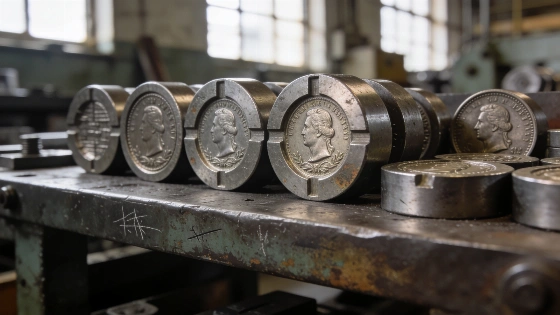
Seven uncancelled coin dies from Indonesia's 1971 rupiah series have been authenticated after decades in obscurity, offering a rare glimpse into the tools behind a pivotal moment in the nation's monetary history
Seven steel dies that should have been destroyed decades ago have resurfaced, now authenticated and encapsulated by NGC, and offered to collectors for $50,000. These are not coins, but the original tools used to strike Indonesia's 1971 10-, 25-, and 50-rupiah pieces-dies that, despite standard protocol, escaped destruction at the mint and survived intact for more than fifty years.
In numismatics, finding an uncancelled die is extremely rare. Mints around the world enforce strict security: obsolete dies are usually defaced or crushed to prevent unauthorized coin production. Yet this group, brought to light by error specialist Mike Byers, includes production dies for three denominations and design-validation dies for the 10-rupiah coin. Their survival runs counter to standard mint practice and offers a direct look into a turbulent period in Indonesia's currency history.
The dies behind the coins
The set includes obverse and reverse dies for the 1971 50 Rupiah, obverse and reverse dies for the 25 Rupiah, an obverse die for the 10 Rupiah, and both obverse and reverse design-validation dies for the 10 Rupiah. These tools produced coins that circulated by the millions, yet the dies themselves were never meant to leave the mint, much less remain undamaged.
NGC, which began certifying coin dies in 2018, describes uncancelled dies as among the rarest items in the field. Because they could still strike coins, mints destroy them as a matter of security. The fact that these Indonesian dies survived is more than a technical curiosity-it's a direct link to a period of economic change. NGC's certification process is now widely recognized as the standard for encapsulated numismatic items, giving collectors a transparent way to verify and grade such tools across global markets.
Indonesia's currency at a crossroads
The early 1970s were a turning point for Indonesia's monetary system. After years of hyperinflation-annual rates reached nearly 1,500 percent in the mid-1960s-the government launched a stabilization program in 1966. By 1971, inflation had dropped to about 2.5 percent, according to Bank Indonesia records. This shift made it possible to reintroduce metal coins for daily use, something that had been out of reach during the worst inflationary years. Bank Indonesia's current policy communications still emphasize the use of interest-rate adjustments, foreign-exchange intervention, and rupiah securities to maintain exchange-rate stability and control inflation as detailed on its official rupiah information page.
The 1971 coinage was not Indonesia's first post-independence metal money, but it marked a major expansion. New 10-, 25-, and 50-rupiah coins joined the 1-, 2-, and 5-rupiah pieces introduced a year earlier. The dies now authenticated by NGC were used to strike coins that would circulate in huge numbers: over 1.2 billion 25-rupiah coins and more than 1 billion 50-rupiah coins, according to published mintage data. The 10-rupiah coin, with a mintage of 286 million, carried a message urging increased production of food and clothing-reflecting the government's economic priorities and its partnership with the United Nations Food and Agriculture Organization.
The designs broke with colonial tradition. Instead of rulers or state symbols, the 25- and 50-rupiah coins featured the Victoria crowned pigeon and the Greater Bird of Paradise, both native to the region. The 10-rupiah coin showed rice and cotton, highlighting the importance of agriculture and self-sufficiency during the stabilization effort.
Minting tools as historical evidence
What makes these dies notable is not just their survival, but their timing. The year 1971 also saw the creation of PERURI, Indonesia's state-owned security printer and mint, formed by merging the country's coin and banknote producers. This institutional change happened alongside the stabilization of the rupiah and the expansion of circulating coinage. The dies are physical evidence from a moment when Indonesia's monetary system was being rebuilt. Bank Indonesia's more recent policy statements continue to highlight the importance of monetary stability, with the central bank reporting CPI inflation of just 1.75% year-on-year in November 2021, showing its ongoing focus on low inflation and stable monetary conditions, in line with global central banking standards.
Collectors can easily find the coins themselves at modest prices, but the dies that made them are another matter. NGC notes that uncancelled dies almost never reach private hands, especially from periods of major economic change. Their existence raises questions about mint security and the fate of other minting tools from the era, but it also gives researchers a rare chance to study the production and design process behind a nation's currency.
For those watching the evolution of coin collecting in a digital age, the appearance of these dies echoes themes explored in reported earlier by Currency Information, where the survival of physical artifacts is increasingly rare as cash use declines and authentication moves online.
Numbers and nuance
The 1971 25- and 50-rupiah coins each saw published mintages over one billion, while the 10-rupiah coin reached 286,360,000. The 25- and 50-rupiah coins continued to be struck with the 1971 date for years, with at least 36.5 million of each produced in 1977 alone. The 10-rupiah coin's design changed in later years, making the 1971 issue distinct. The dies now on the market are rare not just as objects, but as artifacts tied to a specific, transformative moment in Indonesia's monetary history.
Byers is offering the complete group at $50,000, but for specialists, the value of these artifacts is in their ability to connect different threads: ancient monetary traditions, colonial legacies, independence, hyperinflation, stabilization, and the return of practical coinage. Most collectors study history through coins; here, history is preserved in the steel that made them.
The coins struck from these dies were meant for mass circulation, but the dies themselves were never supposed to survive. Their escape from destruction is a rare breach of protocol and a stroke of luck for historians and collectors. The existence of these dies allows for a closer look at how currency systems are built, maintained, and sometimes reinvented in response to crisis. As digital authentication and virtual assets reshape numismatics, the physical presence of these minting tools is a reminder that the machinery of money is as much about process as product.
Coin dies are hardened steel molds used to strike designs onto blank metal discs, turning them into coins. After their working life ends, mints usually destroy or deface dies to prevent unauthorized use. Uncancelled dies-those that remain intact-are exceptionally rare because they pose a security risk if misused. Their survival provides direct evidence of the minting process and, in cases like Indonesia's 1971 dies, a tangible link to moments of economic and institutional change. For researchers, such dies offer insights into design choices, production methods, and the realities of currency manufacture that finished coins alone cannot reveal.