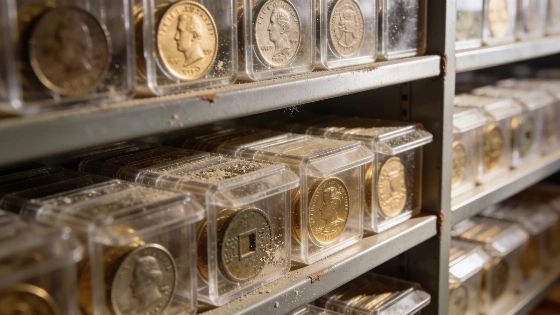
As cash use drops and AI transforms authentication, coin collecting is entering a new era. From digital grading to lunar commemoratives, the next 250 years will test how numismatics adapts to a world where physical currency is no longer essential.
Counterfeiters are preparing for a future where even the sharpest experts may struggle to spot a fake. As coin values climb and manufacturing technology advances, hyperrealistic forgeries are set to challenge the very foundation of numismatics. The next era will not be defined by the coins themselves, but by the ability to prove their authenticity in a world where physical cash is vanishing from daily life.
For collectors, the stakes are rising. The decline of cash in everyday transactions is not a distant scenario-it is already underway. In the United States, cash accounted for 32 percent of all payments in 2017, but by 2023 that figure had dropped to 16 percent. Projections for 2024 suggest a further fall to 11 percent, with digital payments and contactless methods now preferred by the vast majority of Americans. This shift is not unique to the US; across developed economies, coins and notes are rapidly losing their role as a means of payment.
AI and the End of Traditional Grading
Artificial intelligence is already reshaping how coins are authenticated and valued. Since 2018, the Professional Coin Grading Service (PCGS) has used AI and machine learning in its Gold Shield program to assist with counterfeit detection and grading. Over the next two decades, AI grading is expected to become standard, reducing costs and wait times while increasing accuracy. As multi-sensor technology and 3D surface scans become routine, the current Sheldon Scale-a 70-point system for grading coins-may be replaced by far more precise digital standards. Collectors have already seen the introduction of "+" and "*" modifiers to grades, reflecting a demand for finer distinctions. The next step is a complete overhaul of grading, driven by machine learning's ability to analyze metal composition and microscopic features beyond human perception.
Digital technology is also transforming how collectors connect and learn. Online marketplaces, virtual clubs, and educational platforms such as the ANA's eLearning Academy and Young Numismatists of America club have made it possible for hobbyists to access information and build communities worldwide. These tools are no longer novelties-they are becoming essential infrastructure for the hobby, standardizing access to up-to-date pricing, provenance, and authentication resources.
Scarcity, Provenance, and the Rise of Fractional Ownership
As governments gradually phase out coins and paper money, the supply of new collectible material will shrink. Some mints may continue to issue commemorative coins aimed at collectors, but the era of circulating coinage is drawing to a close. In the coming century, ultra-rare coins will become even more difficult to acquire, with many ending up in museums or held by groups of investors. Fractional ownership-already common in the art world-could become a practical solution for numismatics, allowing multiple collectors to share a stake in a single high-value piece. This approach is rare in coin collecting today, but rising prices and limited supply may force a change.
Authentication will become the central challenge. As forgeries become indistinguishable from genuine coins, collectors and institutions will rely on unbroken chains of provenance-detailed records tracing each coin's history back to the pre-digital era. In the future, a coin's pedigree may be as valuable as the object itself. The need for robust provenance is not new, but the technological arms race between counterfeiters and authenticators will make it non-negotiable.
Commemoratives and the Expansion Beyond Earth
With everyday coin production winding down, mints are likely to focus on commemorative issues, sometimes using exotic materials or even minting coins on lunar or Martian soil. The appetite for space-flown numismatic items is already proven: Sacagawea pattern dollars carried into space have fetched over $500,000 at auction, and medals from the Apollo era have realized millions. As permanent human settlements on other celestial bodies become plausible, demand for such commemoratives could surge, offering a new frontier for collectors.
These developments echo the way numismatics has always adapted to changing realities. When Australia's Royal Mint revived the historic Holey Dollar, it was not just a nod to the past but a recognition of how currency innovation shapes collecting, as reported earlier. The future will demand even greater flexibility as the very definition of a coin evolves.
Data and the Digital Shift
By 2076, nearly all payments in advanced economies are expected to be digital, with cash use dropping into the single digits. This transition is driven by convenience, security, and the proliferation of contactless and mobile payment systems. For numismatics, the disappearance of circulating coins will make existing specimens more valuable, but also more vulnerable to sophisticated counterfeiting. AI-assisted grading and digital provenance records will be essential tools for maintaining trust in the market.
Fractional ownership models, already popular for high-value art, may become necessary for coins that are simply out of reach for individual collectors. As the market adapts, the role of museums and institutional collections will grow, preserving access to ultra-rarities that would otherwise disappear into private vaults.
Looking ahead, the collision of rising values, advanced manufacturing, and digital authentication will define the next 250 years of coin collecting. The hobby's survival will depend on its ability to adapt to a world where physical currency is no longer a daily reality, but historical artifacts and digital records remain fiercely contested.
Numismatics has always been more than the sum of its coins. As technology transforms both the risks and rewards of collecting, the discipline will be forced to confront new questions about authenticity, ownership, and value. The end of circulating cash is not the end of the hobby-it is the beginning of a new era where history, technology, and scarcity collide.
Fractional ownership in numismatics refers to a system where multiple individuals share legal and financial interest in a single coin or collection. This model, common in the art world, allows participants to buy shares in high-value items that would otherwise be inaccessible. Ownership is typically managed through legal agreements or digital platforms, and participants may receive proportional benefits if the item is sold or displayed. While rare in coin collecting today, the rise of digital marketplaces and the increasing value of ultra-rare coins could make fractional ownership a practical solution for future collectors, especially as traditional access to physical currency declines.