
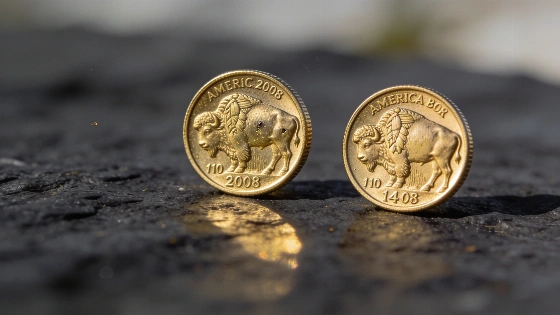
The 2008 American Buffalo 1/10 and 1/4 ounce gold coins pack 0.9999 purity into a rare, single-year run. Collectors eye them as larger bullion coins crowd the market.
One-ounce American Buffalo gold coins keep rolling off the presses at the United States Mint, but the smallest Buffalos from 2008 have faded from view. The 1/10 and 1/4 ounce coins, struck for just that year, carry a level of gold purity that most bullion coins never reach. Yet, these pieces rarely make headlines among investors or collectors. Anyone chasing hard numbers on their exclusive 2008 release will hit a wall: public records lack independent confirmation, and only official U.S. Mint documents can settle the mintage question. See Federal Reserve monetary policy for broader context.
These fractional Buffalos stand out for their 0.9999 gold fineness. Most bullion coins, whether American or foreign, stop at 0.999. That extra decimal-nine parts per ten thousand-matters to collectors who chase technical precision. In practice, a one-ounce coin at 0.9999 purity holds 9,999 parts gold out of 10,000, while a 0.999 coin has 9,990. The missing trace is usually copper, a standard alloy in gold coins. The Bank for International Settlements notes that gold remains a core reserve asset for central banks, and purity standards are tightly watched in global bullion trading.
Price gaps between 0.999 and 0.9999 gold barely register. At $4,500 per ounce, a 0.999 coin contains $4,495.50 in gold, while a 0.9999 coin holds $4,499.55-a $4.05 difference. For the 1/10 ounce 2008 Buffalo, the gap drops to 40 cents. The 1/4 ounce version edges ahead by $1.01 in gold content over a standard bullion coin. These numbers make it clear: scarcity and condition, not metal content, drive premiums for these coins. That pattern holds across the bullion market, where collector demand and perceived rarity push prices above spot, not tiny differences in gold content.
Top-grade examples are easy to find. MS-70 and PF-70 coins, the highest mint state and proof grades, show up often. Collectors pay up for these grades, even though the jump from MS-69 to MS-70 is nearly invisible without magnification. Most buyers stick to slabbed coins graded by trusted third-party services, since even slight wear can knock down value fast. The gap between total mintage and certified population matters, as numismatic guides point out, but no independent population data for the 2008 fractional Buffalos appears in public sources.
The flagship one-ounce American Buffalo has become a fixture in the Mint's bullion lineup. The 1/10 and 1/4 ounce Buffalos, though, never caught the same spotlight. The Mint issued these smaller coins only in 2008, alongside the half-ounce and one-ounce versions. After that, the Mint stuck with the full-ounce coin, leaving the fractional Buffalos as a one-year outlier. Without official confirmation from the U.S. Mint in available search results, collectors should double-check primary sources for the full issuance story.
Gold's price keeps climbing, but demand for these small Buffalos hasn't followed. Limited mintage and high purity haven't pushed them into the mainstream. They remain a niche for collectors who care about technical details and oddities in U.S. coinage. That's a different story from recent U.S. Mint releases like the Supergirl-themed coins covered here, which grabbed attention for novelty and short supply. Meanwhile, the gold market itself has swung wildly, with central banks such as the Federal Reserve and European Central Bank shifting policy rates to counter inflation and currency swings. These moves ripple through bullion demand and pricing.
For most buyers, the 0.999 versus 0.9999 purity debate is academic. Both are extremely pure, and the difference in alloy is invisible without lab tools. Electrolytic refining gets gold to these levels, but the real-world impact on value is tiny. Investors see almost no price gap; collectors may care about the extra decimal, but it rarely moves the market. The International Monetary Fund and other global financial bodies treat both purities as investment-grade, and central bank gold reserves are logged in fine troy ounces, regardless of minor purity tweaks.
Within U.S. gold coinage, the 2008 fractional Buffalos mark a rare mix of purity, scarcity, and overlooked status. Their place in mainstream collecting is still up in the air. For those who chase technical excellence and limited runs, these coins offer a clear alternative to standard bullion. Market premiums can swing with macroeconomic shifts, including changes in U.S. Treasury yields and foreign exchange rates, tracked closely by the Federal Reserve and other central banks.
Gold coin grading is its own world. Third-party grading services set the standard for condition. MS-70 or PF-70 coins are flawless under magnification; MS-69 coins may show the faintest marks. Premiums for top-graded coins can be steep, and authentication by a reputable service is a must to avoid grade disputes. For the latest on gold coin programs and monetary policy, collectors and investors should check official U.S. Mint and central bank releases.