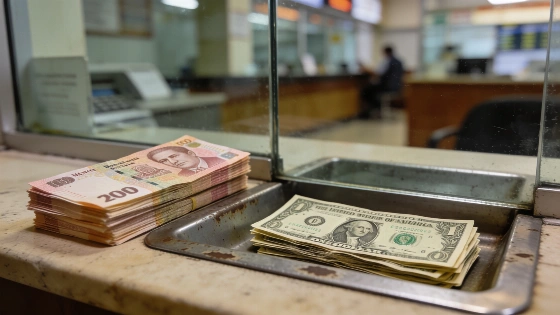
Crédit Agricole expects the Mexican peso to lose about 9% of its value against the US dollar by the end of 2027. The bank's forecast points to a shift in currency trends across Latin America.
Crédit Agricole is warning peso holders: the bank expects the Mexican currency to keep slipping against the US dollar over the next few years. By December 2027, the peso could be down about 9%. This stands out in a region where many emerging-market currencies have held up, even as US rates have gone up.
Higher yields usually help emerging-market currencies. But Crédit Agricole's analysts see Mexico as an exception. Their latest forecast puts the USD/MXN rate at 18.00 by December 2026 and 19.00 by the end of 2027. That's a big move from the 17.27 reference rate on 22 September. It means a 10% jump in the USD/MXN rate and a 9.1% drop for the peso. Still, official numbers from Banco de México show the peso at 17.3015 per dollar on 22 September 2026. The Federal Reserve Bank of St. Louis (FRED) also had it at 17.2454 on 18 September. These figures show the peso was stable in the short term and not near the 18-19 range when the forecast came out. See the Banxico official fixing for details.
Regional divergence in currency outlooks
Crédit Agricole does not see all emerging markets the same way. The bank expects Asian currencies to gain a bit against the dollar, and Central European currencies (CE4) to rise slightly versus the euro. But it singles out Latin America-especially the Colombian and Mexican pesos-as likely to weaken more. This split comes from different economic and policy outlooks across regions. In early September 2026, the peso was stronger, with highs around 16.91-16.98 per dollar. By mid-September, it slipped back to the 17.2-17.3 range, according to Trading Economics and FRED data. See the FRED exchange rate series for more.
Even with US yields rising, Crédit Agricole notes its emerging-market currency index has actually gained against the dollar since July. The US 10-year yield went up about 60 basis points in that time. High oil prices have kept emerging-market short-term rates up, so the interest-rate gap-or carry-over the US remains. But the bank warns that good yields are not enough to keep a currency strong if local problems or outside pressures hit confidence.
Interest rates and currency performance
For Mexico, the bank expects the policy rate to stay at 6.50% through December 2027. That matches the current rate from Banco de México. Investors in peso assets may keep earning solid interest. But Crédit Agricole, echoing earlier warnings from Rabobank, says earning interest does not always make up for currency losses when converting back to dollars. The difference between interest income and currency moves matters for anyone with cross-border exposure. The Federal Reserve shows the peso at 17.2333 per dollar on 18 September and 17.2210 on 19 September. These are small moves, not a sharp drop, during that period.
The bank's forecast sees the USD/MXN rate moving from 18.00 in December 2026 to 18.25 in March 2027, 18.50 in June, 18.75 in September, and 19.00 by December 2027. These targets, based on the September 2023 reference rate, point to a steady peso decline over time. The Bank of Mexico's policy updates and the Federal Reserve's rate decisions will keep shaping what happens next.
Comparisons and broader implications
This cautious view on the peso comes as other big banks warn about emerging-market currencies facing a strong US dollar. As reported earlier, the Indian rupee is also expected to stay under pressure through 2027, even as its central bank tries to steady it. The split in regional forecasts shows how much local economies and policies matter for currencies, even when global trends look supportive. On 23 September 2026, market reports citing Banxico put the peso FIX at about 17.3015 per dollar, with intraday moves to around 17.29. There was no sign of a quick rebound to a stronger peso.
For businesses and people with peso exposure, the main point is clear: higher yields may not protect against losses if the peso keeps weakening. A 9% drop can raise import costs, affect international transfers, and cut the value of overseas investments in pesos. The Bank of Mexico and the Federal Reserve are still the main players to watch, since their decisions shape both rates and exchange expectations.
Crédit Agricole's forecast shows how complex currency markets are. Interest rates, commodity prices, and regional factors all play a part. The bank expects Mexico's policy rate to stay steady, but warns that yield alone is not enough to guard against exchange-rate risk. With some emerging-market currencies set to strengthen and others to weaken, anyone managing currency risk across borders needs to watch both local and global pressures closely.
Understanding currency depreciation and carry
Currency depreciation means a currency loses value against another in a floating exchange-rate system. For the Mexican peso, a projected drop against the US dollar means it will take more pesos to buy each dollar over time. Carry is the interest income from holding a higher-yielding currency, but this can be wiped out-or more-if the currency falls. For investors, businesses, and travelers, knowing how interest rates and exchange rates interact is key to managing costs and risks in cross-border deals.