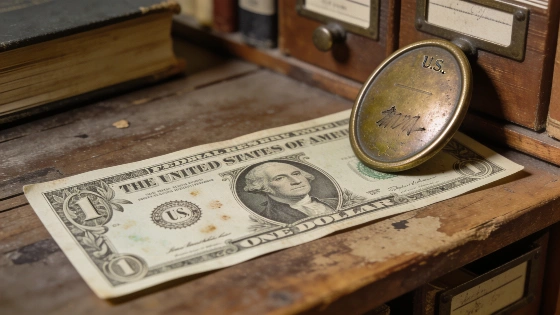
Bronze surcharges were added to U.S. fractional currency in the 1860s to deter counterfeiting, but the process led to unique printing errors. Collectors and historians now study these mistakes for insights into early U.S. banknote production and security.
In the 1860s, the United States faced a severe shortage of coins, prompting the Treasury to issue fractional currency-small-denomination paper notes intended to fill the gap. To combat widespread counterfeiting, officials introduced bronze surcharges, a security feature that involved applying glue and sprinkling bronze powder onto the notes. While this method made counterfeiting more difficult, it also introduced a new set of distinctive printing errors that have become a focus for collectors and currency historians.
The first issue of U.S. fractional currency, known as postage currency, was released in 1862 under the direction of Treasurer Francis Spinner. Its simple design, featuring images of postage stamps, proved easy to counterfeit. In response, the Second Issue adopted more complex designs, including a bronze oval around George Washington's portrait on the front and large numerical bronze surcharges on the back. By the Third Issue, surcharges continued, but only on certain denominations, with the 10¢, 25¢, and 50¢ notes featuring bronze elements on the face or back.
Types of Bronze Surcharge Errors
The process of applying bronze surcharges was manual and prone to mistakes. Among the most notable errors are inverted surcharges, where the bronze numbers or ovals appear upside down relative to the rest of the note. These errors are found across multiple denominations and issues. For example, Second Issue 5¢, 10¢, 25¢, and 50¢ notes have been documented with inverted bronze surcharges, sometimes accompanied by inverted engraved designs on the back. In some cases, both the surcharge and the engraved design are inverted, creating highly unusual varieties.
Third Issue notes, particularly the 10¢ denomination, present even more possibilities for error. The 10¢ note is unique in that it features four bronze "10" surcharges on the face, increasing the chance of misapplication. Some Third Issue 10¢ notes have all four surcharges inverted, while others display inverted surcharges only on the back. Red back fractionals with inverted surcharges are especially rare, with only a handful known to exist.
Misaligned and Missing Surcharges
Not all errors involve inversion. Misaligned surcharges, where the bronze number or oval is shifted far from its intended position, are also found. While minor misalignments are relatively common, dramatic examples-such as a bronze oval covering Washington's portrait or a "25" skewed into the margin-are highly sought after by collectors. Even rarer are notes missing the bronze surcharge entirely. Fewer than five such examples have been confirmed, making them some of the most elusive errors in U.S. fractional currency.
Corner surcharges, small letters or numbers applied to the corners of some Second Issue notes, also present opportunities for error. In some cases, these corner surcharges were applied inverted, further expanding the range of collectible varieties. The complexity of the bronze application process, combined with the manual nature of 19th-century banknote production, ensured that no two error notes are exactly alike.
Collecting and Cataloguing Error Notes
Collectors and researchers have identified dozens of subvarieties of bronze surcharge errors, often catalogued by Friedberg numbers-a system used to classify U.S. currency types and varieties. For instance, there are 25 different Friedberg numbers for the Justice and Spinner Third Issue 50¢ fractional notes with the same Type 1 reverse, reflecting subtle differences in design and error type. The study of these errors not only appeals to collectors but also provides insight into the challenges of early banknote security and production methods.
According to Numismatic News, the largest known collection of fractional currency errors was assembled by Richard Merlau, whose research and documentation have helped clarify the range and rarity of these mistakes. Auction houses such as Heritage Auctions have also played a role in bringing these notes to public attention, with rare varieties commanding significant premiums at sale.
For context, the Second Issue of U.S. fractional currency was produced from October 1863 to February 1867, with denominations ranging from 5¢ to 50¢. The Third Issue followed from December 1864 to August 1869. While millions of notes were printed, only a small fraction display the dramatic errors now prized by collectors. The presence or absence of a bronze surcharge, its orientation, and its alignment can all affect a note's desirability and value.
The fascination with error notes is not unique to U.S. currency. As explored in this analysis of rare U.S. gold coin production, mistakes and anomalies often become the most studied and valuable artifacts in numismatic history, offering a window into the practical realities of currency manufacturing and the evolution of anti-counterfeiting measures.
The use of bronze surcharges on U.S. fractional currency highlights the ongoing tension between security and practicality in banknote production. While the surcharges succeeded in making notes harder to counterfeit, they also introduced new risks of error. Today, these mistakes are not just curiosities-they are important historical evidence of how the United States adapted its currency to meet the challenges of a rapidly changing economy and the limitations of 19th-century technology. The study of these errors continues to inform both collectors and historians about the evolution of money and the persistent challenge of securing it against fraud.