The 1887 Liberty Head Half Eagle stands out as the only $5 gold coin in U.S. history struck exclusively in Proof format, raising questions about its origins, rarity, and the monetary context that shaped its creation
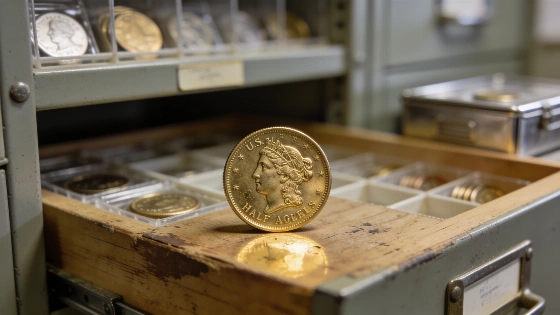
The 1887 Liberty Head Half Eagle occupies a unique place in American coinage history. Unlike other $5 gold coins of its era, every example from this year was produced solely as a Proof, with no business strikes issued for circulation. This singular status has made the 1887 Half Eagle a subject of ongoing debate among numismatists, collectors, and monetary historians.
At first glance, the coin appears to be a typical late-19th-century $5 gold piece. However, its Proof-only status sets it apart, prompting questions about the economic and policy decisions that led to its creation. According to CoinWeek, the absence of a business-strike version in 1887 is not fully explained by official records, but the broader context of U.S. monetary policy in the late 1880s offers some clues.
Proof-Only Status Amid High Gold Demand
In 1887, the Philadelphia Mint produced just 87 Proof Liberty Head Half Eagles, with no regular-issue coins for everyday use. This decision is especially notable given that the San Francisco Mint struck over 1.9 million $5 gold coins the same year, reflecting strong demand for gold coinage in the western United States. The Philadelphia Mint's exclusive focus on Proofs stands in contrast to this high output elsewhere, suggesting a deliberate policy choice rather than a technical or production constraint.
One plausible explanation involves the ongoing debate over bimetallism and the role of gold and silver in the U.S. monetary system during the 1880s. The same year, the Philadelphia Mint also did not produce business-strike double eagles ($20 gold coins), reinforcing the idea that the decision was part of a broader monetary strategy rather than an isolated anomaly affecting only the half eagle denomination.
Survival Rates and Collector Recognition
Of the 87 Proof 1887 Half Eagles originally minted, only about three dozen are believed to survive today, and many of these show signs of wear or cleaning. Unlike other rare Proof gold coins from the period, such as the 1875 and 1876 Three Dollar Gold pieces, the 1887 Half Eagle was not widely recognized as a rarity at the time of issue. As a result, a significant portion of surviving examples are impaired, making original, problem-free coins especially scarce.
For collectors, this means that the 1887 Half Eagle is not only rare in absolute terms but also difficult to find in high grades with original surfaces. The coin's Proof-only status and low survival rate have contributed to strong price premiums compared to other Proof half eagles from the 1880s. For example, price guides often list PR63 examples at around $60,000 and PR64 pieces at $120,000, roughly three times the value of comparable Proofs from 1884 or 1886.
Technical Features and Market Impact
Unlike many Proof half eagles from the early 1880s, the 1887 issue typically displays only modest contrast between frosted devices and mirrored fields. Deep Cameo (DCAM) designations are rare and, when present, may not reflect a dramatic visual difference from standard Cameo pieces. As a result, collectors are advised to focus on overall eye appeal and originality rather than relying solely on grading labels.
There is no universally acknowledged finest known example of the 1887 Half Eagle. Condition census rankings vary, and the small, inconsistent surviving population makes it difficult to establish a clear hierarchy. The auction record for the issue was set in 2018, when a PCGS/CAC PR65 Cameo example from the W. F. Dunham Collection sold for $144,000 at Stack's Bowers. The presence of CAC approval, which signals originality and quality, played a significant role in achieving this price.
Context Within U.S. Coin Collecting
The 1887 Half Eagle's Proof-only status gives it a special role in assembling a complete With Motto Liberty Head Half Eagle set. Unlike some U.S. gold series that require multiple six-figure rarities, this set is considered challenging but achievable, with the 1887 issue serving as a natural focal point. Its combination of historical intrigue, technical distinction, and market scarcity aligns with modern collecting trends that value narrative and context as much as numerical rarity.
For those interested in the broader landscape of U.S. commemorative and rare coins, the story of the 1887 Half Eagle echoes themes found in other notable issues. For example, the enduring appeal of the 1986 Statue of Liberty commemorative coins, which marked a major anniversary and remain highly sought after, is explored in detail in this analysis of the Statue of Liberty coin program.
Facts and Figures: Mintage and Survival
The Philadelphia Mint struck only 87 Proof 1887 Liberty Head Half Eagles, with no business-strike coins produced for circulation that year. By comparison, the San Francisco Mint issued 1,912,000 business-strike half eagles in 1887. Today, experts estimate that approximately 36 examples of the 1887 Proof survive in all grades, with a significant proportion showing signs of wear or cleaning. Auction records indicate that top-quality, original examples can command prices well above $100,000, reflecting both rarity and collector demand.
The 1887 Half Eagle's story highlights the intersection of monetary policy, mint operations, and collector behavior in late 19th-century America. Its Proof-only status was likely shaped by broader debates over gold and silver, as well as the specific production choices of the Philadelphia Mint. For collectors and historians, the coin remains a tangible reminder of how economic policy and numismatic history can converge in a single, enigmatic object.
Understanding the distinction between Proof and business-strike coins is essential for interpreting the significance of the 1887 Half Eagle. Proof coins are specially struck using polished dies and planchets to create a mirror-like finish, intended primarily for collectors rather than circulation. In contrast, business-strike coins are produced in large quantities for everyday use. The absence of a business-strike version in 1887 means that every surviving half eagle from that year was originally created as a collector's item, not as circulating money. This distinction underpins both the coin's rarity and its enduring appeal among numismatists.