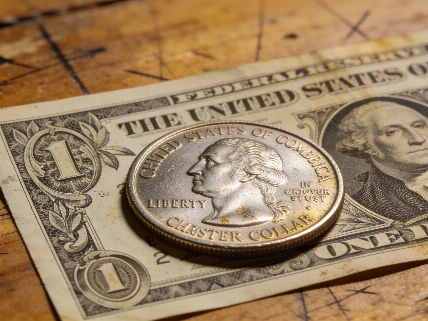
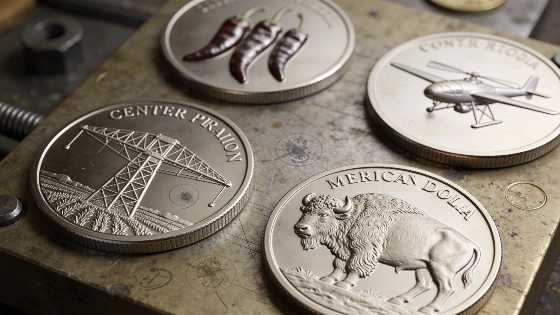
Proposed 2028 American Innovation $1 reverses pair Nebraska irrigation with Colorado chiles, while North Dakota drone systems and South Dakota bison conservation round out the candidates. None has been confirmed for release.
The selection process runs through two advisory bodies before the Secretary of the Treasury makes the final choice. The supplied account says the Commission of Fine Arts, CFA, and Citizens Coinage Advisory Committee, CCAC, review proposals and make recommendations. No final recommendations or official decision on these designs appeared in the available information.
Four states, four stories
Nebraska's proposed designs focus on center-pivot irrigation, developed by Frank Zybach. Elevated pipes mounted on wheeled towers rotate around a central pivot and distribute water across large fields. Compared with earlier irrigation methods, the system reduced labor and produced the circular field patterns now familiar across agricultural areas.
The proposed reverses show irrigation equipment operating across Nebraska farmland. Corn and soybeans also appear in the imagery. It is a practical technology rendered as a landscape, with a footprint visible from above.
Colorado's proposals feature the Pueblo chile, especially the Mosco variety developed through generations of cultivation in the Arkansas River Valley. Colorado State University vegetable crop specialist Dr. Michael Bartolo and his team at the Arkansas Valley Research Center developed the modern Mosco Pueblo chile. Its large, thick-walled peppers and upright growth give the designs a recognizable subject.
Some concepts show chile plants against Colorado's mountain scenery. Others feature harvested peppers or draw on local traditions, including the Pueblo Chile & Frijoles Festival. The proposals make room for agricultural development and the culture built around the crop.
Technology and conservation
North Dakota's candidates shift from fields to the systems behind unmanned aircraft operations. The state is home to the Northern Plains UAS Test Site, while the University of North Dakota has become a center for UAS education and research. The university also developed Vantis, a statewide network that supports beyond-visual-line-of-sight drone operations. It uses radar and communications, along with other aviation infrastructure.
The proposed reverses depict different unmanned aircraft alongside the equipment supporting their operation. Some concepts emphasize national applications. Others focus on use in rural North Dakota communities, giving the designs a choice between a broad view of drone technology and a local setting.
South Dakota's proposals look back to the family of Frederick Dupree and Mary Good Elk Woman, also identified as Hehaka Waste Win. Beginning in the 1880s, the family captured buffalo near Cherry Creek and raised them as the species' population fell dramatically across the Great Plains. Their herd grew over subsequent decades and eventually contributed to the lineage of the Custer State Park herd, as well as other conservation herds.
The proposed designs depict the family alongside buffalo. South Dakota's landscape frames the imagery, linking conservation history with the animal's importance to Lakota culture and the Great Plains. Nebraska's proposals center on engineering; this subject focuses on people's efforts to protect a species.
What the selection decides
The proposed program covers four states in 2028. Its candidates address agriculture and food cultivation, while other designs focus on aviation technology or wildlife conservation. That range describes the themes in the supplied account. It does not establish that the designs, their order or their final imagery have been approved.
A coin's design does not determine its collector value. Visual appeal can matter to collectors, as a report on toned cents illustrates. The available information establishes proposed imagery and a described selection process, not future demand or prices.
The supplied account places the final choice with the Secretary of the Treasury, following committee recommendations. Available information does not independently confirm final recommendations or a decision date. It also does not verify the designs' final status or the coins' release details. No verified 2028 mintage or release date is available, and the technical specifications and final images have not been confirmed.
Coin designs and currency markets
The proposals concern numismatics and cultural history, not monetary policy. A coin's $1 denomination does not establish its collector price or the dollar's foreign-exchange value. Exchange rates reflect how currencies are priced against one another. They can respond to expectations about interest rates and inflation, as well as forecasts for economic growth or risk. These design proposals establish no specific currency-pair rate or movement.
The Federal Reserve's longer-run inflation goal is 2%, measured by the personal consumption expenditures, or PCE, price index. Its policy framework is separate from decisions about coin artwork. The U.S. Bureau of Labor Statistics publishes the consumer price index, or CPI. CPI is a distinct measure of consumer-price change, with different coverage and methodology from PCE. Neither index on its own establishes an exchange-rate movement.
Central-bank policy expectations can influence currency markets through interest-rate differentials. Bond yields also inform investors' assessments, as do inflation data. The European Central Bank's policy decisions shape euro-area rate expectations that market participants may compare with U.S. expectations when pricing the euro against the dollar. Its monetary policy overview describes its policy framework.
No current Fed or ECB rate decision or exchange-rate quote is verified in the available material. The same is true of sovereign bond yields and intervention. No meeting-minute detail or voting dissent is established.