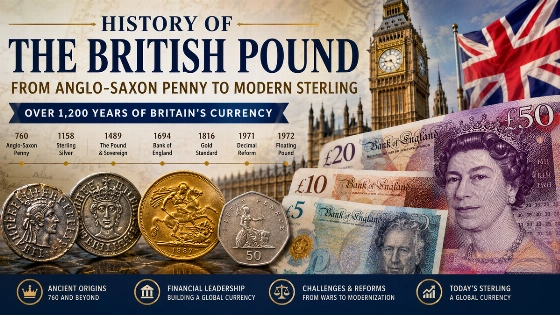
The pound sterling began as a weight-based unit built around the Anglo-Saxon silver penny and developed into the leading currency of nineteenth-century global finance. This detailed history follows sterling through medieval coinage, the Bank of England, the gold standard, wartime devaluations, Decimal Day, Black Wednesday and today’s floating GBP.
The pound sterling is often described as the world’s oldest currency still in continuous use, but the modern pound is the result of more than twelve centuries of change.
Its history begins with Anglo-Saxon silver pennies and a unit of account based on weight. It continues through medieval gold coins, Tudor debasement, the creation of the Bank of England, the rise and collapse of the gold standard, two world wars, decimalisation, fixed and floating exchange rates, European monetary integration and the introduction of polymer banknotes.
The original version of this page contained several important errors. The shilling was not first introduced in 1487, Britain did join the European Union’s predecessor institutions, and sterling is not automatically the world’s highest-valued currency. This restored article separates the history of the pound as a unit of account from the later history of pound coins, banknotes and modern monetary policy.
British Pound: Essential Facts
- Official currency name: Pound sterling
- Common names: Pound, British pound and sterling
- International currency code: GBP
- Currency symbol: £
- Subdivision: 1 pound = 100 pence
- Singular minor unit: Penny
- Plural minor unit: Pence
- Banknote issuer for England and Wales: Bank of England
- Additional banknote issuers: Six authorised commercial banks in Scotland and Northern Ireland
- Coin issuer: The Royal Mint
- Current Bank of England notes: £5, £10, £20 and £50
- Current circulating coins: 1p, 2p, 5p, 10p, 20p, 50p, £1 and £2
- Decimal currency introduced: 15 February 1971
- Current exchange-rate regime: Free floating
- Current monetary-policy target: 2 per cent annual CPI inflation
The Pound in Twelve Stages
- Anglo-Saxon silver: The penny became the central English coin, while the pound developed as a unit of weight and account.
- The £sd system: One pound was divided into 20 shillings and 240 pennies, even though no one-pound coin yet existed.
- Sterling silver: Medieval reforms established a durable silver standard associated with the word sterling.
- Gold coinage: The noble, sovereign, crown and other coins expanded the range of high-value money.
- Tudor reform and debasement: Governments altered the metal content of coins and later restored confidence through recoinage.
- Banknotes and central banking: Goldsmith receipts and Bank of England notes added paper money to the monetary system.
- The gold standard: Sterling became convertible into gold and emerged as the leading currency of nineteenth-century global trade.
- War and devaluation: Two world wars, the end of gold convertibility and the decline of the sterling area transformed the pound.
- Decimalisation: Pounds, shillings and old pence were replaced by a system of 100 new pence to the pound in 1971.
- Floating sterling: The pound moved from fixed post-war rates to a market-determined exchange rate in 1972.
- ERM and inflation targeting: The 1992 exchange-rate crisis was followed by an inflation-targeting framework and central-bank independence.
- Modern sterling: Polymer notes, redesigned coins, digital payments and a major international foreign-exchange role define the pound today.
Why Is It Called the Pound Sterling?
The name pound began as a measurement of weight rather than as the name of a coin. Its deeper linguistic roots are connected with the Latin expression libra pondo, meaning a pound by weight. This helps explain why the currency symbol is £: it developed from the letter L used for libra.
In medieval accounting, a pound represented a large quantity of silver divided into smaller units. The pound was therefore originally a unit for calculating value, debts, taxes and payments rather than a piece of money that people routinely carried.
The origin of the word sterling is less certain. Several explanations have been proposed, including associations with small stars on coins or with merchants from continental Europe. No single theory is universally accepted. What became clear over time was that sterling referred to English money of a recognised standard and later to the currency as a whole.
The modern expressions are related but not identical. Pound sterling is the formal currency name, pound is the principal unit, and sterling is commonly used in finance to distinguish the currency from other pounds such as the Egyptian pound or Lebanese pound.
King Offa and the Anglo-Saxon Silver Penny
The history of the English pound is often traced to the silver pennies struck during the reign of Offa, king of Mercia from 757 to 796. Offa did not create money in Britain, but his high-quality pennies formed part of a more standardised coinage tradition that spread through Anglo-Saxon England.
The silver penny was small, portable and suitable for taxation and market exchange. For centuries it remained the principal English coin. Higher values were frequently accounting units rather than separate denominations.
Early pennies were connected with a weight-based monetary structure. A pound of silver could theoretically be divided into 240 pennies. This produced the system later written as pounds, shillings and pence:
- 1 pound: 20 shillings
- 1 shilling: 12 pennies
- 1 pound: 240 pennies
- 1 penny: 4 farthings
The symbols reflected Latin accounting terms. Pounds were shown with £ from libra, shillings with s from solidus and pence with d from denarius. The resulting system became known as £sd.
Because pennies were the main coins available, people sometimes cut them into halves and quarters to make smaller payments. The word halfpenny literally described half of a penny, while a farthing represented one quarter.
From Anglo-Saxon England to the Norman Kingdom
English coinage became an important instrument of government before the Norman Conquest. Kings controlled minting, changed coin designs at intervals and used recoinage to reinforce political authority. A recognised coin could communicate the ruler’s name, legitimacy and territorial control as well as provide a means of payment.
After the Norman Conquest of 1066, the basic silver-penny system continued. The Normans inherited a sophisticated network of English mints and maintained the pound-shilling-penny accounting structure.
The survival of the system was significant. Dynasties, political institutions and borders changed, but the pound remained an accounting framework. This continuity is one reason sterling can be described as exceptionally old even though its coins, notes, metal standards and exchange-rate regimes have repeatedly changed.
Henry II, Sterling Silver and the Penny Reform of 1158
In 1158, during the reign of Henry II, a major recoinage introduced the coin type commonly called the Tealby penny. Medieval English coinage increasingly became associated with sterling silver, traditionally defined as 92.5 per cent silver and 7.5 per cent other metal.
Mixing silver with a smaller quantity of base metal made coins more durable than pieces struck from nearly pure silver. Durability mattered because coins changed hands repeatedly, could be clipped at the edges and were expected to remain recognisable in circulation.
The medieval monetary system still depended heavily on trust in weight and fineness. If coins contained less silver than expected, their value in trade could fall. If heavier coins circulated alongside lighter ones at the same official value, users had an incentive to save, export or melt the better coins.
Royal control over the mint, periodic recoinages and severe penalties for counterfeiting were therefore central to maintaining the pound’s credibility.
Medieval Gold Coins and the Expansion of Sterling
For much of the early medieval period, the silver penny dominated English circulation. Economic growth and international trade eventually created demand for coins representing much larger values.
Henry III attempted to introduce a gold penny in 1257, but the issue was not a lasting success. A more durable gold coinage developed under Edward III. In 1344 the gold noble appeared as the first regular English gold coin intended for sustained circulation. It was valued at six shillings and eight pence, equal to one third of a pound.
The introduction of gold did not mean that Britain immediately adopted the later gold standard. Gold and silver coins circulated together, and governments had to set official relationships between the metals. Changes in international metal prices could make one type of coin more attractive to export or melt.
Later medieval and Tudor rulers introduced additional denominations. The testoon, an early English shilling coin, developed under Henry VII and entered regular issue in the early sixteenth century. In 1489 Henry VII introduced the gold sovereign, a prestigious coin with a face value of one pound sterling.
This was an important distinction: the pound had existed as a unit of account for centuries before a coin worth exactly one pound appeared.
Tudor Debasement and the Restoration of the Coinage
The metallic value of English coins did not remain constant. During the reigns of Henry VIII and Edward VI, the government reduced the precious-metal content of many coins in a process remembered as the Great Debasement.
Debasement allowed the Crown to obtain more coins from the same amount of precious metal and provided short-term revenue. The longer-term consequences included rising prices, damaged confidence and greater difficulty in domestic and international trade.
Elizabeth I carried out a major recoinage in 1560 and 1561. Debased coins were withdrawn and replaced with money of improved fineness. The reform demonstrated a recurring feature of sterling history: governments could obtain temporary fiscal relief by weakening the coinage, but restoring credibility required costly institutional action.
Mechanical improvements also changed production. Hammered coins were gradually replaced by milled coinage with more regular shapes and edges, making clipping easier to detect. By the reign of Charles II, machine-made coins had become the standard.
The Pound Scots and the Creation of Great Britain
Before the political union of England and Scotland, the two kingdoms used separate pounds. The pound Scots shared historical roots with the English pound but declined substantially in relative value over time.
By the beginning of the eighteenth century, twelve pounds Scots were treated as equivalent to one pound sterling. The Acts of Union of 1707 created the Kingdom of Great Britain and required a monetary reorganisation in Scotland.
Scottish coinage was recalled and converted to the English sterling standard. The pound sterling became the accounting and coinage system of the united kingdom, although Scotland retained separate banking institutions and later developed its own banknote traditions.
This history helps explain the unusual modern structure of British cash. The currency is one pound sterling, but banknotes are not issued by only one institution throughout the whole country.
Goldsmith Notes and the Birth of British Banknotes
Paper money in England developed partly from the practices of seventeenth-century goldsmith-bankers. Customers deposited coins and precious metal for safekeeping and received written receipts. These receipts could be transferred, used in payment and eventually functioned as money.
The Bank of England was founded in 1694, initially to help finance the government. It accepted deposits and issued notes promising to pay the bearer. Early notes were often handwritten and could represent unusual amounts containing pounds, shillings and pence rather than standard modern denominations.
The wording I promise to pay the bearer on demand survives on Bank of England notes. Originally, it meant that a holder could return the note and receive its value in coin, ultimately linked to precious metal. Today it means that the Bank will exchange the note for another Bank of England note of the same value; there is no right to demand gold.
Banknotes expanded the supply of convenient high-value money. They also introduced new questions about credit, reserves, counterfeiting and the ability of banks to honour their promises.
The Great Recoinage and the Move Towards Gold
By the 1690s, England’s hammered silver coinage had been badly clipped and worn. The Great Recoinage of 1696 attempted to replace the old pieces with machine-made coins of full weight.
The reform improved the physical condition of the currency but created disruption and expense. It also occurred while the relative market values of gold and silver were changing.
Isaac Newton, serving as Master of the Mint, recommended a value for the gold guinea in 1717. The official rate made gold relatively attractive within Britain, encouraging silver to leave circulation. Britain gradually moved towards a gold-based monetary system even before the gold standard was formally established by legislation.
The guinea became one of the best-known British gold coins. Its value eventually settled at 21 shillings, or one pound and one shilling. Even after the coin disappeared from ordinary use, guineas remained a traditional pricing unit in some professions, auctions and luxury markets.
War, the Restriction Period and the Gold Sovereign
The wars with Revolutionary and Napoleonic France placed severe pressure on British public finance and gold reserves. In 1797, the Bank of England suspended the conversion of its notes into gold. This period became known as the Restriction Period.
Banknotes continued to circulate without routine gold redemption. Their purchasing power depended increasingly on confidence in the state, taxation, monetary management and the expectation that convertibility would eventually return.
The Coinage Act of 1816 reorganised the system and formally established gold as the principal monetary standard. Silver coins became token money: their face value exceeded the market value of the silver they contained, and their acceptability depended on law rather than full intrinsic value.
A new gold sovereign valued at one pound was first issued in 1817. It became one of Britain’s most internationally recognised coins. Full gold convertibility resumed in 1821.
Sterling and the Nineteenth-Century Gold Standard
During the nineteenth century, Britain became a leading industrial, commercial and financial power. London developed into the central market for international banking, insurance, trade finance and foreign exchange.
Under the classical gold standard, the pound had a fixed relationship with gold. Other countries that adopted gold definitions for their currencies could calculate exchange rates through the metallic content of each unit.
This reduced some forms of exchange-rate uncertainty and supported long-distance trade and investment. Bills of exchange denominated in sterling were widely used, while central banks, governments and merchants held claims in London.
Sterling became the leading reserve and trade currency of the first era of modern global financial integration. Its position rested on more than the metal content of coins. It depended on Britain’s trading network, the scale of London’s financial markets, confidence in contracts and the ability of the Bank of England to defend convertibility.
The Bank Charter Act of 1844 strengthened the institutional framework for Bank of England note issuance by separating the Issue Department and restricting the creation of notes not backed under the legal rules. Commercial banks continued to create deposit money, but the Bank’s notes became increasingly central to the national system.
The Pound Sign and the Language of Sterling
The symbol £ developed from a stylised capital L, referring to the Latin libra. Horizontal strokes were added over time, and forms with one or two crossbars have both been used.
The international code GBP is much newer. It identifies the pound sterling under the ISO 4217 currency-code system. In financial markets, sterling may be discussed through currency pairs such as GBP/USD and EUR/GBP.
Nicknames and traditional expressions also became part of British monetary culture:
- Quid: an informal term for one or more pounds
- Bob: an informal pre-decimal term for a shilling
- Tanner: a sixpence
- Florin: a two-shilling coin, equal to one tenth of a pound
- Half crown: two shillings and sixpence
- Guinea: 21 shillings
The First World War and the End of the Classical Gold Standard
The outbreak of the First World War in 1914 disrupted international payments and placed pressure on gold reserves. Britain suspended the ordinary workings of the classical gold standard and introduced emergency measures to support the banking system and conserve gold.
Small-denomination Treasury notes were issued because gold coins disappeared from everyday circulation. The war greatly expanded government borrowing and altered the relationship between the state, the Bank of England and the financial system.
Britain attempted to restore the pre-war gold parity in 1925. The pound returned at approximately 4.86 US dollars, the old official rate. Critics argued that the chosen parity overvalued sterling, placed pressure on exports and contributed to domestic economic weakness.
The restored system did not survive the global financial crisis. In September 1931 Britain abandoned gold convertibility. From that point, holders of Bank of England notes no longer had a right to exchange them for gold.
The Sterling Area and the Changing International Order
After leaving gold, Britain managed the pound through foreign-exchange policy, reserves and the Exchange Equalisation Account. Countries and territories with close financial links to Britain formed what became known as the sterling area.
Members held reserves in sterling, maintained exchange relationships with the pound and used London for international payments. This system extended sterling’s global importance beyond Britain itself.
The Second World War weakened Britain’s external finances and increased dependence on the United States. The post-war international system was organised around the US dollar and the Bretton Woods institutions rather than around sterling and gold.
The Bank of England was nationalised in 1946, ending more than 250 years of private shareholder ownership.
Bretton Woods, Convertibility and the 1949 Devaluation
Under the Bretton Woods system, sterling had a fixed value against the US dollar, while the dollar was officially linked to gold for foreign monetary authorities.
The post-war rate placed one pound at about 4.03 US dollars. Britain attempted to restore current-account convertibility in 1947, but pressure on reserves forced the experiment to be suspended after only a short period.
On 18 September 1949, the pound was devalued from 4.03 dollars to 2.80 dollars. Several currencies linked to sterling followed the change.
The devaluation acknowledged that the previous rate could not be maintained under Britain’s post-war economic conditions. It also demonstrated the decline of sterling’s earlier position relative to the dollar.
The 1967 Devaluation
Britain continued to defend the fixed rate of 2.80 dollars through the 1950s and much of the 1960s. Persistent balance-of-payments pressure, reserve losses and speculative attacks made the system increasingly difficult to maintain.
On 18 November 1967, the government devalued the pound by one seventh, reducing the official rate from 2.80 dollars to 2.40 dollars.
The change became one of the most politically remembered events in modern British monetary history. It affected import prices, international confidence and debates about Britain’s economic performance.
The devaluation did not mean that every domestic price immediately changed by the same percentage. An exchange rate measures the external price of a currency; its effects on wages, retail prices and living standards depend on trade, contracts, policy and the broader economy.
Decimalisation: From 240 Pennies to 100 Pence
For more than a thousand years, British money used a non-decimal structure:
- 12 old pennies: 1 shilling
- 20 shillings: 1 pound
- 240 old pennies: 1 pound
The system had deep cultural roots but was increasingly inconvenient for accounting, retailing, machinery and international business. Other countries had already adopted decimal currencies.
The government announced the decision to decimalise in 1966, and Parliament passed the first Decimal Currency Act in 1967. Decimal Day took place on 15 February 1971.
The pound was retained as the main unit but was divided into 100 new pence. The old symbols and relationships were replaced by a simpler structure:
- 1 pound: 100 pence
- 50 new pence: 10 old shillings
- 10 new pence: 2 old shillings
- 5 new pence: 1 old shilling
Some old and new coins circulated together during the transition. The old shilling and florin, for example, remained usable as equivalents of 5p and 10p for years after Decimal Day.
Later changes introduced the 20p coin in 1982, the round £1 coin in 1983, the circulating £2 coin in 1998 and a new twelve-sided £1 coin in 2017.
The Pound Begins to Float
The Bretton Woods fixed-rate system came under growing pressure at the beginning of the 1970s. The United States ended the dollar’s official gold convertibility in 1971, and major currencies struggled to maintain agreed parities.
Britain allowed sterling to float in June 1972. The exchange rate was no longer defended at a single permanent dollar value and could move in response to market demand, interest rates, inflation, trade, investment and expectations.
Floating did not mean that the authorities became indifferent to the exchange rate. Governments and the Bank of England continued to monitor sterling, manage reserves and sometimes intervene. The key difference was that there was no longer a standing promise to convert pounds at one fixed external rate.
Sterling experienced substantial volatility during the 1970s. Inflation, oil shocks, industrial conflict and concern over public finances contributed to pressure on the currency. In 1976 the United Kingdom negotiated an IMF programme, an event that became closely associated with the economic difficulties of the decade.
North Sea Oil, Financial Markets and the 1980s
The development of North Sea oil changed Britain’s trade position and influenced market perceptions of sterling. At times the pound benefited from oil revenue and high interest rates; at others it weakened as inflation, recession or changing global capital flows altered demand.
Financial deregulation and the 1986 Big Bang reforms expanded the role of London as an international financial centre. Sterling trading became increasingly connected with global banks, institutional investors and derivatives markets.
The pound’s exchange rate could move sharply even when the domestic coin and banknote system remained unchanged. This distinction is important: the history of the currency’s physical form and the history of its external value are related but separate.
The European Exchange Rate Mechanism and Black Wednesday
The United Kingdom joined the European Exchange Rate Mechanism in October 1990. The system required participating currencies to remain within agreed bands around central exchange rates.
Economic conditions made the chosen sterling rate difficult to defend. Britain faced recession and high interest rates, while German reunification influenced monetary conditions across Europe.
On 16 September 1992, speculative selling placed enormous pressure on the pound. The authorities raised interest rates and intervened in the market but were unable to maintain sterling within the ERM bands. The United Kingdom suspended participation in the mechanism on the day remembered as Black Wednesday.
The event was a major political and financial failure for the government, but the move out of the ERM also allowed interest rates to fall and gave monetary policy a different framework.
Inflation Targeting and Bank of England Independence
After leaving the ERM, the United Kingdom adopted an explicit inflation-targeting approach in October 1992. Monetary policy was increasingly explained through published targets, forecasts and interest-rate decisions.
In May 1997, the Bank of England received operational independence to set interest rates. The government continued to define the inflation target, while the Bank’s Monetary Policy Committee decided how to use monetary-policy tools to meet it.
The current target is 2 per cent annual inflation measured by the Consumer Prices Index. A floating exchange rate allows sterling to respond to market conditions, while monetary policy focuses primarily on price stability rather than defending a fixed currency value.
The framework does not eliminate exchange-rate changes. Expectations about interest rates, growth, inflation, government policy and global risk can all cause the pound to rise or fall.
Britain, the European Union and the Euro
The original article incorrectly suggested that the United Kingdom avoided joining the European Union. Britain joined the European Economic Community in 1973 and remained part of the later European Union until its withdrawal in 2020.
The United Kingdom did not, however, adopt the euro. It negotiated an opt-out from the part of the Maastricht Treaty that would otherwise have required participation in the final stage of Economic and Monetary Union.
The euro began as an accounting and financial-market currency in 1999, and euro banknotes and coins entered circulation in 2002. Sterling remained the United Kingdom’s currency.
The pound’s survival was therefore not the result of Britain remaining outside European integration altogether. It resulted from a specific legal and political decision not to replace sterling with the single currency.
After the United Kingdom left the European Union, the pound continued under the same basic institutional structure: a floating exchange rate, Bank of England monetary policy and domestic issuance of notes and coins.
Modern Bank of England Banknotes
The Bank of England currently issues four banknote denominations:
- £5: Sir Winston Churchill
- £10: Jane Austen
- £20: JMW Turner
- £50: Alan Turing
All current Bank of England notes are printed on polymer. The first polymer note, the Churchill £5, entered circulation in 2016. Polymer notes are designed to last longer, remain cleaner and provide advanced security features.
Banknotes featuring King Charles III entered circulation on 5 June 2024. The King’s portrait appears on the existing designs, while the reverse subjects remain unchanged.
Notes featuring Queen Elizabeth II remain legal tender and circulate alongside the King Charles III versions. New notes with the King’s portrait are introduced gradually as worn notes are replaced and demand changes.
Scottish and Northern Irish Banknotes
The Bank of England is not the only issuer of sterling banknotes. Six authorised commercial banks issue notes in Scotland and Northern Ireland.
These notes are denominated in pounds sterling and are backed under a legal framework supervised by the Bank of England. Issuing banks must hold assets at least equal to the value of their notes in circulation.
The expression legal tender is often misunderstood. It has a narrow legal meaning connected with settling debts in court. It does not mean that every shop must accept every form of cash in every part of the country.
Bank of England notes are legal tender in England and Wales, but not in Scotland or Northern Ireland. Scottish and Northern Irish banknotes are generally accepted by agreement and banking practice rather than because they have universal legal-tender status.
Modern British Coins
The Royal Mint produces the United Kingdom’s circulating coins. The standard denominations are:
- 1 penny: 1p
- 2 pence: 2p
- 5 pence: 5p
- 10 pence: 10p
- 20 pence: 20p
- 50 pence: 50p
- 1 pound: £1
- 2 pounds: £2
Modern coins carry the portrait of the reigning monarch. Coins with portraits of earlier monarchs remain valid unless formally withdrawn.
The Royal Mint also produces commemorative and bullion coins. Some have legal-tender status but are not intended for normal circulation, and retailers are not generally required to accept them in everyday transactions.
Is the Pound the World’s Most Valuable Currency?
A common claim is that sterling is the world’s most valuable currency. This statement confuses the price of one currency unit with the strength, size or importance of the currency system.
One pound may exchange for more than one US dollar, but several currencies have a higher unit value than sterling. Unit values are heavily influenced by how a country chooses to divide and name its currency. A government could theoretically redenominate its money so that one unit represented ten or one thousand old units without making the economy richer.
More useful measures include:
- The currency’s share of international trade and payments
- Foreign-exchange trading volume
- Use as an official reserve asset
- Depth and liquidity of financial markets
- Inflation and purchasing-power stability
- Confidence in monetary and legal institutions
By these measures, sterling remains internationally important, but it no longer holds the dominant position it occupied before the First World War.
Sterling in the Global Foreign-Exchange Market
The pound remains one of the world’s principal traded currencies. According to the Bank for International Settlements survey of activity in April 2025, sterling was the fourth most actively traded currency, appearing on one side of 10.2 per cent of foreign-exchange transactions.
The US dollar, euro and Japanese yen had larger shares. Sterling’s continued position reflects London’s role as a global financial centre, the size of British markets and the currency’s use in investment, financing and risk management.
Foreign-exchange turnover does not measure the health of the British economy by itself. A currency can be heavily traded because investors are buying, selling, hedging or speculating in response to uncertainty as well as confidence.
What Determines the Pound’s Value Today?
Sterling operates under a free-floating exchange-rate regime. Its market value is influenced by many interacting factors:
- Interest rates: Changes in Bank of England policy can affect returns on sterling assets.
- Inflation: Persistent inflation can reduce domestic purchasing power and influence expectations about policy.
- Economic growth: Stronger or weaker output affects investment and tax expectations.
- Trade and current-account flows: Imports, exports, income and international transfers create demand for different currencies.
- Government policy: Fiscal plans and political credibility influence investors.
- Global risk: International crises can redirect money between currencies and assets.
- Market expectations: Exchange rates often react to anticipated future events before official data change.
There is no permanently correct sterling exchange rate. A stronger pound can reduce import costs but make British exports more expensive abroad. A weaker pound can support exporters while raising the domestic price of imported goods and energy.
Cash, Cards and Digital Sterling
The form in which people use pounds continues to change. Cash remains an official and widely recognised form of money, but cards, bank transfers, mobile applications and online payments account for a large share of everyday transactions.
Most sterling exists not as notes and coins but as electronic deposits held in commercial banks. These balances are denominated in pounds and can be transferred through payment systems without physical cash changing hands.
The Bank of England and HM Treasury have also studied the possibility of a retail central bank digital currency, often described publicly as a digital pound. Research and design work do not themselves mean that a digital pound has been introduced or that cash is being abolished.
The long history of sterling shows that new forms of money usually develop alongside older ones before their roles become clear. Banknotes once circulated beside gold and silver; electronic bank money now circulates beside notes and coins.
Timeline of the British Pound
- Late eighth century: Silver pennies associated with King Offa help establish a durable Anglo-Saxon coinage tradition.
- Anglo-Saxon period: The pound develops as a unit equal to 20 shillings or 240 pennies.
- 1066: The Norman kingdom retains the English silver-penny and £sd accounting system.
- 1158: Henry II introduces the Tealby penny during a major recoinage.
- 1257: Henry III’s gold penny appears but does not become a lasting regular currency.
- 1344: Edward III introduces the gold noble for regular circulation.
- 1489: Henry VII introduces a gold sovereign valued at one pound.
- Early 1500s: The testoon develops into the English shilling coin.
- 1540s: The Great Debasement reduces the precious-metal content of many coins.
- 1560–1561: Elizabeth I restores the coinage through recoinage.
- 1694: The Bank of England is founded and begins issuing notes.
- 1696: The Great Recoinage replaces clipped hammered silver coins.
- 1707: The union of England and Scotland brings Scottish coinage onto the sterling standard.
- 1717: The official valuation of the guinea helps move Britain towards a gold-based system.
- 1797: Gold convertibility is suspended during war with France.
- 1816: The Coinage Act establishes the formal gold standard.
- 1817: The modern gold sovereign is introduced.
- 1821: Gold convertibility resumes.
- 1844: The Bank Charter Act restructures Bank of England note issuance.
- 1914: The classical gold standard is suspended at the start of the First World War.
- 1925: Britain returns to gold at the pre-war parity.
- 1931: Britain leaves the gold standard.
- 1946: The Bank of England is nationalised.
- 1949: Sterling is devalued from $4.03 to $2.80.
- 1967: Sterling is devalued from $2.80 to $2.40.
- 15 February 1971: Decimal Day replaces 240 old pennies with 100 new pence to the pound.
- June 1972: Sterling begins to float.
- 1983: The circulating £1 coin is introduced.
- 1990: The United Kingdom joins the European Exchange Rate Mechanism.
- 16 September 1992: Black Wednesday forces sterling out of the ERM.
- October 1992: The United Kingdom adopts inflation targeting.
- May 1997: The Bank of England receives operational independence for monetary policy.
- 1998: The current-style circulating £2 denomination is introduced.
- 1999: The euro begins, but the United Kingdom retains sterling under its opt-out.
- 2016: The first Bank of England polymer banknote enters circulation.
- 2017: The twelve-sided £1 coin replaces the older round design.
- 5 June 2024: Banknotes featuring King Charles III enter circulation.
- 2025: Sterling remains the fourth most traded currency in the BIS foreign-exchange survey.
Common Misconceptions About the Pound
The Pound Began as a One-Pound Coin
It did not. The pound existed for centuries as a unit of weight and account before a coin with a face value of one pound was introduced.
The Shilling Was Introduced in 1487
The dates and terminology are more complicated. Henry VII introduced the gold sovereign in 1489, while the testoon developed into the regular English shilling coin in the early sixteenth century.
Britain Never Joined the European Union
Britain joined the European Economic Community in 1973 and later became an EU member. It negotiated an opt-out from adopting the euro and withdrew from the EU in 2020.
A High Exchange Rate Means the Strongest Economy
The numerical price of one currency unit cannot by itself measure economic strength. Unit size, inflation, financial-market depth, trade and institutional credibility are all relevant.
Every British Banknote Is Legal Tender Everywhere in the UK
Legal tender has a specific legal meaning and differs by jurisdiction. Acceptance in shops is generally a matter of agreement between buyer and seller.
The Promise on a Banknote Means It Can Be Exchanged for Gold
Gold convertibility ended in 1931. The Bank of England will exchange its notes for other Bank of England notes, not for a fixed quantity of gold.
Why the History of Sterling Matters
The history of the pound connects several major transformations in the development of money.
The first is the movement from weight to denomination. The pound began as a quantity of silver but gradually became an abstract unit represented by coins, notes and electronic balances.
The second is the movement from metallic value to institutional value. Medieval users examined weight and fineness. Modern users depend on law, monetary policy, payment systems and public confidence.
The third is the relationship between currency and political union. Sterling developed through Anglo-Saxon kingdoms, Norman rule, the union with Scotland, the British Empire, European integration and the modern United Kingdom.
The fourth is the changing structure of international monetary power. Sterling moved from a medieval national unit to the leading currency of nineteenth-century global finance and then to an important but no longer dominant modern reserve and trading currency.
The fifth is the tension between fixed rules and policy flexibility. Britain used silver standards, bimetallic relationships, gold convertibility, dollar pegs, European exchange-rate bands and finally a floating rate with an inflation target.
Conclusion
The pound sterling has an unusually long history, but it has never been a completely unchanging currency.
Its earliest foundations lie in Anglo-Saxon silver pennies and a pound of account divided into 20 shillings and 240 pence. Medieval governments developed sterling silver coinage and introduced gold nobles and sovereigns. Tudor debasement, Elizabethan restoration and the Great Recoinage showed how strongly confidence depended on the quality of money.
The creation of the Bank of England added transferable paper notes to the system. Britain’s gold standard and London’s financial markets later made sterling the leading currency of nineteenth-century international trade and reserves.
War, debt and changes in global power ended that dominance. Britain left gold in 1931, devalued under Bretton Woods, decimalised in 1971 and allowed the pound to float in 1972. The failure of the ERM policy in 1992 led to inflation targeting, followed by operational independence for the Bank of England in 1997.
Today sterling exists as coins, polymer banknotes, bank deposits and electronic payments. It remains a major global currency under a free-floating exchange rate, but its value is no longer guaranteed by silver, gold or a fixed dollar parity. It depends on the productive economy, monetary institutions, financial markets and the continuing willingness of people to accept pounds in payment.
- Exchange-Rate Regimes
- Banknotes and Coins
- Monetary Reforms
- Currency History
- Individual Currency Histories
- Predecessor Currencies
- United Kingdom
- World Currencies
- Pound sterling (GBP)
- Bank of England
- Currency Appreciation
- Currency Depreciation
- Currency Devaluation
- Managed Float
- Legal Tender
- Banknote Series
- Decimalisation
- Bank for International Settlements
- ISO 4217