
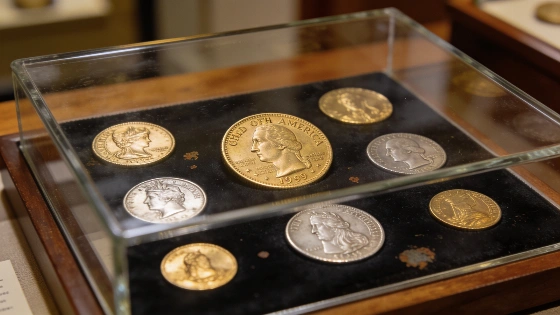
A single 1879 Quintuple Stella led five US coins past the million dollar mark at Heritage's 2026 ANA auctions, as collectors pushed total sales to over $67 million and set new records for American and world rarities
When a single American coin crosses the $2.5 million mark, the entire numismatic world takes notice. At Heritage Auctions' 2026 ANA sales, the 1879 Liberty Head Quintuple Stella did just that-realizing $2,562,000 and shattering its own previous record. But the real story is how this sale, and four other US coins that each broke the million dollar threshold, signaled a new era of collector appetite for extreme rarity, pedigree, and historical significance.
Heritage's August and September auctions in Dallas did not just set records-they redefined them. The US Coins Signature Auction alone generated $39.9 million, while the World & Ancient Coins Auction added $26.4 million, and a physical cryptocurrency sale contributed another $850,798. The combined total: $67,184,066. These numbers are not just impressive-they are a direct reflection of the market's willingness to pay for coins that combine rarity, condition, and story.
Quintuple Stella and the Million Dollar Club
The 1879 Liberty Head Quintuple Stella, cataloged as Judd-1643 and graded PR64+ Deep Cameo by PCGS, is more than a gold coin. With only five known examples-one held by the Smithsonian-it represents an experimental chapter in US monetary history, when the Mint explored metric-based coinage to align with international standards. This particular specimen, from the Bob R. Simpson Collection and once owned by Virgil Brand, now stands as the most valuable of its kind ever sold at auction.
It was not alone. Four other US coins joined the seven-figure ranks: an 1879 Coiled Hair Stella (Judd-1638, PR67 Cameo NGC) at $1,891,000; an 1824/1 Capped Head Left Quarter Eagle (PR67 PCGS) at $1,494,500; a unique 1876 Liberty Double Eagle pattern (Judd-1490, PR64+ Cameo PCGS, CAC) at $1,403,000; and an 1880 Coiled Hair Stella (Judd-1660, PR64 Cameo PCGS) at $1,189,500. Each coin's value was driven by a combination of absolute rarity, top-tier certification, and storied provenance.
For context, the 1824/1 quarter eagle is one of only two known Proofs, with the other held by the Smithsonian. The 1876 Double Eagle pattern is unique, missing even from the most legendary pattern collections. The 1880 Coiled Hair Stella is the rarest of the four major Stella varieties, with just ten traced examples. These are not coins that appear at auction every year-or even every decade.
Beyond the Headliners: Condition and Context
While the million dollar coins grabbed headlines, other results revealed the power of condition rarity and historical context. The 1897-S Liberty Double Eagle, graded MS67 PCGS, CAC, soared to $390,400-obliterating its previous $60,375 record from 2005. This coin, with a direct provenance to Louis E. Eliasberg, Sr. and the Clapp estate, remains in its late-1980s PCGS holder and is the finest known of its date.
Early federal gold also made waves. The unique 1797 Small Eagle Half Eagle, 16 Stars (BD-4, AU58+ PCGS), brought $317,200. Not correctly identified as a separate variety until 1972, this coin is now recognized as unique and serves as the plate coin in the standard reference for early US gold die varieties.
Proof-only issues and mint errors also found new highs. An 1884 Liberty Double Eagle (PR64 Cameo NGC) set a record at $268,400, while a mated pair of 1860-O Seated Liberty Half Dollar and half dime planchet-struck together and surviving as a pair since 1860-realized $219,600. Even a 1914 Proof Lincoln Cent (PR68+ Red PCGS, CAC) from the Bolt Collection reached $195,200, now the most valuable Proof Lincoln cent from the 1909-1916 period.
World Gold and Global Rarities
The World & Ancient Coins Auction was dominated by Scandinavian and Russian gold, with a Christian IV 10 Ducat of 1623 from Glückstadt Mint leading at $561,200. Only four examples of this coin are known, with two held by national museums. A Frederik III gold 10 Ducats (Portugaloser, ND 1668-1669, MS63★ NGC) followed at $512,400, and a 1608 Christian IV gold Sovereign (3 Guilder, MS62 NGC) brought $488,000. These coins rarely appear at public auction, and their results confirm a surge in collector interest for high-grade Scandinavian gold.
Russian and British proof gold also set benchmarks. A Nicholas II gold Proof 25 Roubles (1896, PR61 NGC) realized $390,400, while a George II gold Proof 5 Guineas (1729, PR63 NGC) reached $329,400. Brazilian and Latin American rarities were not left behind: a João VI gold ingot of Mato Grosso (1818, 139.5g) brought $317,200, one of only four such bars believed to remain in private hands. The first date of the celebrated Pillar Dollar series, a 1732 Philip V "Milled" 8 Reales (MS61 NGC), set a record at $207,400.
Ancient gold medallions and rare colonial issues added further depth. A Magnentius AV medallion (AD 350-353, 3-solidi, 13.38g) sold for $268,400, and a Macedonian Kingdom Philip II gold stater (Choice MS★ NGC) set a new type record at $158,600. Brazilian and Mexican rarities, including a Maria I & Pedro III gold 1600 Reis (1780-B, MS64 NGC) and a Zacatecas Ferdinand VII "L.V.O." 8 Reales (1810, AU55 NGC), rewrote auction records for their types.
Physical Cryptocurrency and Conceptual Collectibles
Heritage's physical cryptocurrency auction, anchored by The Otoh Collection, Part VIII, added $850,798 to the week's total. The top lot, a BTCC titanium Loaded (Unredeemed) 1 Bitcoin 2016 (MS69 Antiqued NGC), realized $85,400. This token, loaded before Bitcoin's second halving in July 2016, represents a tangible link to an earlier era of digital currency. Two other loaded full-Bitcoin lots each achieved $82,350.
In a twist, a Kialara "FOMO" Conceptual Post-it Art Note-serial number 01 of 12-sold for $10,980, despite containing no precious metal. The piece, accompanied by an irrevocable IOU for $1,000, forces the owner to choose between redeeming its value and preserving its collectible status. Another contemporary issue, the Polymerbit x Zetra "1206/NOTE" Cold Storage Document, fetched $2,074. These results show that even conceptual and digital artifacts are now part of the broader currency collecting landscape.
Data and Market Signals
Across the three Heritage events, total sales reached $67,184,066 between August 31 and September 5, 2026. The US Coins Signature Auction accounted for $39,918,268, the World & Ancient Coins Auction for $26,415,000, and the Physical Cryptocurrency sale for $850,798. Five US coins each exceeded $1 million, with the top lot-the 1879 Quintuple Stella-realizing $2,562,000. Several world coins, including Scandinavian and Russian gold, crossed the half-million dollar mark, while new records were set for Brazilian, Mexican, and ancient rarities.
What Defines Value in Modern Numismatics
These results make one fact clear: collectors are no longer satisfied with rarity alone. The most sought-after coins now combine absolute scarcity, top condition, historical context, and a pedigree that connects them to legendary collections. The 1879 Quintuple Stella, for example, is not just rare-it is a physical artifact of a failed attempt to align US coinage with international standards, and its ownership history reads like a who's who of American numismatics.
This trend is not limited to the US. Scandinavian gold, Russian proof issues, and Brazilian ingots all found new highs, driven by collectors who value both the story and the object. Even digital and conceptual pieces, such as loaded Bitcoin tokens and art notes, are being absorbed into the market as new forms of currency collectibles.
Heritage's 2026 ANA auctions demonstrate that the market rewards coins and artifacts that offer more than just a low population number. Provenance, preservation, and narrative are now as important as technical rarity. This is a shift that echoes recent developments in US coin design, as the Mint's selection of 37 artists for its Artistic Infusion Program-reported earlier-shows a growing recognition that the story behind a coin can be as valuable as the metal itself.
Experimental patterns like the Quintuple Stella highlight a period when the United States considered aligning its gold coinage with the metric system, aiming for compatibility with international standards. The "Stella" series, including the $4 and $20 patterns, was never adopted for circulation, but these coins now serve as tangible evidence of 19th-century debates over monetary policy and global integration. Their rarity is not just a matter of mintage, but of historical contingency-most patterns were melted or lost, leaving only a handful for collectors and museums. Today, their value is shaped by both their technical features and their place in the broader narrative of currency evolution.