
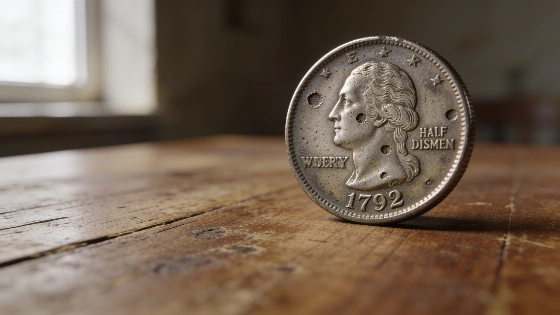
A high-grade 1792 half disme has exposed overlooked die reworking and chemical etching at the dawn of US federal coinage, challenging long-held assumptions about early minting technology and craftsmanship
Fresh evidence from a rare 1792 half disme is changing what we know about the first US coins. A close look at a high-grade example shows that engravers at the Philadelphia Mint used more advanced methods than most people thought. They fixed mistakes in the coin's denomination with gang punches and acid etching. This goes against the old idea that these coins were just rushed products from a new mint. The 1792 half dismes are the first silver coins made by the US federal government after the Coinage Act passed on April 2, 1792. That law set up the US Mint and brought in a decimal currency system. The half disme was worth 1/20 of a dollar, according to the U.S. Mint and FedLaws.
Collectors and researchers have told the same stories about the 1792 half disme for years. They talk about its legendary status, where the silver came from, and how Chief Coiner Henry Voigt supposedly rushed the job. But this newly studied coin tells a different story. It's more complicated. On July 9, 1792, about 1,500 half dismes were struck. Thomas Jefferson wrote down that he delivered $75 in silver to the Mint and got the whole batch back just four days later. The process was fast and experimental. That's a fact from FedLaws.
Hidden layers in the die
At a recent World's Fair of Money® convention, a collector brought in a 1792 half disme made from a late die state. Under magnification, the coin showed faint traces of misplaced letters above "HALF DISME." Raised shapes that look like the S, A, I, and M from "DISME" sit above and around the main inscription. The area is rough and pitted. This pattern-called spalling-means the die surface chipped and flaked. The original denomination was punched too high. The engraver then reworked the die to fix it. Early Mint workers often had to improvise. They were still figuring out how to do things right. Later, the US Treasury and, in modern times, the Federal Reserve System would set stricter standards.
The engraver didn't swap out the die or polish it smooth. Instead, acid was used to dissolve the unwanted letters. This left a chemically changed surface. After more use, the die started to flake and chip. That's why late die state coins show this odd texture. The ghost letters line up in a way that points to a gang punch-a tool that stamps several letters at once. Not single punches. That takes skill. Early Mint engravers don't always get credit for that. They had to work fast and save resources. That need for efficiency still shapes how central banks and mints operate today. You can see it in the policies of the Federal Reserve and the European Central Bank (ECB).
Technical evidence and mint practices
This half disme gives a rare look at how the 1792 mint worked. The ghost letters, their shape, and the spalling all show that acid etching was used to fix a misplaced denomination. This method was quicker and wasted less than making a new die. The Mint had little time and few resources. Still, there's no official technical report or statement from the US Mint confirming these exact methods. These findings come from the researcher's physical study of the coin. They are not official facts from the Mint.
These details challenge the idea that early US coins were just the result of rushed improvisation. The evidence shows a mix of experimental metallurgy, chemical fixes, and practical problem-solving. Using a gang punch shows the engravers wanted speed and consistency. They were already looking for ways to work smarter, even as the Mint was just getting started. That drive for innovation would later shape US monetary policy. The Federal Reserve and other central banks now use complex tools to manage currency stability, interest rates, and inflation. The Federal Reserve's monetary policy resources document this evolution.
Comparisons and historical context
Physical analysis is still the best tool in numismatic research. This case proves it. The discovery of acid etching and die reworking on the 1792 half disme matches other moments in US coin history. Sometimes, technical errors and fixes only come to light decades later. For example, a 2004 proof dime error was found years after it left the Mint. Even modern coins can slip through with big mistakes. The move from experimental coins to standard production went hand in hand with the rise of formal monetary policy. Now, the Federal Open Market Committee (FOMC) and the ECB's inflation targets are key to global currency and bond markets.
The 1792 half disme is often seen as a simple relic from the Mint's first days. That's not the whole story. The new evidence shows its production took real skill in metallurgy, chemistry, and engraving. The coin's surface tells how engravers adapted and solved problems. Not just how they rushed under pressure. The first regular American silver dimes didn't appear until 1796. The 1792 half dismes were a short, pre-standard series, as shown by Executive Coin.
Facts and data
The 1792 half disme was made before the Philadelphia Mint's official coinage. That was 234 years ago. The coin shown at the World's Fair of Money® convention came from a late die state. You can see spalling and ghost letters. The die was reworked with acid to erase misplaced denominations, then put back to work. These findings come from direct study and overlay analysis of the coin. Auction records show a specimen graded MS68 sold for $1,985,000 in September 2018. An MS66 example brought $793,125 in 2013. The coin's value and importance are clear, as reported by Men's Journal.
Die reworking means fixing mistakes in coin dies-the metal pieces that stamp coins. In the late 1700s, engravers sometimes used acid to remove unwanted parts from a die. This could make the metal brittle. After repeated use, the die might flake or chip. Gang punches, which stamp several letters at once, saved time but could lead to mistakes. The 1792 half disme shows both methods. Early US minting was experimental. Engravers had to work with what they had and adapt to new technology. As the US Mint grew, its methods changed. Oversight from the US Treasury and, later, the Federal Reserve shaped these changes. Today, policy statements and meeting minutes from these institutions are key to understanding currency stability and foreign exchange.