The 1806 Draped Bust Quarter stands out for its ten die marriages, a bold eagle redesign, and rare varieties like the B-8, which fetched $7,200 even in worn condition. Its survival rate and collector appeal make it a key piece in US currency history
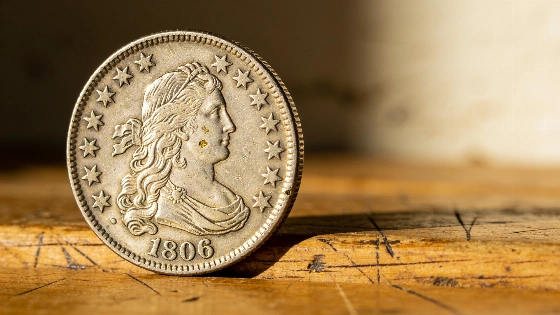
In March 2026, a battered 1806 Draped Bust Quarter graded Good-4 brought $7,200 at auction. The price had nothing to do with its condition. It was a Browning-8, one of the rarest die marriages in early US coinage. This coin is often dismissed as common. That's a mistake. The 1806 quarter hides ten die marriages, a sharp change in national symbols, and the only overdate in the Draped Bust quarter series. For collectors, it's a window into the chaos and creativity of early American money.
Most collectors can actually find an 1806 quarter. The biggest rarities in early US silver cost six or seven figures. The 1806 issue is different. It's a real shot at owning a piece of history. But the B-8 auction proves something else. Even a worn-out coin can become a trophy if the die pairing is right. Greysheet reports that only a few thousand examples of each date from 1805 to 1807 survive. That's not many. Collector demand stays high for these coins, as shown in Greysheet pricing data.
Die marriages and the Browning system
The 1806 quarter stands out for its production quirks. There are ten known die marriages for this date. Each gets a Browning number, B-1 through B-10. Ard W. Browning set up this system in 1925. It tracks which obverse and reverse dies the Philadelphia Mint paired up. These aren't just numbers. They drive the hunt for rare coins and spark bidding wars. The B-10 wasn't even known when Browning wrote his book. New finds still happen. The story isn't finished.
The B-1 is the only overdate in the Draped Bust quarter series. Mint workers reused an 1805 die and punched a 6 over the 5. The 5 still shows. Collectors chase this variety, both for the overdate and the story behind it. Top-grade examples have sold for $188,000. Even lower-grade coins matter for their history. Greysheet calls the 1806 Over 5 the most popular and important Draped Bust quarter variety. Collectors treat it as a separate type because the overdate is so clear and the minting process so unusual.
The eagle redesign and production surges
The 1806 quarter marks a big change in American symbols. The first quarters, like the 1796, had a natural-looking Small Eagle on the back. By 1804, the Mint switched to the Heraldic Eagle, based on the Great Seal. The new design shows a shield, arrows, olive branch, and the motto E PLURIBUS UNUM. It's a bolder look. The reverse finally spells out "25 C." so people knew the value. At the time, Spanish colonial silver still ruled the market. The Federal Reserve notes in its historical reviews that foreign coins, especially Spanish silver, kept circulating in the US well into the 1800s.
The Mint struck 206,124 quarters in 1806. Only the 1807 issue had more in the Draped Bust series. But most didn't survive. PCGS says about 4,750 regular 1806 quarters exist in all grades. Only 55 are MS60 or better. Just two reach MS65 or higher. Early minting was rough. Open collars, uneven rims, and weak strikes were common. High-grade coins are rare. The best regular-date coin, a Browning-9 PCGS MS65 CAC, sold for $102,000 in 2018. Another Gem brought $81,562.50 in 2023. The market is thin. Price depends on condition and die variety, as the 2025-2026 Greysheet catalogs confirm.
Why AU58 matters for collectors
AU58 is the sweet spot for many collectors. These coins keep much of their original shine and detail. They fall just short of Mint State but don't cost as much as the top grades. In June 2025, an 1806 B-3 graded PCGS AU58 sold for $9,000. It had frosty surfaces and a strong strike. AU58 coins look almost Mint State but stay within reach. Die marriage, strike, and eye appeal still matter, but AU58 is a practical goal. The European Central Bank points out in its research that collector demand for rare coins often tracks bigger trends in asset diversification, especially during times of currency swings. That was true in early 1800s America.
The 1806 Draped Bust Quarter weighs 6.74 grams and measures 27.5 mm across. It's 89.24% silver and 10.76% copper. All were struck at the Philadelphia Mint with no mintmark. The edge is reeded. The reverse shows the Heraldic Eagle. Every die marriage is a business strike.
Rarity, survival, and the collector's challenge
The B-8 die marriage is the rarest of the bunch. Only 11 examples were recorded in a 2010 reference. Its reverse stands out. There's a repunched mark at the lower-left of the C in "25 C." and the olive branch stem touches the C. Advanced collectors chase it. The $7,200 sale of a Good-4 B-8 in 2026 proves that die variety can matter more than condition. This isn't just an 1806 quarter thing. Other US coins show the same pattern, as reported earlier with the Civil War Two Cent Piece and its hidden Indian Head cent portrait.
Even though the Mint made over 200,000 quarters in 1806, few survived. Early production was spotty. Silver depositors wanted bigger coins. Spanish colonial coins still dominated trade. Quarters got ignored. After 1807, the denomination disappeared until 1815, when the Capped Bust design arrived. Every 1806 quarter that survives is a piece of a country still figuring out its money. Each die marriage tells a story of reuse, repair, and the rough reality of early minting. The International Monetary Fund (IMF) has shown how the lack of standard coins and the use of foreign silver made early US monetary policy a headache. The 1806 quarter's rarity and variety reflect that struggle.
This coin is more than a collectible. It's a record of a nation's changing identity, technical ambition, and economic risk. For collectors, a nice AU58 gives history, rarity, and eye appeal. It's close to Mint State, so you see Robert Scot's design as it looked two centuries ago. But it doesn't cost as much as the top rarities. The coin's story-overdates, die marriages, and a new eagle-keeps it at the center of early US silver collecting. For more on how US coinage and monetary policy evolved, see the Federal Reserve's monetary policy resources.
Die marriages are key in early US coin collecting. Each one is a unique pairing of obverse and reverse dies. That means small changes in numbers, letters, or design details. Dies wore out, cracked, or got reused. New combinations appeared. Sometimes you see overdates or repunched marks. The Browning system, still used today, helps collectors spot and track these differences. What looks like a single coin issue turns into a complex puzzle. This focus on die variety sets early US coin collecting apart. Later coins, made in huge numbers with better controls, don't offer the same surprises.