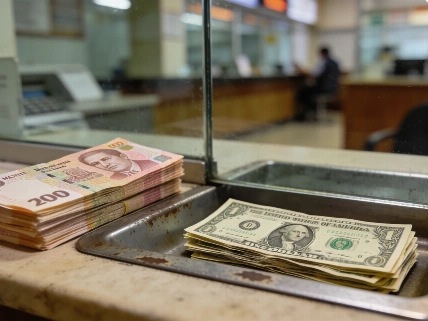

Major currencies including the US dollar, euro, and Australian dollar remained stable as traders weighed weak US jobs data, rising oil prices, and geopolitical risks ahead of a key US inflation report that could shape global monetary policy
Currency markets paused on Tuesday as the US dollar, euro, and Australian dollar all traded in narrow ranges, reflecting a period of uncertainty ahead of a critical US inflation release. The Dollar Spot Index was little changed at 99.84, while the euro hovered near $1.1540 and the Australian dollar held at $0.7055. This stability followed a series of conflicting signals, including a surprise contraction in US employment and renewed geopolitical tensions in the Persian Gulf, leaving traders reluctant to take strong positions before new data emerges.
Recent US labor market figures have shifted expectations for Federal Reserve policy. The US Labor Department reported a loss of 23,000 jobs in July, with previous months' numbers revised sharply lower. This unexpected weakness led many market participants to scale back bets on a September interest rate hike, causing US Treasury yields to fall and the dollar to retreat from its recent highs. However, the dollar's decline has been limited by a surge in global energy prices, as oil benchmarks climbed to multi-week highs amid diplomatic deadlock over the Strait of Hormuz.
Geopolitical Risks and Central Bank Responses
Diplomatic efforts to resolve shipping tensions in the Strait of Hormuz stalled after the US administration introduced new conditions to an Iranian-Oman proposal, including demands for compensation from Tehran for regional conflict damages. The resulting uncertainty has kept oil prices elevated, raising concerns about persistent inflation pressures in major energy-importing economies such as those in Europe and Asia. These developments have complicated the outlook for central banks already facing mixed economic signals.
In Australia, the Reserve Bank of Australia (RBA) left its benchmark cash rate unchanged at 4.35%, as widely expected. RBA Governor Michele Bullock acknowledged that underlying inflation in the second quarter was softer than forecast, but emphasized that ongoing price pressures require vigilance. The Australian dollar remained steady, with the RBA reiterating its willingness to raise rates again if inflation risks intensify.
Eurozone Awaits Key Data
The euro traded in a tight range as European currency desks weighed domestic economic momentum against external shocks from higher energy costs. Market participants are now focused on a series of upcoming releases, including second-quarter GDP figures for the euro area and final July inflation data from Germany, France, and Spain. These indicators will help clarify whether the European Central Bank can maintain its current policy stance at its next meeting in September.
For context, recent coverage of Asian currency movements highlighted how the South Korean won weakened as the US dollar gained ground and the Japanese yen lost some of its intervention-driven strength. This shift in sentiment was closely linked to expectations for US inflation and Federal Reserve policy, as discussed in a recent analysis of Asian currency trends.
All Eyes on US Inflation
Attention now turns to Wednesday's US Consumer Price Index (CPI) report, which is expected to show a 0.2% month-on-month increase in core inflation. A softer-than-expected reading would reinforce the view that a cooling labor market is helping to contain price growth, potentially allowing the Federal Reserve to extend its pause on rate hikes. Conversely, a stronger inflation print could reignite debate over the timing and scale of future policy moves, with ripple effects across global currency and bond markets.
According to the latest available data, the Dollar Spot Index was unchanged at 99.84 on Tuesday, the euro traded near $1.1540 against the US dollar, and the Australian dollar held at $0.7055. The Reserve Bank of Australia's policy rate remains at 4.35%, while US labor data for July showed a net loss of 23,000 jobs, contributing to a reassessment of near-term Federal Reserve policy expectations.
Central banks face a complex balancing act when inflation and growth signals diverge. While a weaker labor market can ease inflationary pressures, external shocks such as rising energy prices may keep headline inflation elevated even as domestic demand slows. This dynamic complicates policy decisions, as central banks must weigh the risks of tightening too much against the dangers of falling behind on inflation. The coming weeks will test whether policymakers can maintain stability as new data and geopolitical developments unfold.