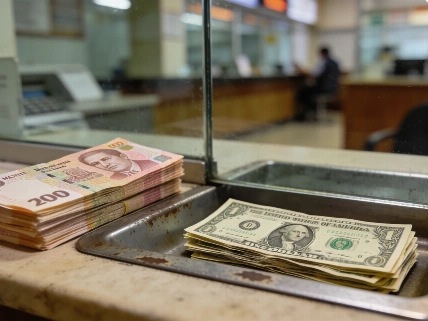


The South Korean won led declines among Asian currencies as the US dollar gained ground and the Japanese yen lost recent intervention-driven strength. Investors are watching upcoming US inflation data for signals on future Federal Reserve policy.
The South Korean won recorded the sharpest decline among major Asian currencies at the start of the week, as the US dollar regained momentum and the Japanese yen reversed part of its recent intervention-fueled recovery. Market participants are closely monitoring upcoming US inflation figures, which are expected to influence the Federal Reserve's next policy steps and, by extension, global currency markets.
The US Dollar Index, which tracks the dollar against a basket of major currencies, edged up by 0.18% to 99.72, remaining near its lowest level since early June. This modest rebound followed a weaker-than-expected US jobs report, which reduced the likelihood of a Federal Reserve rate hike in September. According to market pricing, the probability of a September rate increase has fallen to around 44%, down from 67% just a week earlier. The US economy unexpectedly lost jobs in July, and previous months' employment gains were revised lower, adding to uncertainty about the Fed's policy direction.
Won and Yen Under Pressure
The South Korean won was the weakest major Asian currency in early Monday trading, with the USD/KRW exchange rate rising 0.54% to 1,415.05. This movement reflects both the dollar's renewed strength and specific pressures on the won, including higher oil prices. Brent crude approached $84 per barrel amid ongoing uncertainty over the reopening of the Strait of Hormuz, a key energy shipping route. South Korea's significant dependence on energy imports makes the won particularly sensitive to changes in global fuel costs.
The Japanese yen also weakened, with the USD/JPY pair climbing 0.30% to 158.27. The yen has now surrendered much of the ground gained after the recent coordinated intervention by Japan and the United States, which was the first such action since 1998. That intervention, triggered when the yen fell to a four-decade low near 164 per dollar, briefly pushed the currency as high as 155 per dollar. However, the yen has since slipped back above 158, highlighting the challenges of sustaining intervention-driven gains when underlying factors-such as wide US-Japan interest rate differentials, Japan's fiscal outlook, and geopolitical risks-continue to weigh on the currency. For a deeper look at the limits of recent yen support, see this analysis of structural obstacles facing US-backed yen intervention.
So far in August, the yen has fallen about 0.5% against the dollar after gaining 3.2% in July. The upcoming Japanese public holiday could add to volatility, as thinner trading conditions often lead to sharper currency moves. Meanwhile, the Bank of Japan's July meeting summary indicated growing support among policymakers for faster rate hikes in response to rising inflation risks.
Australian and Regional Currencies Await Policy Signals
The Australian dollar remained under pressure ahead of the Reserve Bank of Australia's policy decision, with the AUD/USD pair slipping 0.14% to $0.7058. The New Zealand dollar also weakened, with NZD/USD down 0.2% to $0.5884. The Reserve Bank of Australia is widely expected to keep its key policy rate unchanged at 4.35%, but investors are focused on the central bank's guidance for clues about the future path of rates and inflation.
Other Asian currencies saw mixed moves. The USD/CNY pair edged 0.05% higher to 6.7464, while the USD/SGD rose 0.13% to 1.2796. The Indian rupee also slipped, with USD/INR up 0.03% to 95.226, and the Thai baht saw a slight gain, with USD/THB down 0.08% to 33.005. These shifts reflect a combination of local factors and broader market anticipation ahead of key US economic data releases.
Key Data Ahead: US Inflation in Focus
Attention now turns to Wednesday's US Consumer Price Index (CPI) report, which is expected to provide the next major test for the Federal Reserve's policy outlook. Consensus forecasts suggest that core CPI will rise 0.2% month-on-month in July, bringing the annual rate to 2.5%, down slightly from 2.6% in June. Additional data on US producer prices and retail sales, due later in the week, will offer further insight into inflation trends and consumer demand.
For the South Korean won, Japanese yen, and other Asian currencies, the direction of US monetary policy remains a central driver. Any surprise in US inflation or policy guidance could trigger renewed volatility across the region's exchange rates, especially for currencies exposed to energy prices or sensitive to global risk sentiment.
On Monday, the USD/KRW rate rose 0.54% to 1,415.05, marking the won as the weakest major Asian currency in early trade. The USD/JPY climbed 0.30% to 158.27, while the US Dollar Index increased 0.18% to 99.72. The probability of a US Federal Reserve rate hike in September dropped to 44% following a weaker July jobs report, compared to 67% a week earlier. Brent crude oil traded near $84 per barrel, adding pressure to energy-importing currencies like the won.
Currency intervention is a tool used by central banks or governments to influence the value of their currency, often through direct buying or selling in the foreign exchange market. While such actions can produce sharp short-term moves, their lasting impact depends on underlying economic fundamentals, such as interest rate differentials, fiscal policy, and market confidence. In the case of the Japanese yen, recent coordinated intervention with the United States temporarily strengthened the currency, but persistent structural factors-including Japan's low interest rates relative to the US and ongoing fiscal challenges-have limited the durability of these gains. Intervention is most effective when it aligns with broader policy shifts or when market participants believe it signals a genuine change in direction, rather than a temporary defense of a particular exchange rate level.