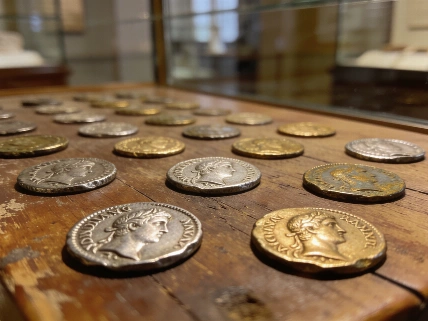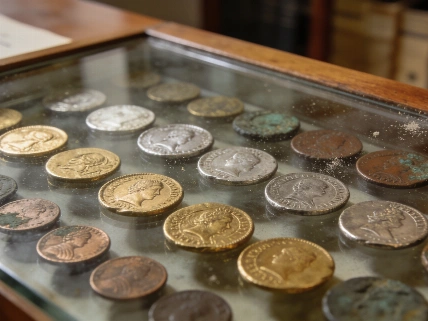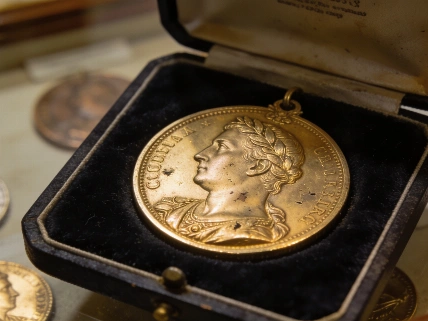
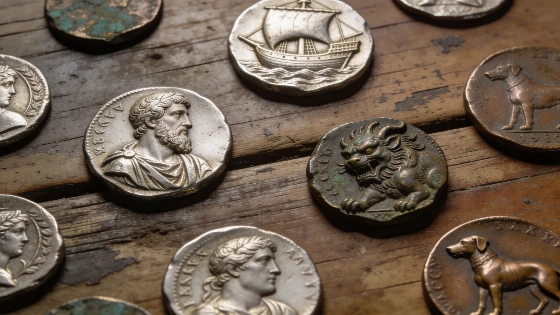
Homer's face, mythical monsters, and epic scenes turned ancient coins into portable stories. These rare pieces reveal how money became a tool for rivalry and mythmaking among Greek and Roman cities.
A battered silver didrachm from Ios reportedly fetched CHF 360,000 in 2022. That number made headlines in collector circles. But there's a catch. No official auction house or museum has confirmed the sale, as recent research points out. Still, the coin's draw is clear. It carries an idealized portrait of Homer, the poet whose words shaped Western literature. This is just one case. Ancient coins became a way for cities and empires to fight over Homer's legacy and stamp the Odyssey's most haunting moments onto metal. ECB statistical data backs up the importance of currency as a cultural tool.
Homer's world was full of gods, monsters, and wanderers. But coins didn't exist in western Asia Minor until the seventh century BCE-long after the Trojan War's supposed era. As Homer's poetry became the backbone of Greek and Roman culture, his stories and characters started to appear on coins. These coins traveled farther and lasted longer than any scroll. They outlived monuments. Today, central banks like the Federal Reserve and Bank of England track how money moves and circulates. They know coins' durability and reach matter for policy.
Competing claims and civic pride
Greek cities fought to claim Homer as their own. Smyrna, Chios, Cyme, Colophon, Athens, and Ios all wanted the honor. Their rivalry showed up on their coins. Smyrna's silver drachm from around 190/189-180 BCE shows Homer seated with a scroll. Apollo appears on the other side. Homer looks blind but holds a written text. The image hints at the old debate: did the epics come from oral tradition or written word? In 2023, this coin sold for over $28,000. That price reflects more than rarity. It shows the value of cultural ownership. But, like the Ios didrachm, there's no independent confirmation from major auction houses or regulators. Federal Reserve policy resources note the need for caution with such figures.
Cyme, near today's Aliağa in Türkiye, minted a Roman-era bronze assarion under Commodus (about 184-190 CE) with Homer's name and face. Ios, the Cycladic island said to be Homer's grave, produced what many experts call the best portrait of the poet. The didrachm's late Classical style and its BCD Collection pedigree made it even more desirable. Each coin acted as a traveling ambassador. It carried a city's claim into distant markets and army camps. That was soft power in metal.
Odysseus and the currency of myth
Roman coins brought the Odyssey's most moving scenes to life. In 82 BCE, C. Mamilius Limetanus issued a silver serrate denarius. It shows Ulysses (the Roman Odysseus) meeting his dying dog Argos. The moment is pure recognition and loss. The Mamilian family claimed descent from Odysseus's son Telegonus. Their coin design was about lineage as much as art. The serrated edge may have been meant to stop forgers, but even ancient counterfeiters made plated copies. The real reason for the edge is still debated.
Emperor Trajan brought back this design almost 200 years later. His rare restitution denarius dropped the serrated edge but kept the heart of the scene: Ulysses and Argos, Mercury on the front, and a long inscription naming both Trajan and the original moneyer. Only a few of these coins survive. They're even harder to find than the Republican originals.
Other coins turned to the Odyssey's monsters. Sextus Pompey, fighting for Sicily during Rome's civil wars, struck a denarius around 37-36 BCE with Scylla. She's part woman, part fish, with snarling dogs and a ship's rudder. The image nods to Homer and signals naval power in the Strait of Messina. Later, big Roman bronze contorniates showed Scylla attacking Odysseus's ship. Myth became action on metal.
Symbols, sacrifice, and the price of home
The Odyssey's sirens, whose song doomed sailors, appeared on an electrum stater from Kyzikos (about 550-500 BCE). The siren, half bird and half woman, holds the city's tunny fish symbol. Ithaka, Odysseus's rocky home, issued rare bronze coins in the fourth and third centuries BCE. Some show the hero's pointed cap. One pairs him with Zeus's thunderbolt. In September 2024, a fourth-century example sold for $4,750. That's a direct link between legend and local pride.
Not every coin scene is clear. A tiny electrum hekte from Kyzikos (about 450-330 BCE) shows a man in a pilos cap sacrificing a ram. Is it Odysseus preparing for his trip to Hades? Or Phrixus, another mythic traveler? No one knows for sure. Kyzikos made hundreds of coin designs, most with little to do with its own history except for the ever-present tunny fish. The mystery only adds to the appeal.
Facts and figures: the market for myth
Coins with Homer and the Odyssey fetch big sums at auction. The Ios didrachm is said to have sold for CHF 360,000 (about $370,000) in 2022. The Smyrna drachm reached CHF 26,000 (over $28,000) in 2023. A rare Kyzikos electrum stater with a siren brought £3,200 in 2017. A fourth-century BCE Ithaka bronze sold for $4,750 in 2024. These prices show the strong demand for coins that blend literature, art, and civic ambition. But recent research warns that these numbers should be viewed with care. There's a lack of official auction or regulatory confirmation.
For collectors and historians, these coins are more than old metal. They show how money became a way to tell stories, compete, and keep cultural memory alive. As reported earlier, the fate of historic coin collections often depends on changing laws and collector tastes. But the pull of myth on metal never fades. The International Monetary Fund (IMF) and Bank for International Settlements (BIS) study how history and culture shape currency value and cross-border flows. Narrative and identity still matter in global finance.
Why the Odyssey still matters for money
Coins outlast rulers and regimes. They even outlast the languages of their legends. The Odyssey's journey from spoken tale to coin design shows that money can keep stories alive. Odysseus's cap, the sirens' song, Scylla's jaws, Argos's loyalty-these details survive in silver, bronze, and electrum. They keep circulating long after the old stories faded.
For today's observer, ancient coins prove that money is more than a way to pay. It's a canvas for identity. It's a tool for rivalry. It's a record of what people choose to remember. The Odyssey's place on coins isn't just a collector's oddity. It's a window into how cultures use money to claim, contest, and remember their place in history. Central banks like the European Central Bank and the Federal Reserve still study the symbols and uses of currency. They know the stories money carries can shape both how people see it and how policy is made.
Ancient coins offer a rare look at the crossroads of art, politics, and money. Unlike modern banknotes, which are usually standardized and centrally issued, Greek and Roman coins often showed the ambitions and identities of single cities or families. Designs could advertise local myths, make political claims, or honor legendary ancestors. Coins traveled across regions, spreading these messages. That made them powerful tools of soft power and cultural diplomacy. The Odyssey's move onto coins proves that money can be both an economic tool and a vessel for memory. The story lives on in metal.