
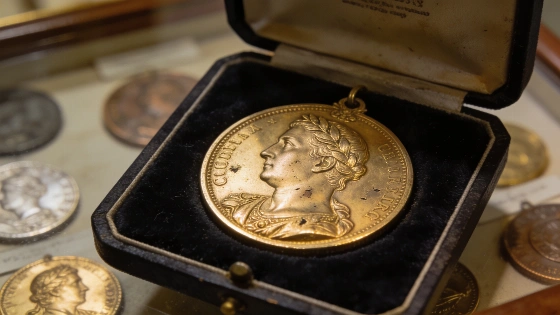
A 104-gram gold medal from the 1858 royal wedding of British and Prussian royalty, traced to the Hohenzollern Imperial Collection, headlines Atlas Numismatics' new fixed-price list spanning over two thousand years of coin history.
The 1858 gold royal wedding medal now leads Atlas Numismatics' latest fixed-price list, notable for both its size-104.18 grams-and its historical connections. This medal links two royal families and reflects the shifting alliances of 19th-century Europe. Its gold content and rarity set it apart in the collectibles market, where central banks like the Federal Reserve and the European Central Bank (ECB) keep a close eye on gold prices through their monetary policies.
The medal was struck to commemorate the marriage of Prince Friedrich Wilhelm of Prussia and Victoria, Princess Royal of Britain. Designed by Friedrich Wilhelm Kullrich, it shows the couple's busts on the front and a detailed scene of them kneeling before an angel on the back, with both the Prussian and British coats of arms below. The wedding took place at the Chapel Royal, St James's Palace on January 25, 1858, just over a decade before the unification of Germany. Friedrich Wilhelm would later become German Emperor Friedrich III, tying the medal to major changes in European politics and currency.
Imperial provenance and survival
This medal's documented history adds to its appeal. Atlas Numismatics traces it to the Imperial Collection of the Hohenzollern Museum at Monbijou Palace in Berlin, with inventory numbers HM 299 and MKB 1504, and links it to the estate of Kaiser Wilhelm I. The Hohenzollern collection was moved from Monbijou Palace to the Berlin City Palace near the end of World War II, seized by Soviet forces, and returned to East Berlin in 1958, where it stayed mostly out of public view at the Bode Museum. Only in 2025 was the fate of many pieces, including this medal, formally settled. The medal's journey reflects the broader upheavals in European currencies and institutions during the 20th century, as noted in ECB historical reviews.
Graded MS64 DPL (Deep Prooflike) by NGC, Atlas lists this as the highest-graded example at NGC as of September 2026. References include BHM-2624 Variant (Gold), Marienburg 6491 (in silver), Sommer K 22, and Mues/Olding 770. The price is $89,500, reflecting its rarity and provenance. Gold prices have moved sharply in recent years, with central bank reserves and currency interventions shaping the market. The ECB reference exchange rates show ongoing volatility in gold and major currencies as monetary policy and inflation expectations shift.
Ancient to modern highlights
The new Atlas Numismatics list includes more than just royal gold. Among the 358 coins, medals, and tokens are pieces from over two thousand years of history: an ancient Paeonian silver tetradrachm, a 1646 Christian IV gold ducat with a Hebrew inscription, an 1812-A French 20 Francs of Napoleon I in mint state, a 1697 silver medal from Lübeck honoring four mayors, a 1692 William and Mary silver Crown, and a 1666 silver Filippo of Milan from the childhood of Carlo II of Spain. This range shows the ongoing appeal of numismatics as both a record of history and a collector's pursuit, even as institutions like the Bank of England and the International Monetary Fund (IMF) track the evolution of physical and digital currencies.
For collectors watching how coin collecting is changing, the story of this medal echoes themes in recent analysis about digital authentication and the decline of physical cash. Still, the presence of a substantial, gold artifact with clear provenance shows that physical coins and medals continue to attract attention and value, even as the field adapts.
Market context and data
Atlas Numismatics updates its online inventory monthly, offering a wide range of coins and medals. The 1858 gold wedding medal, weighing about 30 ducats and measuring 51 mm, is priced at $89,500. As of September 2026, it is the highest-graded example at NGC. The current list includes 358 items, with highlights from ancient Greece to early modern Europe, reflecting the depth of today's numismatic market. Interest in high-value collectibles is shaped by macroeconomic factors, including inflation indices like the Consumer Price Index (CPI) and sovereign bond yields, which central banks monitor for their effect on asset prices and investor behavior.
Collectors interested in these pieces or future releases can subscribe to Atlas Numismatics' monthly newsletter for updates on new additions and market trends.
The intersection of royal history, political alliances, and numismatic artistry in this medal offers a rare opportunity for collectors and historians. While digital technologies and changing payment habits are reshaping coin collecting, the value of physical artifacts-especially those with clear provenance and historical depth-remains strong. The 1858 gold wedding medal shows that, even as the field changes, tangible currency and medals still connect past and present in ways digital assets cannot.
Commemorative medals like the 1858 royal wedding piece are fundamentally different from circulating coins. Coins are made for daily transactions and must meet strict standards for denomination, weight, and composition. Medals, by contrast, are usually produced to mark specific events, anniversaries, or achievements. Their value depends more on historical context, craftsmanship, and provenance than on face value. In this case, the medal's ties to British and Prussian royalty, its survival through war and political change, and its documented journey through major European collections all add to its significance. For collectors, understanding these differences helps explain why some medals command high prices and why their stories last long after their original purpose has faded.