
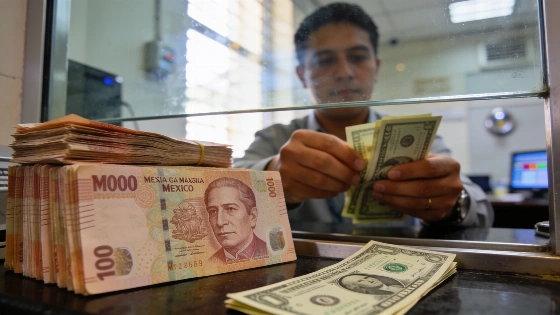
UBS now sees the USD/MXN at 17.50 by year-end, dialing back expectations for a peso rebound as Mexico's rate advantage over the US shrinks and global markets shift.
UBS has changed its view on the Mexican peso. The bank now expects the USD/MXN exchange rate to hit 17.50 by December. That's a more cautious stance than before. The peso has struggled to recover after a rough stretch. Higher global yields have chipped away at Mexico's interest-rate edge. Analysts are rethinking how tough the road ahead could be. The Bank of Mexico (Banxico) just kept its main rate at 6.50% for the third straight meeting. It also dropped its earlier hint that rates would stay on hold for a long time. That move rattled markets, as Reuters reported.
The Federal Reserve's latest numbers show the peso's weakness. The USD/MXN jumped from 17.2252 on 21 September to 17.6932 by 25 September. UBS's new December target of 17.50 is still below that late-September spike. The bank expects some recovery, but not the strong bounce it once predicted. UBS also raised its March 2027 forecast to 17.40. The June and September 2027 targets stay at 17.20.
Interest-rate gap narrows
Mexico's higher rates have long drawn foreign investors. The peso became a favorite for carry trades-where investors borrow in low-rate currencies and buy higher-yielding ones. That edge is fading. As global yields climb, the gap between US and Mexican rates has shrunk. The week before Banxico's September meeting, the peso lost about 3%. The rate difference between Banxico and the Fed dropped to just 2.50-2.75 percentage points. It used to be much wider. Carry trades still work, but the payoff is smaller. Banxico and the Federal Reserve both flagged this shift in recent updates.
UBS thinks Banxico will stick to its own plan. The bank expects Mexico's policy rate to stay at 6.50% through 2026. Banxico is watching local economic signals, not just following the Fed. In September, Banxico held rates steady but dropped its old promise of a long pause. That signals more flexibility. Banxico still sees inflation falling back to its 3% goal, but not until late 2027. The central bank warns that inflation risks are still tilted upward.
Other banks see things differently
UBS is not alone, but some banks are more upbeat. Goldman Sachs predicts the USD/MXN at 16.75 in three months, 17.00 in six months, and 17.25 in a year. That's a bit stronger than UBS's September 2027 call. These splits show how uncertain the peso's path is. Banxico Governor Victoria Rodríguez Ceja says the peso's recent drop won't push inflation above what's already in the bank's forecasts. Banxico still expects inflation to slowly fall toward 3%.
UBS points to two big risks for the peso's rate appeal. A sharp US slowdown could hurt. Trade fights under the United States-Mexico-Canada Agreement (USMCA) could also weigh on the currency. Either would put new pressure on the peso. On the flip side, if investors keep taking risks and US policymakers send positive signals, the peso could bounce back. UBS warns that carry income helps, but a steep peso drop can wipe out those gains fast.
Peso's slide and the bigger picture
Other banks have noticed the peso's recent fall. Crédit Agricole expects the Mexican currency to keep weakening through 2027. The bank sees a roughly 9% drop against the US dollar, as reported earlier. This fits a wider rethink of Latin American currencies as global markets tighten and US policy stays uncertain.
The numbers are clear. The USD/MXN shot up from 17.2252 to 17.6932 in just four days in late September. After Banxico's September meeting, the peso hovered near 17.7 per dollar. Some reports put it at 17.7152. UBS's new targets-17.50 for December 2026 and 17.40 for March 2027-show that while a rebound is possible, easy wins for peso holders may be gone for now. That's a big shift.
UBS's steady June and September 2027 forecasts at 17.20 suggest the bank sees a chance for the peso to settle down if outside shocks stay away and Mexico's policies hold up. But the shrinking rate gap and risk of US economic or trade trouble keep the outlook shaky. Banxico's next policy meeting is set for 5 November 2026. The last meeting of the year lands on 17 December. Minutes from the September meeting will come out on 8 October.
Carry trades: how they work and what's at stake
Carry trades mean borrowing in a currency with low rates and investing in one with higher rates. The peso has often been a target because Mexico's rates are high. But these trades only pay off if the exchange rate stays steady. If the peso drops hard, losses can pile up fast. As global yields rise and the US-Mexico rate gap narrows, the risk for peso carry trades grows. Anyone exposed to the USD/MXN rate needs to watch policy moves and outside shocks closely. The balance is shifting.