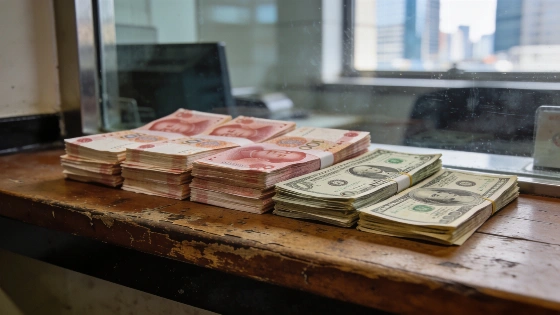
UBS expects the US dollar to fall further against the Chinese yuan, projecting a USD/CNY rate of 6.50 by mid-2027 as strong exports and policy support outweigh low inflation and interest rate differences.
UBS now forecasts that the US dollar to Chinese yuan (USD/CNY) exchange rate could reach 6.50 by mid-2027, a further drop in the dollar's value against the yuan. If this plays out, it would mean a 3.1% decline from current levels. In early September, the yuan traded near 6.71 per dollar on the spot market. Despite strong export numbers, the currency has not seen a sharp revaluation so far, and market reaction has been muted (CNBC).
UBS does not see interest rate differences as the main driver. The yuan still faces a negative rate gap compared to the dollar. Instead, the bank points to China's rising export receipts and the People's Bank of China's (PBoC) willingness to allow gradual appreciation. UBS expects the USD/CNY to fall to 6.60 by the end of 2026 and then to 6.50 by mid-2027. Over the past year, the pair has already dropped more than 4%. The PBoC continues to manage the yuan with a controlled floating regime. For 8-9 September, the central parity rate was set at 6.7804 against the dollar, with a trading band of ±2% around this reference, according to Reuters and official releases.
Exports outpace domestic weakness
China's exports remain strong. In August, customs data showed exports up 25% year-on-year in US dollar terms, while imports rose 28.2%. Both numbers beat market expectations and highlight the strength of external demand (AP). High-tech and AI-related goods led the way, bringing in steady foreign currency that supports the yuan. However, the timing and amount of these conversions can vary, adding some uncertainty to the outlook.
Domestically, inflation is still low. The National Bureau of Statistics reported annual consumer price inflation at 0.8% in August, with core inflation at 1.0%. Food prices were 1.4% lower than a year ago, showing weak domestic price pressures. Producer price inflation rose to 3.8% year-on-year in August, up from 3.5% in July, reflecting stronger demand for raw materials and tech products. This mix-strong exports and muted inflation-means the yuan is currently supported more by trade flows than by monetary policy, a point also noted by the International Monetary Fund (IMF) in recent reports.
Interest rate gap and policy choices
UBS's forecast comes even though US policy rates are expected to stay higher than China's for much of the period. The bank expects a small cut in China's policy rate by June 2027, while US rates remain elevated. Normally, this rate gap would work against the yuan, making the forecasted appreciation more notable. The Federal Reserve's stance still shapes global capital flows, but in China's case, strong trade surpluses and managed currency policy are offsetting the impact.
UBS argues that export-driven inflows and a weaker US dollar will be the main factors. The PBoC's tolerance for a gradual rise in the yuan is also key. At a recent briefing, Chinese officials called the internationalization of the renminbi an "irreversible trend" and stressed their commitment to currency stability, rejecting competitive devaluation. Deputy Governor Lu Lei said China does not seek trade advantage through currency weakening and will keep expanding settlement in national currencies and currency swap lines, as detailed in the State Council Information Office briefing. Still, if a stronger yuan starts to hurt exporters while domestic demand stays weak, authorities may become less comfortable with further gains. The move to 6.60 by year-end looks achievable, but holding at 6.50 will depend on these supportive factors lasting into 2027.
Data points and market context
At the latest close, the USD/CNY rate was near 6.7083. Over the past year, the pair has fallen by more than 4%. UBS's projections suggest another 3.1% drop in the dollar's value against the yuan by mid-2027. These forecasts match the bank's earlier analysis, which highlighted the role of export conversions and policy signals. The PBoC's daily reference rate and managed float remain central to short-term currency moves, as the central bank balances market forces with policy goals.
China's currency outlook differs from other Asian markets, where policy tightening and export surges have led to different results. For example, the South Korean won has outperformed regional peers thanks to record semiconductor exports and aggressive central bank action, as reported earlier.
Editorial perspective
UBS's scenario for the yuan carries risks. The forecast depends on strong export flows, continued PBoC support for gradual appreciation, and a stable global dollar environment. Any shift in these could change the outlook. Still, UBS's focus on trade flows and policy signals, rather than just interest rates, reflects a more detailed view of what drives currency moves today. For international businesses and travelers, the takeaway is that the yuan's path will depend less on textbook monetary policy and more on trade realities and Beijing's evolving approach.
Exchange rates are shaped by many factors: trade balances, capital flows, interest rate gaps, and central bank policy. In China's managed float system, the central bank can guide the currency within a set range, but market forces-especially export receipts and investor sentiment-remain important. Understanding these dynamics is key for anyone dealing with cross-border payments, contracts, or travel involving the yuan.