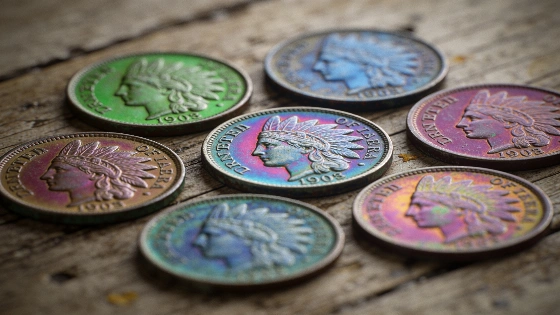
Indian Head cents with bold natural toning are now some of the most fought-over coins in the US market. Proofs with green, rainbow, or magenta colors can sell for twice as much as standard coins, but many are still within reach for collectors.
Proof-toned Indian Head cents have turned into a hot spot for collectors chasing both rarity and eye appeal. The most prized coins-those with strong green, rainbow, or magenta colors-can bring premiums up to 100 percent over regular proofs, according to CAC Grading, LLC. Still, recent checks of auction records and price guides like those from NGC have not confirmed these exact premiums or the $1,000 to $4,000 range for most toned proofs. These numbers are best seen as rough guides and need to be checked against major auction house sales and third-party grading data from sources like the NGC Coin Price Guide. Even with demand rising, many toned proofs still trade below the highest reported prices.
What makes these coins stand out is not just their color, but the odd history behind them. In 1878, the Philadelphia Mint started selling off unsold proof cents at the end of the year, often in bulk. Dealers kept these coins in mint tissue or sulfur-heavy envelopes, which by accident led to the bright toning that collectors chase today. There are stories that dealer Abe Kosoff bought "thousands" of proof Indian Head cents from 1878 to 1909 and that this stash is the main source of toned proofs now, but these claims are not confirmed in independent numismatic books or auction records. The big hoards that came to market in the 1930s, like those from the estates of David Proskey and A.M. White, did shape the market, but the full backstory of many toned proofs is still up for debate among advanced collectors and researchers.
Color categories and market value
Collectors now sort proof Indian Head cents into four main color groups: green, rainbow, blue, and pink or magenta. Green-toned coins, especially those with a sea-green front and magenta back, are the most wanted and can sell for twice as much as standard proofs. Rainbow-toned coins are very rare. Their mix of scarcity and looks means they may be undervalued for how much collectors want them. Blue-toned proofs are the most common, but their price depends on how bright and original the color is-dull or questionable toning can make buyers walk away. Pink and magenta coins are less rare than green or rainbow, but still in high demand and usually bring 20 to 40 percent more than standard proofs. For example, a typical untoned 1888 Indian Head Cent in NGC MS-63 BN was recently listed at $199, showing that only the most striking toned proofs get big premiums, as seen at Coast to Coast Coins & Currency.
Proofs made before 1878 with good toning are especially hard to find. When they do turn up, advanced collectors go after them. Blue-toned proofs, while nice to look at, are much more common and need to be checked closely for real, natural color. CAC approval is often used as a sign of originality, especially for blue or red-and-blue coins, which sometimes show questionable toning. Third-party grading and certification have become more important as the market grows. This matches what is happening in rare coin markets worldwide, where grading standards and a coin's backstory are key to setting value. The Federal Reserve has also pointed this out in its reviews of collectibles as alternative assets.
Historical shifts and collector strategies
The rush for toned Indian Head cents is a recent thing. For years, collectors focused on business-strike coins. Proofs, especially toned ones, got little attention except for a few rare dates like the 1864 "L on Ribbon" proof. Things changed as more collectors noticed the beauty and low mintage of toned proofs, and as big hoards from estates like David Proskey and A.M. White hit the market. It's also worth noting that the Indian Head cent series is different from the Indian Head gold coins designed by Bela Lyon Pratt in 1908. Those gold coins, with their sunken design, are a separate market and are often driven by gold melt values and bigger economic trends, including Federal Reserve interest rate moves and swings in gold prices, as tracked in Federal Reserve monetary policy.
Now, putting together a full set of proof-toned Indian Head cents is seen as a real achievement. Rainbow-toned proofs, in particular, are seen as strong bets for future value because they are rare and still not priced as high as their demand might suggest. Still, collectors are warned not to overpay for blue-toned coins and to focus on originality and CAC approval when they can. As reported earlier, grading calls and surface details can swing both value and collector confidence, especially in the rare-coin world. The European Central Bank has also noted in its financial stability reviews that alternative assets like rare coins can be sensitive to changes in liquidity and investor mood, especially when currencies are volatile.
Facts and figures
Indian Head cents were made from 1859 to 1909. Proof-toned coins, especially those from after 1878, are most often found in the $1,000 to $4,000 range, with green-toned coins sometimes selling for up to twice as much as standard proofs. Pink and magenta-toned proofs usually bring a 20 to 40 percent premium. Rainbow-toned proofs are rare at auction and can go even higher, but their true value is still being set as more collectors chase them. For reference, the NGC price guide lists the melt value for historic Indian Head $3 gold coins at $631.51 as of September 21, 2026. This shows how price guides for gold coins are updated often to match global gold prices and exchange rates.
Understanding toning and market risks
Toning happens when the metal in coins reacts with its storage environment, like sulfur in envelopes or tissue. Natural toning can boost both value and appeal, but fake or questionable toning can hurt a coin's chances in the market. Collectors should know that originality is key for value, and third-party graders like CAC are playing a bigger role in checking for real color. As the market for toned Indian Head cents grows, the line between natural and artificial toning will stay central to both pricing and collector trust. The Bank for International Settlements has pointed out in its research that transparency and standard rules in alternative asset markets, including coins, are needed to keep investor trust and market stability.
Grading is a core part of the rare-coin market, especially for proofs where surface quality and originality set the price. Grading services look at both the technical grade and whether the toning is acceptable, which can be a judgment call. A single grade difference or a question about whether the toning is real can mean the difference between a small premium and a record price. For collectors, knowing the details of grading and the story behind each coin is key to making smart choices in a market where looks and history matter as much as rarity.