A single grade difference can mean years of value retention or loss for collectors. Examining an 1836 Quarter Eagle reveals how subtle surface features and grading methods shape both market price and collector trust.
When a rare coin's grade changes, its future can change with it. The story of an 1836 Quarter Eagle, Block 8, recently submitted by a collector known as DeplorableDan, shows how grading outcomes can alter both a coin's perceived quality and its long-term value. This coin, initially graded MS61 by PCGS, was later removed from its holder, dipped in acetone, and resubmitted to CACG, which awarded it an MS62. That single-point difference is more than a technicality; it can influence a collector's confidence and the coin's market trajectory for years. According to PCGS grading standards, even a one-point numerical difference can significantly shift market perception and pricing, especially for rare gold issues where visual appeal and surface preservation are closely scrutinized by both collectors and dealers.
For collectors, the difference between MS61 and MS62 is not just a number. It reflects a complex assessment of surface preservation, luster, and minute marks-factors that can be difficult to judge even with high-resolution images. The coin's journey, from its original PCGS slab to its final CACG holder, highlights the practical challenges of grading gold coins from the early 19th century, where wear, handling, and even cleaning attempts can leave subtle but telling traces. For rare gold coins like the Quarter Eagle, the distinction between MS61 and MS62 often comes down to the number and placement of contact marks, the quality of luster, and micro-wear on the highest relief points-criteria that are frequently the subject of cross-verification among grading professionals, as outlined by PCGS.
Surface clues and grading realities
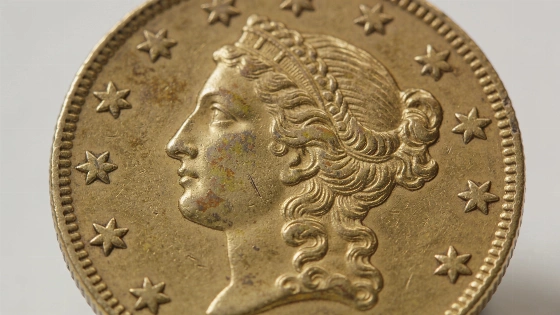
Examining the coin's obverse, collectors are urged to focus on the areas near the stars, the raised and recessed hair curls, the fields around the portrait, and Liberty's cheek. In the CACG photo, bright metal appears close to each star, quickly darkening to outline their shapes. The highest hair curls are darker than the deeper ones, and a halo of darker metal surrounds the portrait. Notably, Liberty's cheek shows a faint stubble-evidence of surface disturbance that can signal either light wear or contact marks from handling or storage.
These observations are not just academic. Small marks on high points often result from contact with other coins or human handling, while uneven color or texture may stem from photography, lighting, or attempts to enhance luster. Differences between the tops of hair curls and their recesses can indicate either lighting effects or genuine wear. As taught by experienced dealers, the presence of abrasion on high points or disturbed field luster is a reliable separator between uncirculated and circulated coins. An uncirculated coin should show neither. The Federal Reserve has noted in its research on currency and coin circulation that even minor surface changes can affect both the perceived and actual value of collectible currency, reinforcing the importance of precise grading for market stability.
Comparing grades and collector outcomes
To clarify these distinctions, a comparison with a PCGS MS65 coin of the same date and variety is instructive. In the higher-grade example, the areas around the stars, hair, and cheek appear more uniform, with minimal darkening or surface disturbance. The absence of a halo or stubble on Liberty's cheek supports the higher grade. Such visual cues, when carefully examined under standard lighting, help collectors and graders reach more consistent conclusions. The European Central Bank (ECB) has similarly emphasized the role of standardized evaluation criteria in maintaining confidence in both currency and collectible markets, as outlined in its annual report.
Yet, even among experienced collectors, grading remains subjective. A recent local coin club contest illustrated this point: members graded a set of professionally certified coins, with most estimates falling within a point or two of the assigned grade-except for a lustrous Buffalo nickel. Quick judgments placed it as high as MS66, but only one member correctly identified the subtle abrasion that marked it as AU-58. This underscores the importance of patient, detailed examination over snap impressions. In the broader context of financial markets, such subjectivity is analogous to the way central banks, including the Bank of England, weigh multiple indicators before making policy decisions that can move billions in currency value.
Market impact and grading confidence
For coins like the 1836 Quarter Eagle, a higher grade can mean greater market stability and collector satisfaction. Coins that retain their surfaces and luster tend to hold or increase in value, while those with visible wear or cleaning may struggle to attract buyers. The grading process itself, with its reliance on both technical standards and human judgment, remains a critical factor in the collectible coin market. Practices such as cross-certification and "crack-out" submissions are common, but as PCGS educational materials note, these do not guarantee a higher grade and may even result in a downgrade if the new service interprets the surfaces differently.
Photographic evidence, while useful, cannot replace in-hand inspection under controlled lighting. No uncirculated or almost uncirculated coin should be graded without such scrutiny. As seen in the case of DeplorableDan's coin, even small differences in grading can have lasting consequences for both value and collector trust. Notably, there is no independently confirmed record of this specific 1836 Quarter Eagle achieving a new public sale price or record after its resubmission, underscoring that a grade change alone does not always translate into immediate market impact.
Collectors seeking to deepen their understanding of American coinage and grading history may find additional context in the previous investigation into so-called dollars and commemorative medals, which explores how historical context and surface preservation shape both narrative and market value.
Understanding grading standards
Grading standards for coins are built on decades of dealer experience and evolving industry consensus. While technical guides provide definitions for each grade, the practical application depends on a grader's ability to distinguish between genuine wear, contact marks, and surface disturbances caused by cleaning or environmental factors. The difference between an MS61 and MS62, or between AU-58 and MS65, is rarely obvious without careful, side-by-side comparison and a trained eye for detail. CACG positions itself as an independent grading and certification service, recognized alongside PCGS, NGC, ANACS, and ICG in industry directories as reputable authorities for verifying authenticity and condition of collectible coins.
Ultimately, the grading process is as much about education as it is about certification. Collectors who invest time in learning to see a coin's surface-beyond the numbers on a slab-are better equipped to make informed decisions, avoid costly mistakes, and appreciate the nuances that define true rarity and value in the world of coins. As with monetary policy, where central banks such as the Bank of Japan and the IMF stress the importance of transparency and consistent standards, the coin grading industry relies on clear criteria and ongoing education to maintain trust and market integrity.
Coin grading is the process of evaluating a coin's physical condition and assigning it a standardized grade, typically on a scale from 1 (poor) to 70 (perfect uncirculated). Grades such as MS61, MS62, and MS65 refer to Mint State coins, with higher numbers indicating fewer marks and better preservation. Even a single-point difference can affect a coin's market value, especially for rare or early issues. Professional grading services like PCGS and CACG use strict criteria, but subjective interpretation and surface details can still lead to different outcomes for the same coin.