The 1837 Feuchtwanger Cent was a privately issued coin that gained public acceptance during a national coin shortage, offering a glimpse of what US currency could have become if Congress had chosen a different path
In 1837, a small, unofficial coin started showing up in New York. It was the Feuchtwanger Cent. Dr. Lewis Feuchtwanger, a chemist, made it himself. This was no government issue. But the country was short on coins. Shops and markets needed change. People took the new cent and used it everywhere. For a short time, it looked like this private token might change the way Americans used money. The coin appeared just as the old Coronet Head Cent was being replaced by the Braided Hair Cent. That was a rough period for US currency. Small coins were scarce. The PCGS Population Report and numismatic records confirm how unstable things were.
Congress looked at Feuchtwanger's idea. He wanted to swap out the big, heavy copper cent for his lighter token. Lawmakers said no. But the public said yes. People wanted something new. They trusted Feuchtwanger's coin when the government couldn't deliver. The Federal Reserve's historical reviews point out that private money often pops up when official coins run short. It happened here.
The Panic and the Chemist
The Panic of 1837 hit hard. Banks failed. Gold and silver disappeared. Even pennies were tough to find. Dr. Lewis Feuchtwanger, a German-born chemist in New York, saw the problem. He ran the city's first German pharmacy. He also collected minerals and wrote about gems. But metals fascinated him most. That's what led him to coins.
He thought the old copper cent was too big and too costly. It measured about 27.5 mm. The Mint lost money making it. Feuchtwanger came up with a smaller cent, just 18.5 mm across. That's about the size of a dime. He used his own alloy-"Feuchtwanger's Composition"-a mix of copper, nickel, and zinc. It looked like silver but had none. It didn't rust and cost less than pure copper. Feuchtwanger said his metal was brighter, tougher, and cheaper. Collectors still debate how many tokens he made. The exact number is unknown. But the alloy was a real breakthrough. The US Mint was searching for cheaper metals at the time. You can find more details in collector forums and the PCGS Population Report.
Design and Circulation
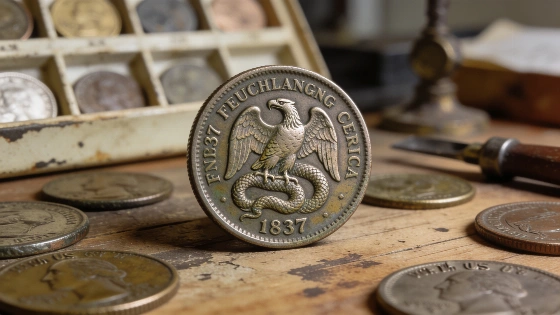
The coin's look was bold. On the front, an eagle fights a snake. It's a striking image. The back says "ONE CENT" inside a wreath, with "FEUCHTWANGER'S COMPOSITION" around the edge. Feuchtwanger sent samples to Congress. He wanted approval. Senator Thomas Hart Benton liked the idea. Mint Director Robert Maskell Patterson did not. In 1838, the Mint said no. That ended any hope for a federal contract. Feuchtwanger also asked Congress to let him make trial 1- and 3-cent coins. No official records exist for those. They stayed private tokens, not government coins. This is backed up by collector threads on CoinTalk.
Even after rejection, Feuchtwanger's coins spread fast. From 1837 to 1844, more than a million of them changed hands. New York needed small change. People used the tokens as money, even though they weren't official. That's how desperate things got during the Hard Times era. The Federal Reserve's research on currency substitution shows this wasn't a one-off event. Private money often fills the gap when official coins run out.
Collector Value and Varieties
Today, collectors call the 1837 Feuchtwanger Cent HT-268 in the Hard Times token series. Older books list it as Low-120. There are at least 14 die varieties-six for the front, nine for the back. Some are common. Others are rare. The eagle's high relief means the center often looks weak. That makes grading tricky. Some rare types may have been made as late as the Civil War. They don't show up in mid-1800s collector lists.
Collectors still want these coins. Worn examples can sell for less than $200. Mint State pieces go for $500 or more. Rare die pairs can bring much higher prices. One AU58 coin sold for $21,000 at auction in October 2024. Private minting led to planchet flaws and odd metal mixes. These quirks add to the coin's charm. Its value also comes from being outside the official US coin system. Modern catalogs and the Federal Reserve's monetary policy archives confirm its unique status.
Legacy of a Failed Proposal
The Feuchtwanger Cent is more than a coin. It's a story of private action solving a public problem. People needed small change. Feuchtwanger gave it to them. Congress said no to his alloy and design. But the US later dropped the big copper cent and switched to smaller, nickel coins. Feuchtwanger saw the future before it happened. The European Central Bank (ECB) has found that currency reforms often follow private innovation and public demand for better coins.
Collectors love the Feuchtwanger Cent for its history, rarity, and proof of real-world money experiments. Jaeger and Bowers ranked it number four in their list of 100 Greatest American Medals and Tokens. That's high praise. Some coins stayed in use until the Civil War. High-grade pieces are rare. Their survival shows they were useful, not just curiosities.
Stack's Bowers Galleries will auction a Feuchtwanger Cent on June 3, 2026. New collectors will get a shot at owning a piece of Hard Times history. The coin's journey from private experiment to everyday money shows how currency can change when official systems break down. The Bank for International Settlements (BIS) notes that unofficial coins like these can shape later central bank policy and reforms.
If you're curious about how coins are made, a recent report on Malaysia's 1971 50 sen coin shows how rare minting tools can shape a coin's legacy. It's a reminder: the way coins are made often outlasts the rules that created them.
Facts and Figures
The 1837 Feuchtwanger Cent is about 18.5 mm wide. That's much smaller than the official large cent, which was 27.5 mm. Over a million Feuchtwanger cents reportedly circulated from 1837 to 1844. Some stayed in use until the Civil War. Rare die types can sell for over $20,000. Common, worn coins might go for less than $200. It all depends on condition and rarity.
Private tokens like the Feuchtwanger Cent are called Hard Times tokens. They include copper, brass, and mixed-metal pieces made during the economic troubles of the 1830s and 1840s. These tokens filled the gap when official coins ran out. They often circulated right alongside government money. The line between legal tender and practical cash got blurry. The Federal Reserve and ECB still study how coin shortages and private tokens affect modern money. The Feuchtwanger Cent is a lesson from history.