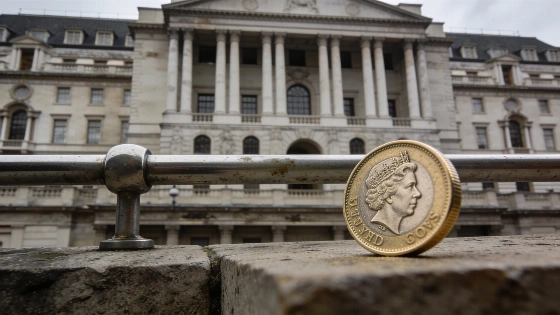
The Pound dropped against the Euro and Dollar after UK business surveys showed slower growth but rising services prices. The Bank of England now faces a tough decision ahead of its next meeting.
Services prices are rising in the UK, putting the Bank of England in a tight spot. New business surveys show growth is slowing, but inflation is not letting up. On Wednesday, the Pound lost ground against both the Euro and the US Dollar. Markets are unsure what the central bank will do next. The Bank of England left its Bank Rate at 3.75% in September. The Monetary Policy Committee was split 6-3-three members wanted a 25 basis point hike to 4%. This shows some still want tighter policy, according to the Bank of England minutes.
The flash composite Purchasing Managers' Index (PMI) for September fell to 51.7 from 52.5 in August. This was below the expected 52.0. The services sector matched this reading. Manufacturing's main index ticked up to 52.0, but its output weakened. Even with softer growth, the September survey found services firms raised selling prices at the fastest pace in four months. Services inflation is still strong, even as activity cools. This matches the Bank of England's warning that inflation could top 4% in early 2027, up from 3.1% in August, based on recent data from Reuters and the BoE.
Exchange rates react to economic signals
The Pound fell 0.41% against the US Dollar to 1.3288, pushing its September drop to 1.92%. Against the Euro, it slipped 0.13% to 1.1640. These moves came after the Bank of England kept rates steady. Investors are now looking for clues about what comes next. Stronger economic activity and high prices mean a November rate hike is still possible, as market analysts note and as seen in the Reuters PMI report.
The PMI data alone points to a small 0.2% rise in GDP for the quarter. But the Bank of England has raised its third-quarter growth estimate to 0.4%, up from 0.1%. This shows some optimism. The Bank's September minutes mention better business and consumer confidence. Still, the outlook for the rest of the year is weak. Some forecasters see growth slowing to just 0.1% in the fourth quarter as fiscal worries and higher borrowing costs drag on activity.
Policy dilemma intensifies
Rising services prices make the Bank of England's job harder. Services inflation is still strong, even as growth slows. The Monetary Policy Committee now has to weigh the risk of stubborn inflation against a weaker economy. The split vote in September shows how tough this is, with some policymakers still leaning toward tighter policy.
Recent events echo earlier times when weak UK data hit the Pound and raised doubts about the central bank's resolve, as reported earlier. But now, the gap between price pressures and economic momentum is even wider. The Bank of England's next move is less predictable. Currency markets and global investors are watching closely.
Growth and inflation in focus
Exchange Rates UK Research, using live market data and official releases, points out that the PMI's 0.2% growth estimate may be too low if past trends repeat. Both the Bank of England and independent analysts expect a 0.4% GDP rise for the third quarter. But the outlook for the rest of the year is still weak. Higher-than-expected government borrowing figures on Tuesday add more uncertainty for policymakers. Fiscal worries could slow things down even more.
For those watching the Pound, the tug-of-war between inflation and growth is key. The Bank of England's next decision will have to deal with the risk that services inflation stays above target, even as the wider economy slows. This tension will likely keep Sterling sensitive to new data and policy news in the coming weeks. Central banks like the BoE, the Federal Reserve, and the European Central Bank often have to choose between supporting growth and fighting inflation. But the UK's current situation is especially sharp. When services prices rise while the rest of the economy slows, policymakers must decide whether to focus on price stability or growth. The Bank of England's next meetings will test how it handles these pressures, and the outcome will shape Sterling's path and the wider economy.