
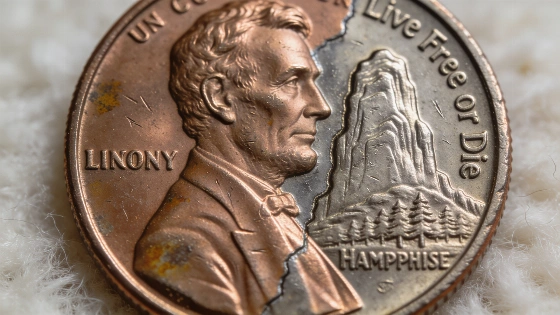
A one-of-a-kind US Mint error coin, showing both a cent and a quarter, just sold for almost $17,000. Struck in 2000, this coin's overlapping designs make it a standout in the world of rare coins.
A coin worth just twenty-six cents on its face has grabbed headlines by selling for nearly $17,000. The sale happened at a recent GreatCollections auction. This rare US Mint error, known as the "26-Cent Coin," drew heavy interest from collectors. After 44 bids, the final price hit $16,962.50, which includes a 12.5% buyer's premium. The strong bidding shows how much collectors value rare coins, even as the US dollar stays under close watch by the Federal Reserve for its role in global markets, as reported by NJ.com.
The story behind the coin is just as strange as its price. In 2000, a Lincoln cent was struck over a finished New Hampshire state quarter. This created a double-denomination coin with features from both. You can see Abraham Lincoln's profile and cent markings mixed with parts of the New Hampshire quarter's design. Collectors have nicknamed it the "26-cent coin." This mistake didn't happen on a blank planchet. Instead, cent dies hit a finished quarter, so both coins' 2000 dates are visible. WSB-TV and AP-style reports confirm these details.
How the error happened
Errors like this are extremely rare. Here, a cent blank ended up in the press and was struck over a finished quarter, not a plain planchet. This kind of mistake only happens in unusual situations inside the US Mint. The Mint makes billions of coins each year, but only a few double-denomination errors ever get authenticated and sold. That's why this coin stands out, according to NJ.com.
The coin was graded Mint State-65 by the Professional Coin Grading Service (PCGS). That means it's in top shape, with only small marks away from the main design. Both the cent and quarter dates-2000-are easy to spot, which adds to its appeal. GreatCollections called it a "spectacular example" of how a quick mistake at the Mint can create a unique collectible. The PCGS MS-65 grade is well known among collectors and investors. It signals a strong strike and good eye appeal, a standard often listed in auction catalogs and tracked by the Bank for International Settlements for trends in currency and precious metals.
Fierce bidding and final price
The "26-Cent Coin" sparked a bidding war. Forty-four bids came in before the auction closed. The final price, with the 12.5% buyer's premium, reached $16,962.50. This shows how much collectors will pay for error coins that are rare, visually striking, and have clear history. The sale comes as the US Consumer Price Index (CPI) shows moderate yearly increases, and the Federal Reserve's policies keep shaping currency values at home and abroad.
The US Mint makes billions of coins every year, but only a few double-denomination errors are ever found and certified. This coin's clear overlapping features and high grade set it apart from more common mistakes. Its rarity is on par with the limited runs of commemorative coins from the 50 State Quarters Program, which ran from 1999 to 2008 and included the New Hampshire quarter in August 2000, as WSB-TV and AP-style coverage note.
Numismatic rarity and collector demand
Double-denomination coins are some of the most sought-after errors in US coin collecting. Their draw comes from the visible clash of two different coin designs, something you almost never see outside the Mint. The "26-Cent Coin" now joins a small group of error coins that have brought big auction results. This echoes the excitement seen when other rare US Mint errors have surfaced, as reported earlier. The European Central Bank (ECB) has pointed out in its monetary policy bulletins that rare collectibles, including coins, can act as alternative stores of value, especially when currency markets are volatile.
Even though the coin's face value is just twenty-six cents, its real worth comes from how rare it is, its condition, and the story behind it. The auction shows that collectors are willing to pay a premium for coins that break the mold and offer a glimpse into the unpredictable side of minting. No post-auction disputes or official challenges have been reported, according to independent reports from September 22-23, 2026. This confirms the coin's place as a true numismatic rarity, as covered by NJ.com and WSB-TV.
What are double-denomination errors?
Double-denomination errors happen when a coin is struck on a planchet that's already been minted as a different denomination. This is not the same as an off-center strike or a planchet flaw. It takes two separate minting steps to create this kind of error. Authentication and grading matter a lot, since the error coin market is very sensitive to condition and history. Collectors and investors should know that while some coins like this can sell for high prices, most mint errors are much less dramatic and valuable. As central banks like the Federal Reserve and the ECB keep an eye on inflation and currency flows, the rare coin market remains a small but steady part of the bigger financial picture, often moving on its own path.