
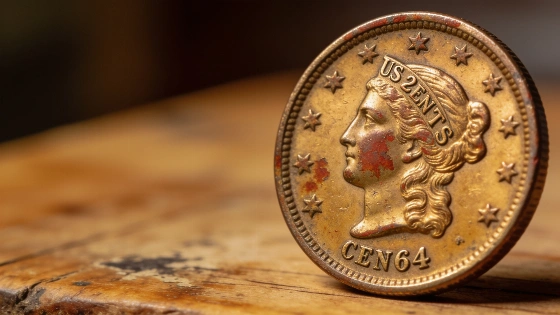
A faint Liberty profile from an Indian Head cent shows up on the 1864 Two-Cent Piece. The FS-1901 variety is a rare mistake and a glimpse into the money crisis of the Civil War.
Pick up a well-kept 1864 Two-Cent Piece and tilt it in the light. You might spot a ghostly face where it doesn't belong. Above the S in CENTS, the outline of Liberty from an Indian Head cent appears. This isn't damage after minting or a collector's trick. It's the FS-1901 variety-a coin that records the moment two different US coin dies struck each other and left their mark on American money.
Collectors have always hunted for die clashes. These happen when coin dies hit each other without a blank planchet in between, leaving parts of one design on the other. But FS-1901 is different. Here, the reverse die of a two-cent piece hit the obverse die of an Indian Head cent. The coins have different sizes and weights, but both are bronze. The result: Liberty's nose and lips float above the S in CENTS, easy to spot if you know where to look. Catalogers list these die clash varieties, and you'll find FS-1901 in the NGC VarietyPlus database and in the U.S. Mint's old records.
The currency crisis that birthed a new coin
The two-cent piece came out of Civil War money chaos. By 1864, gold and silver coins had disappeared from daily use. People hoarded them. Even copper-nickel cents were hard to find. Stores and shoppers had to use private tokens and small paper bills. Congress stepped in on April 22, 1864. Lawmakers approved a lighter bronze cent and created the two-cent coin. Both were designed by James Barton Longacre and made of 95% copper with tin and zinc. This was a direct answer to the coin shortage. The U.S. Treasury and what would later become the Federal Reserve (founded in 1913) struggled to keep enough money moving and to keep trust in the dollar during the war, as shown by the National Museum of American History and the U.S. Mint's records.
The two-cent piece was more than a quick fix. It was the first US coin to carry the motto IN GOD WE TRUST. That phrase would stay on American money. The first 1864 coins had a Small Motto, but the Mint soon switched to a Large Motto, which became the standard. Nearly 20 million two-cent pieces were made in 1864. Most were Large Motto coins. Only about 25,000 are thought to be Small Motto examples. This change is well documented in coin catalogs and shows how the Mint reacted fast to public opinion and new laws. It's not so different from how the modern Federal Reserve reacts to inflation and policy changes, as seen in recent FOMC meeting minutes.
How the FS-1901 clash happened
Die clashes are common in US coins, but FS-1901 is not a normal case. Instead of two dies from the same coin, the two-cent reverse die hit an Indian Head cent obverse die. The two-cent piece is 23 millimeters across and weighs 6.22 grams. The Indian Head cent is smaller-19 millimeters and 3.11 grams. Both used the same bronze alloy and had the same designer. The switch to 95% copper with 5% tin and zinc was a big change from the old copper-nickel mix. This is like how central banks today change coin metals and denominations when metal prices jump or supplies run short, as tracked by the Bank for International Settlements (BIS).
The proof is on the coin: a faint, sunken Liberty profile above the S in CENTS on the two-cent reverse. Auction houses like Heritage and GreatCollections have described this feature. The nose and lips are the main clues for FS-1901. Every coin struck from that reverse die shows some trace of the clash. No one knows for sure how the two different dies ended up together. Some think it was a test strike or an experiment at the Mint. There are no official records from the Philadelphia Mint about this event. The U.S. Mint's silence on this clash is like the way central banks sometimes keep details of their decisions out of public meeting notes.
Market recognition and collector demand
The FS-1901 variety is now a fixture in the coin market. PCGS gives catalog numbers to Brown, Red-Brown, and Red examples. The Red-Brown is number 38245. Auction results show steady demand. Stack's Bowers sold a PCGS MS64RB for $2,314 in March 2011. Heritage has sold several, including an MS65RB for $1,380 in October 2021 and an MS65+RB for $960 in August 2022. These prices show the variety's rarity and appeal to specialists, but they aren't current values. Like rare coins and currency, prices can swing with the economy, changes in U.S. Treasury yields, and Federal Reserve rate moves. These all affect how much investors want hard assets and collectibles.
Condition matters for the FS-1901 clash. The CAC MS64RB coin, named Coin of the Week for September 23, 2026, is in Choice Mint State. It still has enough reddish copper color to show off the clash detail. Unworn surfaces make it easier to see the faint Liberty profile. In coin collecting, condition is as important as grade is for top sovereign bonds in the secondary market, as noted in the Federal Reserve's policy releases.
The two cent piece's brief life and lasting impact
The two-cent coin didn't last long. After almost 20 million coins in 1864, production dropped fast: less than 14 million in 1865, just over three million in 1866, and only 65,000 for circulation by 1872. When regular coins came back after the Civil War and the copper-nickel five-cent coin appeared in 1866, the two-cent piece became unnecessary. The Mint stopped making them for circulation in 1872 and struck only Proofs in 1873. The denomination was ended by the Coinage Act of 1873. This quick drop in mintage is like how central banks today pull or redesign currency when the economy changes, as seen in the ECB's reviews of euro banknotes and the Federal Reserve's yearly currency reports.
Even with its short run, the two-cent piece made its mark. It brought IN GOD WE TRUST to US coins and captured a wild time in American money history. The FS-1901 variety adds another twist, keeping the physical proof of two denominations meeting in a way the Mint never planned. More than 160 years later, the faint Liberty profile above CENTS still draws collectors and historians.
If you want to read about other Civil War coin oddities, the reported earlier story of the 1861 D Gold Dollar made under Confederate control is another look at how crisis and quick thinking shaped US money.
Specifications and diagnostic features
The 1864 Two-Cent Large Motto FS-1901 was made at the Philadelphia Mint with no mintmark. James Barton Longacre designed it. The coin weighs 6.22 grams, is 23 mm across, and is 95% copper with tin and zinc. The front shows a Union shield with crossed arrows and leaves, IN GOD WE TRUST above, and the date below. The back has 2 CENTS inside a wheat wreath and UNITED STATES OF AMERICA around the edge. The key sign for FS-1901 is the Indian Head cent Liberty profile above the S in CENTS on the back.
The FS-1901 variety shows how even normal mint work can create lasting coin mysteries. Most die clashes involve only one denomination, but FS-1901 needed a rare set of events. Both coins had the same designer and new bronze alloy in 1864, which may have played a part, but the full story is still unknown. For collectors and historians, FS-1901 is proof that making coins can lead to surprises that keep people searching for answers.