
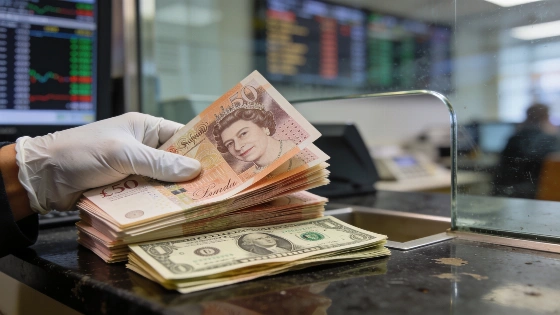
The British Pound reached a new August high versus the US Dollar after a sharp drop in US Treasury yields, while its performance against other major currencies remained mixed, reflecting diverging economic signals and central bank expectations
The British Pound advanced to its highest level against the US Dollar since early August, propelled not by domestic inflation data but by a pronounced decline in long-term US Treasury yields. This move highlights how global bond markets and central bank policy expectations can overshadow local economic releases in driving currency values.
While UK inflation figures for July were closely watched, the main catalyst for the Pound's surge was the US Treasury's decision to double the size of certain long-dated bond buybacks, easing pressure on the US bond market and weakening the Dollar. As a result, GBP/USD climbed to 1.362006, marking a 0.62% gain on the day, while the Pound's performance against other currencies was more uneven.
US Dollar Weakness Drives GBP/USD Higher
The decisive shift in GBP/USD followed a sharp drop in 30-year US Treasury yields after the Treasury announced expanded buyback operations of at least $4 billion per event. This intervention helped stabilize the US bond market after recent volatility, pulling the Dollar lower and allowing the Pound to break above recent resistance levels. The Federal Reserve's upcoming minutes remain a key risk, as any signal of renewed tightening could reverse some of the Dollar's recent losses.
UK inflation data, released the same morning, showed headline CPI rising to 2.9% in July from 2.6% in June, broadly matching expectations. Core inflation held steady at 2.6%, while services inflation eased to 3.4%. These figures kept Bank of England rate-cut expectations in check but did not provide the kind of upside surprise that would typically trigger a sharp Sterling rally on their own. Meanwhile, the UK labour market remains soft, with unemployment at 4.9% and private-sector pay growth at its slowest since 2020.
Mixed Pound Performance Across Major Currencies
The Pound's rally was not universal. While GBP/USD and GBP/CNY reached the top of their 30-day ranges, the Pound lost ground against the Euro and New Zealand Dollar. GBP/EUR slipped to 1.167400, down 0.16% on the day, as the Euro benefited from the Dollar's weakness and a lack of fresh impetus from UK data. The Japanese Yen, meanwhile, remains the strongest major currency over the past month, with GBP/JPY at 215.59981, down 0.17% on the day.
Elsewhere, the Australian Dollar stayed firm, with GBP/AUD only marginally higher at 1.912744. The Canadian Dollar was steady, supported by higher oil prices and a July inflation rate of 3.0%. The Swiss Franc rebounded as global yields fell, pulling GBP/CHF down 0.73% to 1.09157. The New Zealand Dollar outperformed, with GBP/NZD dropping 0.31% to 2.297935, reflecting improved risk appetite and G8 currency rotation.
Key Data and Upcoming Events
According to Exchange Rates UK Research, the Pound's strongest gains this month have been against the Yen, Rupee, US Dollar, and Yuan, while it has lagged against the South African Rand, Canadian Dollar, Norwegian Krone, and Australian Dollar. The ERUK dashboard shows GBP/USD and GBP/CNY at the top of their 30-day ranges, with the 14-day RSI for GBP/USD above 70, indicating stretched momentum. In contrast, GBP/EUR remains near the lower end of its recent range.
Looking ahead, several events could influence currency markets. The Federal Reserve's minutes, due later today, will test whether markets are correct in pricing a lower chance of further US rate hikes. On Thursday, China is expected to keep its loan prime rates unchanged, while Friday brings UK retail sales data and Japan's CPI release. Oil prices remain a key driver for currencies such as the Canadian Dollar, Norwegian Krone, Indian Rupee, and South African Rand.
For readers interested in how US economic data can shift the Pound's direction, a recent analysis explores the impact of weak US retail sales on Sterling's outlook in more detail: how disappointing US data has previously weighed on the Dollar.
Understanding Currency Moves Beyond Local Data
Currency movements often reflect a complex interplay between domestic economic indicators and global financial conditions. While inflation and labour-market data shape central bank expectations, shifts in global bond yields and cross-border capital flows can quickly override local fundamentals. The recent Pound rally against the Dollar demonstrates how actions by the US Treasury and Federal Reserve can have immediate effects on exchange rates worldwide, even when domestic data is broadly in line with forecasts. For international businesses, travelers, and anyone making cross-border payments, understanding these dynamics is essential for managing currency risk and anticipating potential volatility.