
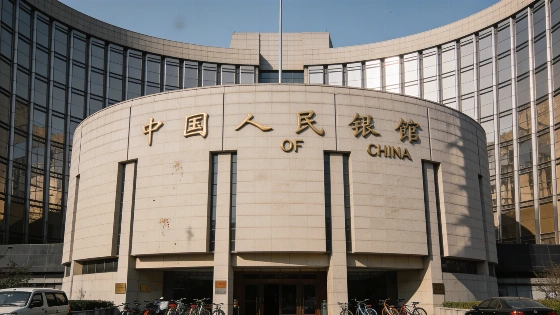
The People's Bank of China is moderating the pace of the Yuan's appreciation against the US Dollar, but analysts expect the Chinese currency to continue strengthening gradually through 2027, supported by robust export inflows and policy guidance
The Chinese Yuan has been steadily appreciating against the US Dollar, with the USD/CNY exchange rate recently reaching its lowest point in over three years. As of late August 2026, the pair traded near 6.7210, down from almost 7.00 at the start of the year. This sustained move reflects a combination of strong export-driven foreign exchange inflows and the People's Bank of China's (PBoC) ongoing policy management.
According to research from UBS, the Yuan's appreciation is expected to continue, albeit at a measured pace. The bank forecasts USD/CNY to fall to 6.60 by the end of 2026 and reach 6.50 by mid-2027. These projections are based on the persistent conversion of export earnings into local currency, which has averaged around $37 billion per month over the past quarter. Despite relatively weak domestic demand in China, the country's external accounts remain a powerful support for the currency, with a trade surplus of $112 billion recorded in July alone.
PBoC's Approach: Gradual, Not Reversal
The PBoC has signaled its preference for a stronger Yuan, but it is actively working to prevent excessive or rapid appreciation. This is primarily achieved through the daily setting of the central parity rate, known as the fixing. On a recent occasion, the PBoC set the midpoint at 6.7852, which was 633 pips weaker than the market consensus, marking the largest such deviation in six months. This move serves as a warning to market participants against expecting a straight-line rise in the Yuan's value, but it does not indicate a desire to push the USD/CNY rate back toward 7.00.
UBS analysts believe that as long as the Yuan's appreciation does not undermine China's export sector-a key driver of economic growth-policymakers will remain comfortable with a gradual strengthening. The bank maintains a positive outlook on the Yuan, citing China's solid balance-of-payments position and the likelihood of broader US Dollar weakness. From the current level of 6.7210, the forecasted move to 6.50 by mid-2027 would represent an additional decline of about 3.3% in the USD/CNY rate.
Export Flows and Policy Tolerance
The current rally in the Yuan is unusual in that it coincides with subdued domestic consumption and investment. Instead, the main driver has been the steady conversion of export proceeds, which has created persistent downward pressure on the USD/CNY exchange rate. This dynamic is helping to offset the effects of softer retail demand and weaker business sentiment within China.
Policy tolerance remains the central variable in the outlook. The PBoC's willingness to slow, but not reverse, the Yuan's gains reflects a balancing act between supporting exporters and maintaining currency stability. This approach is consistent with broader trends in Asian currency management, as highlighted in a recent analysis of shifting preferences away from the US Dollar among major regional economies.
Key Data and Outlook
Over the past six months, the USD/CNY exchange rate has declined in five out of six completed months, moving from nearly 7.00 at the start of 2026 to the low 6.72 range by late August. China's trade surplus reached $112 billion in July, and export-related foreign exchange conversions have averaged $37 billion per month in recent months. UBS projects USD/CNY at 6.60 by December 2026 and March 2027, and 6.50 by June and September 2027, assuming current trends persist and policy tolerance remains unchanged.
The PBoC's strategy of applying the brakes rather than reversing direction means that while sharp moves are likely to be resisted, the underlying trend of gradual Yuan appreciation is expected to continue, barring a significant change in external or domestic conditions.
The mechanism of the PBoC's daily fixing plays a central role in China's managed float exchange-rate regime. By setting the central parity rate each morning, the PBoC can influence the pace and direction of the Yuan's movement without committing to a fixed rate or allowing a fully free float. This system gives policymakers flexibility to respond to both domestic economic needs and external pressures, while providing market participants with signals about official tolerance for currency moves. The approach is designed to avoid destabilizing swings that could harm exporters or financial stability, while still allowing the Yuan to reflect underlying economic fundamentals over time.