
Mobutu Sese Seko's regime in Zaire left a legacy of currency manipulation, with Katanga's short-lived coins revealing how political power and monetary policy intertwined during the Congo Crisis
Joseph-Désiré Mobutu, later known as Mobutu Sese Seko, was a central figure in the Democratic Republic of the Congo's turbulent post-independence era. Rising from army chief of staff during the Congo Crisis of 1960, Mobutu played a decisive role in the overthrow of Patrice Lumumba's government, with support from the United States and Belgium. By 1965, after a second coup, Mobutu consolidated power and began a 32-year rule marked by authoritarianism and personal enrichment.
Mobutu's regime, which renamed the country Zaire in 1971, became synonymous with kleptocracy. While the nation's economy suffered from inflation, mounting debt, and currency devaluation, Mobutu amassed a personal fortune estimated at up to $5 billion. The mechanisms behind this accumulation of wealth remain partly obscured, but the story of Katanga's coins offers a revealing glimpse into how currency policy and personal gain could intersect.
Katanga's Short-Lived Currency
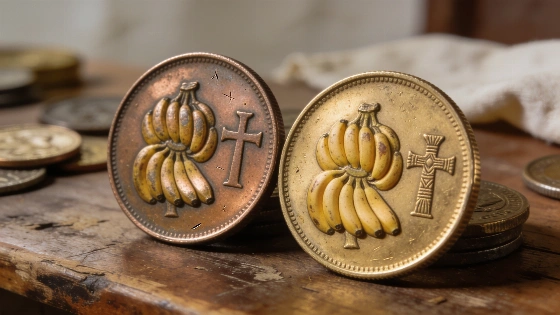
During the early 1960s, the mineral-rich Katanga region declared independence from the rest of the Congo, issuing its own currency-the Katangese franc. Mobutu, then a key military leader, authorized the minting of copper coins in 1 and 5 franc denominations. These coins featured a bunch of bananas on one side and the traditional Katanga copper cross on the other, referencing both local culture and the region's economic base. The coins circulated briefly in 1961 before Katanga was reintegrated and the Congolese franc restored as the official currency in 1963.
In addition to the copper coins, a limited number of 5 franc pieces were struck in gold. The exact mintage remains uncertain, but estimates suggest up to 20,000 gold coins may have been produced. Unlike their copper counterparts, these gold coins never entered general circulation and are now considered rare collector's items. Most were reportedly melted down, with only a handful surviving in private collections.
Currency Manipulation and Personal Gain
The existence of gold coins identical in design to the copper 5 franc pieces raises questions about their intended use. The prevailing theory is that Mobutu and his associates could have swapped copper coins for gold ones of the same face value, effectively extracting gold from the nation's reserves under the guise of routine currency operations. This form of currency manipulation allowed for the accumulation of significant personal wealth at the expense of the country's financial stability.
Such practices were not unique to Zaire. Throughout history, currency manipulation and the creation of pattern or non-circulating coins have been used by governments and individuals to profit from monetary systems. For example, the rare 1887 Liberty Head Half Eagle in the United States, discussed in an analysis of America's only proof-only $5 gold coin, illustrates how coinage decisions can have lasting financial and historical consequences.
Economic Impact and Historical Context
Mobutu's manipulation of currency and state resources contributed to chronic economic instability in Zaire. By the late 1980s, the country faced hyperinflation, with the Zaire losing value rapidly against major currencies such as the US dollar. For example, between 1980 and 1990, the Zaire depreciated by more than 99% against the US dollar, reflecting both domestic mismanagement and external pressures. The collapse of the Katangese franc and the subsequent devaluation of the Zaire left ordinary citizens with little protection against the erosion of their savings and purchasing power.
Mobutu's grip on power weakened in the 1990s as international support waned following the end of the Cold War. In 1997, Laurent-Désiré Kabila led a successful rebellion, forcing Mobutu into exile in Morocco, where he died later that year. The legacy of Mobutu's currency policies remains a cautionary tale about the risks of unchecked political power over monetary systems.
The Katanga coins, especially the elusive gold 5 franc pieces, have become sought-after collectibles, valued not only for their rarity but also for the complex history they represent. Their story highlights the intersection of politics, economics, and numismatics in shaping a nation's financial destiny.
Pattern coins-those produced in limited numbers for testing, presentation, or speculative purposes-occupy a unique place in monetary history. Unlike circulating currency, pattern coins often blur the line between official money and collectible artifact. Their creation can serve legitimate purposes, such as evaluating new designs or materials, but they can also be exploited for personal or political gain. The Katanga gold coins authorized during Mobutu's era exemplify how pattern issues can be used to divert wealth or influence monetary policy behind the scenes. Understanding the distinction between circulating and pattern coins is essential for collectors, historians, and policymakers seeking to interpret the true impact of currency decisions on a nation's economy and legacy.