
Japan's 5-yen and 10-yen coins now contain metal worth more than their face value, raising questions about the future of small change as cash use declines and production costs climb
Metal prices are squeezing Japan's smallest coins. The copper, zinc, and aluminum inside 5-yen and 10-yen coins now match-or even top-their face value. For these coins, the metal is worth more than the number stamped on them. This flip comes from global price jumps and supply problems. The Bank of Japan warns that these pressures can disrupt how cash moves and how money is managed, especially with currency swings and inflation in the mix.
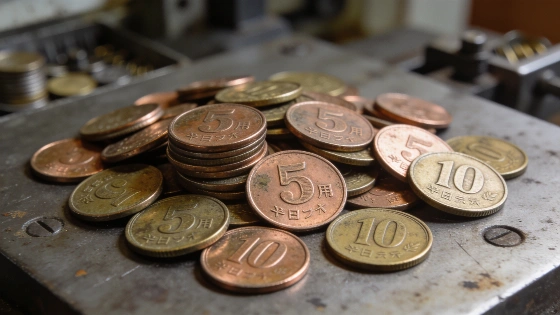
Numbers tell the story. It takes about 14.8 US cents in materials to make a US quarter. Japan's 10-yen coin, made mostly of copper, now holds 10.4 yen in metal value, based on June 15 prices from JX Metals and Mitsui Mining & Smelting. The 5-yen coin, a copper-zinc mix, contains metal worth 6.3 yen. Even the 1-yen aluminum coin now packs about 70% of its face value in metal. These figures show a growing gap between what coins are worth as money and what they cost to make. By late September 2026, copper in Japan hit 2,420 yen per kilogram. Zinc reached 718 yen per kilogram. The squeeze on coin production is not letting up, according to Japanese commodity market data.
Metal prices and coin production
The Ministry of Finance runs the Japan Mint in Hiroshima, Osaka, and Saitama. It keeps the true cost of making coins secret, citing counterfeiting risks. Still, the ministry admits copper prices are now a real worry. Recent mine accidents have made things worse, cutting supply and pushing costs higher. Official Japan Mint data shows the 1-yen coin still uses 1 gram of aluminum. The 5-yen and 10-yen coins keep their old copper and zinc mix. That makes them sensitive to swings in metal prices.
Officials say the hit to the budget is limited. Most new coins come from recycled metal taken from old coins. Japan also has tough laws against hoarding or melting coins. Damaging or melting coins can mean up to a year in jail or a fine of 200,000 yen (about $1,230). The ministry has not said it will pull or redesign these coins. But the math is changing. The Bank for International Settlements (BIS) has pointed out that rising costs can push central banks to rethink small coins worldwide.
Cash use declines as digital payments rise
Cash is losing ground in Japan. A 2024 survey by the Financial Literacy and Education Promotion Organization of Japan found only 61.6% of households with two or more people still pay cash for amounts up to 1,000 yen. Ten years ago, that number was 89.2%. Digital payments are everywhere now. The need for small coins is fading. Nikkei reports, "As electronic payment methods spread rapidly, questions are being raised about the role of coins." The Bank of Japan's policy statements keep noting the shift to cashless payments. Demand for new coins keeps dropping.
Still, the Ministry of Finance says coins are needed for people who can't use digital payments. There are no plans to stop making coins for now. But the 5-yen coin hasn't been minted since 2021. The 1-yen coin hasn't been issued since 2016. In 2025, 150 million 10-yen coins were made. No numbers for 2026 yet. The 2026 10-yen coin is only in the Japan Mint 2026 Mint Set. The European Central Bank (ECB) faces the same debate. Metal prices and digital payments are changing the cash game across advanced economies.
Legal and practical limits
Japan's law bans melting or destroying coins. The penalties are meant to stop people and businesses from cashing in on rising metal value. The Ministry of Finance keeps production costs secret, saying openness could help counterfeiters or illegal melting. The US takes a different approach. It reports coin costs openly. When the penny's metal value topped its face value, the US stopped making it. The 5-cent coin could be next if trends hold.
Economists in Japan sometimes ask if small coins will become too costly to mint if metal prices and currency rates keep moving. For now, the ministry's stance is steady. But the numbers are under the microscope. As reported earlier, higher metal prices have already shaken up the coin collector market in Japan and the US. Rare and copper-heavy coins are drawing new interest.
On June 15, the metal in a 10-yen coin was worth 10.4 yen. The 5-yen coin's metal was valued at 6.3 yen. The 1-yen coin's aluminum now makes up about 70% of its face value. The 5-yen coin hasn't been minted since 2021. The 1-yen coin hasn't been issued since 2016. In 2025, 150 million 10-yen coins were made. No 2026 numbers yet. The Ministry of Finance still won't say what it costs to make coins.
Coins in Japan rarely get pulled or redesigned unless the currency system changes or there's a clear economic reason. The cost to make coins depends on metal prices, recycling, minting tech, and how much cash people use. Digital payments keep growing. Metal prices keep moving. Central banks and finance ministries everywhere are weighing the need for small change against the rising cost of keeping coins in people's pockets. In Japan, the law on coin use and destruction is strict. But the economics are shifting. Sooner or later, policy may have to catch up. For more on monetary policy and coin issuance, see the Bank of Japan statistics guide.