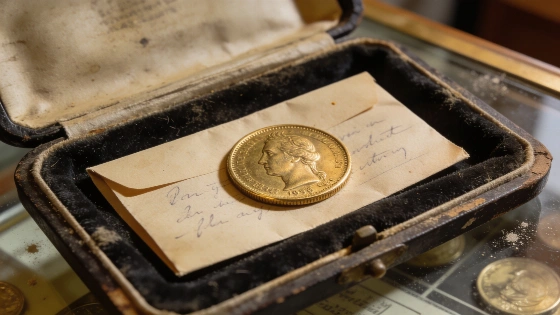
A rare 1797 gold eagle linked to President Ulysses S. Grant's collection has reappeared in San Francisco, reigniting debate over how much evidence is needed to authenticate a coin's storied past and its journey through collectors' hands
When a velvet tray in a San Francisco coin shop turned up a pristine 1797 gold eagle, the real surprise wasn't its condition but the envelope it came in. Someone had written "President Grant Collection" on the front. For a coin that may have passed through Ulysses S. Grant's hands, provenance is everything-if the evidence stands up. In today's market, where gold prices swing with global policy and investor moods, a coin's value depends as much on its story as its rarity. Recent Federal Reserve meetings have shown how inflation and interest rates shape demand for gold, with the dollar's ups and downs often pushing collectors and investors toward tangible assets like rare coins.
Tracing a coin's path after it leaves circulation is rarely straightforward. In this case, the envelope-nearly a century old-suggested a direct link to Grant. But as any numismatist will say, a claim in ink is only as good as the records behind it. The search for proof led to the 1932 Morosini sale catalog, where a 1797 eagle matching this one was listed among just 17 U.S. coins. The odds of a random match are slim, but without a photo, there's still doubt. This is a familiar problem for financial regulators like the SEC and the Bank for International Settlements, who stress the need for clear records and documentation in both traditional and digital asset markets.
Unraveling the Grant-Morosini connection
The story behind this coin is as tangled as any in American numismatics. After his presidency, Grant received Japanese gold coins from Emperor Meiji in 1879. Some of these coins disappeared from public view for over a century, only to turn up at a Kagin's auction, where a Smithsonian intern confirmed their identity. The missing coins were traced to New York businessman Giovanni Morosini, who acquired part of Grant's collection-either by purchase or as a gift-before the rest went to the Smithsonian. Morosini's obituary confirmed the connection, but the full path of each coin remains unclear. This episode echoes the complexities of international gold flows, which central banks like the Bank of Japan and the European Central Bank watch closely, since gold reserves play a role in currency stability and foreign exchange.
Last summer, the Grant saga took another turn. While teaching at Witter Coin University, the author saw the 1797 eagle in question, still in its original envelope. The coin's prooflike surfaces and uncirculated state made it stand out, but its backstory was the real draw. The shop's owner, Seth Chandler, immediately asked if the provenance could be proven to the satisfaction of grading services-institutions that want near-absolute certainty before putting a famous name on a coin's holder. This demand for certainty mirrors the strict standards set by the Federal Reserve and other central banks when verifying gold reserves, as outlined in the Federal Reserve monetary policy framework.
Evidence and the limits of certainty
Authenticating rare coins is a high-stakes process. Grading services like PCGS and NGC want solid documentation-a clear chain of custody, photos, or official records. In this case, the envelope's handwriting, the Morosini sale listing, and the historical context make a strong case, but fall short of the airtight proof grading services demand. The missing photo in the 1932 catalog means the evidence is strong but not conclusive. This is similar to the standards used by the International Monetary Fund and the Bank for International Settlements, which require thorough documentation for sovereign gold holdings and cross-border transfers to keep markets honest.
For collectors, the difference between a coin with a documented history and one without can mean a huge swing in value and significance. The Grant eagle's journey shows the tension between wanting to connect objects to famous figures and the limits of historical record-keeping. As seen in eBay's recent expansion of its authentication program for collectible coins over $500, reported in a previous investigation, the market's appetite for certainty is only growing. This trend is reinforced by the broader financial climate, where rare coins have seen more demand as alternative assets during periods of inflation and currency swings, as covered in recent Reuters reports of rare coin auctions reaching nearly $2 million for exceptional pieces.
What makes provenance matter
In rare coins, provenance is more than a curiosity-it's a kind of currency. A coin's documented history can turn it from a commodity into a cultural artifact, but only if the evidence can stand up to professional skepticism. The Grant eagle's case shows how even the best stories can be tripped up by gaps in the record. For now, the envelope and catalog entry offer a plausible, if not ironclad, link to one of America's most famous presidents.
Auction records show that 1797 eagles are among the rarest early U.S. gold coins, with fewer than 100 known in all grades. Prooflike, uncirculated examples are especially scarce, and those with presidential provenance are almost unheard of. The 1932 Morosini sale listed only 17 U.S. coins, making the match with the San Francisco eagle statistically remarkable, though not conclusive without a photo. The rarity and value of such coins are further highlighted by the global gold market's sensitivity to central bank policy, as seen in the ECB's exchange rate bulletins, which track gold's performance against major currencies.
In numismatics, provenance means the documented ownership history of a coin or banknote. Some items can be traced through official records, auction catalogs, and archives, but many rely on less formal evidence like envelopes, handwritten notes, or family stories. The standard for what counts as proof varies between collectors, dealers, and grading services. In high-profile cases, even strong circumstantial evidence may not be enough for a formal attribution, highlighting the importance of documentation and the uncertainty that follows historic coins long after they leave circulation.