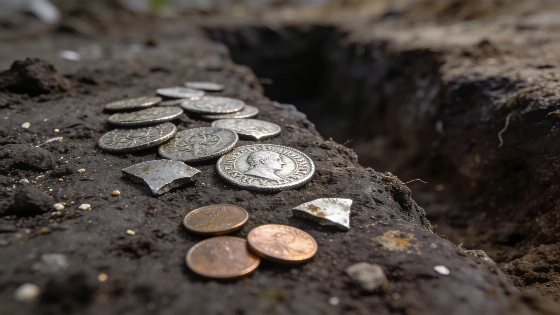
A hoard of 59 Islamic silver coins near the Vistula Lagoon and 266 Danish pennies from Ribe link early Abbasid silver with Baltic trade. Chemical tests suggest much of the Danish coins' silver came from Islamic coinage.
Researchers tested 25 pennies from Denmark and found trace elements suggesting that more than half the silver in each came from Islamic coins. The results add evidence to an earlier discovery near the Vistula Lagoon: 59 Islamic silver coins buried in the mid-810s.
The silver changed hands and form. Dirhams used or cut for exchange may have been melted down and struck into local pennies.
The 266 pennies were found in 2018 at Ribe, Denmark's oldest town and the site of an eighth- and ninth-century mint. A recent analysis used X-ray fluorescence to examine a sample of 25 coins. That sample points to a strong Islamic source for the silver, though it covers only a fraction of the hoard.
At least 30 dies were used to strike the pennies. One side bears a face traditionally associated with the Norse god Wodan; the other shows a stag. The coins appear to have been minted at Ribe. Researchers have suggested that their silver may have reached Scandinavia as ingots after being melted elsewhere.
Thomas Birch of the National Museum of Denmark said minting the coins in the hundreds of thousands would represent a huge quantity of Islamic silver. Each penny could buy ale or bread. Birch said it could also buy simple tools.
The Russian Academy of Sciences' Institute of Archaeology found the 59 coins while excavating an eighth-century settlement about 1.2 kilometres from the Vistula Lagoon in the Kaliningrad region. On the Polish side, the lagoon connects indirectly to the Baltic Sea through the Szkarpawa and Vistula rivers. On the Russian side, the Kaliningrad Lagoon reaches the Baltic through the Pilawa Strait.
The hoard contains 29 complete dirhams and 30 fragments. Many were deliberately cut in half, consistent with use as small change. Some have suspension holes, suggesting they may also have been worn as ornaments. Small cuts along other edges may record tests of silver purity and authenticity.
One coin was issued under Marwan II, the last Umayyad caliph. The other 58 are Abbasid dirhams, dating from 746 to 815. The latest coin points to burial around the mid-810s. Most were minted under Harun al-Rashid, who ruled from 786 to 809. Twenty-five came from Madinat al-Salaam, now Baghdad. Others were struck at al-Kufa. Additional coins came from Nishapur and al-Muhammadiyya.
The Abbasids took power in 750, and the hoard belongs to an early phase of Islamic silver circulation in Eastern Europe. Its archaeological record is especially valuable because the coins were documented during excavation. Earlier Islamic-coin finds in the Kaliningrad region were mostly dated to the 10th century. One was incomplete; another lacked enough excavation records to establish when it was buried.
In the first of four periods of Abbasid coin emissions, dirhams generally had silver fineness of .950 to .980 and a standard weight of about 2.9 to 3.1 grams. After about 767, the caliph's name often appeared on silver and copper coins. Local governors and other officials were also named on coins across the metals.
A separate Viking-age hoard found near the Glomma River in southern Norway offers another example of silver moving among regions. BR.az reported that more than 3,000 coins had been recovered there, including English coins. German and Norwegian examples were also found. The hoard was estimated to have been buried around 1040 to 1050, and excavation was continuing.
Ribe lies about 685 miles almost directly west of the Vistula Lagoon. Modern collector markets follow a different logic of scarcity and demand, covered in coin-market reporting. The Ribe pennies, by contrast, were everyday money. The finds place Islamic silver within networks that linked Vikings with merchants across Eastern and Northern Europe.