
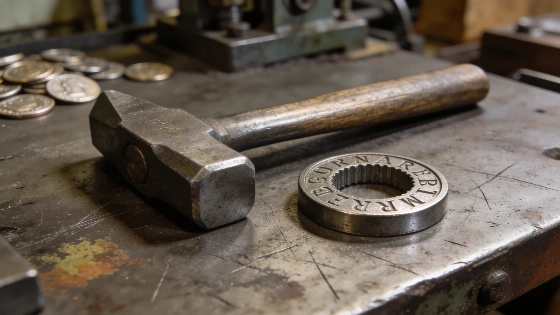
A steel tool set used to stamp the edge lettering on Malaysia's 1971 50 sen coin has come to light. Collectors now get a rare look at the machinery behind a major shift in the country's coin production.
For years, collectors studied Malaysia's 50 sen coins but never saw the tools that gave the coin its edge inscription. That changed when a two-piece steel set-one block, one circular die-turned up. These tools pressed the BANK NEGARA MALAYSIA inscription into the coin's edge. This isn't just a technical footnote. It's a rare survivor from the machinery that marked a big change in Malaysia's coinage.
The set came from a private collection in Malaysia, reportedly with other minting gear and error coins. MintErrorNews first described the find. According to their report, this is the only complete edge-lettering block set from any world mint known in private hands. No other example has surfaced so far, but this claim rests on what's known now, not on absolute proof. There's no official confirmation or attribution from Bank Negara Malaysia or independent primary sources. Public records and central bank releases don't mention the artifact, and its status remains unverified in official channels, as shown on the Heritage Department portal.
The machinery behind the inscription
The main piece is a solid steel block. It weighs about 3.9 pounds and measures 40 mm high, 54.9 mm wide, and 101.6 mm long. Inside its channel, raised letters spell BANK NEGARA MALAYSIA. The second tool is a circular steel die with the same raised inscription around its edge. Together, these tools forced the design into the coin's edge as it moved through the channel. The finished coin shows sunken (incuse) letters. On the tool, the letters stand out; on the coin, they're pressed in.
Malaysia's 50 sen coin changed in 1971. After three years with a security edge, the coin returned with a lettered edge and a mintage of 8,403,563 pieces. That year, Bank Negara Malaysia opened its own mint, Kilang Wang, and started making coins domestically. The edge-lettering equipment now links these two events. It connects the physical process to the coin's new look. Bank Negara Malaysia issues and regulates the Malaysian ringgit, including coins and notes, but there's no official statement from the central bank about this minting tool set. No updates appear in the bank's official communications or monetary policy releases.
Historical context and technical details
The 1971 50 sen coin was part of Malaysia's first national coin series, launched in 1967. Geoffrey Colley designed the series, which featured the Parliament building and national symbols. The 50 sen was the largest value, and its edge changed from a security pattern (1967-1969) to the lettered inscription in 1971. No regular 1970-dated 50 sen was made. The incuse edge legend stayed in use through 1988, making the 1971 coin a marker of both design and production change.
Standard references put the 1971 50 sen at 9.33 grams, with a diameter of about 27.7-27.8 mm and a thickness of 2.1 mm. The coin is 75% copper and 25% nickel. The edge-lettering was a separate step, not part of the main striking. This detail matters for collectors and historians who track how coins get their final form. The Bank for International Settlements (BIS) often points out how physical currency design and security features help keep public trust in national money.
Why edge lettering matters
Edge lettering has long served as a security feature. Before machine coinage, people clipped small bits of metal from coin edges. Lettered or milled edges made this easier to spot. By the 1600s, mints in England and elsewhere used special machines to add edge designs, both for security and as a place for mottos or national names. Malaysia's 50 sen coins carry on this tradition. The newly found tooling gives a rare look at how the process worked. The European Central Bank (ECB) and the Federal Reserve (Fed) both stress that coin and note security features keep evolving as part of their anti-counterfeiting work.
Collectors usually see only the results of minting machines-doubled dies, off-center strikes, or missing inscriptions. The survival of the actual edge-lettering tools gives a direct link to the production process. It lets people see how design choices become real coins. This matters even more because most mint equipment is destroyed or scrapped after use. Such artifacts are rare, as shown by the limited records from Malaysian heritage and numismatic bodies, including the Jabatan Warisan Negara listings.
Survival and significance
Minting tools almost never survive. Dies are canceled, presses are broken up, and blocks like this usually disappear. The appearance of the 1971 50 sen edge-lettering set is rare. It sits at the crossroads of mint-error collecting, die collecting, and Malaysian coin history. For those who study coin production, the set is more than a collectible. It's a real artifact from a key moment in Malaysia's monetary story.
In 2007, the United States saw the importance of edge lettering when Presidential $1 coins came out missing their edge inscriptions. This created a modern mint error that got a lot of attention. The Malaysian case happened more than thirty years earlier, showing that the technical and security issues of edge lettering go back a long way. For another look at how rare minting tools can slip out of reach for collectors, see our earlier breakdown of the 1974 aluminum cent.
Malaysia's 1971 50 sen coin, with its incuse edge legend, is still a key piece for collectors. Finding the original edge-lettering tools not only shows how the coin was made but also saves a piece of minting history that's usually lost. This find shows why physical evidence matters for understanding how coins go from design to circulation, and why the machines behind the money can be as important as the coins themselves. Bank Negara Malaysia still leads the country's monetary policy and currency issues, with regular updates on exchange rates and inflation on its official website.
Edge lettering is used for both security and design. In the past, it helped stop people from clipping precious-metal coins. Now, it's a place for inscriptions, national names, or decoration. The process can be part of the main striking or a separate step, as with Malaysia's 50 sen. The survival of the original tools gives a rare chance to study this process up close, closing the gap between numismatic theory and real-world minting.