
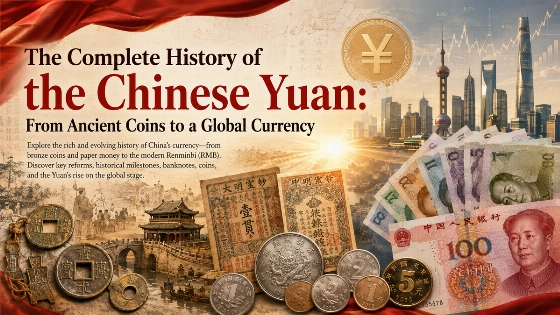
The Chinese yuan stands at the end of one of the world’s longest monetary histories, stretching from cowrie shells and bronze cash coins to paper money, silver dollars and the modern renminbi. This detailed guide explains the reforms, political crises and monetary institutions that shaped China’s currency, including the creation of the RMB in 1948, the 1955 redenomination and the development of the digital yuan.
From ancient cowrie shells and square-holed bronze coins to paper money, silver dollars, the modern renminbi and e-CNY, China’s currency history spans more than three millennia of monetary innovation and reform.
China’s monetary history stretches across more than three thousand years. It encompasses cowrie shells, bronze objects shaped like farming tools and knives, round coins with square holes, silver ingots valued by weight, some of the world’s earliest paper currencies, foreign trade dollars, revolutionary banknotes and, most recently, a central bank digital currency.
The modern Chinese yuan is therefore not simply a currency introduced in the twentieth century. It represents the latest stage in a long series of attempts to standardise money across one of the world’s largest and most commercially active territories.
The currency used in the People’s Republic of China is formally called the renminbi, meaning “the people’s currency”. Its basic unit is the yuan. The People’s Bank of China first issued renminbi banknotes on 1 December 1948, before the formal establishment of the People’s Republic in October 1949. The modern currency nevertheless inherited its unit name, decimal structure and many monetary ideas from reforms introduced during the late Qing dynasty and the Republican period.
Chinese Money in Seven Stages
- Cowries — Ancient commodity money.
- Bronze forms — Spades, knives and early coins.
- Cash coins — Round coins with square holes.
- Paper money — Jiaozi, chao and state notes.
- Silver systems — Taels, sycee and trade dollars.
- Renminbi — National currency from 1948.
- e-CNY — Central bank digital currency.
Chinese Yuan: Essential Facts
- Official currency name: Renminbi
- Chinese name: 人民币
- Meaning: “People’s currency”
- Basic unit: Yuan
- Chinese characters: 元 or 圆
- Subdivision: 1 yuan = 10 jiao = 100 fen
- International currency code: CNY
- Common abbreviation: RMB
- Offshore market designation: CNH
- Currency symbol: ¥
- Issuing authority: People’s Bank of China
- First renminbi issue: 1 December 1948
- Major redenomination: 1955, at 10,000 old yuan to 1 new yuan
Renminbi and Yuan: What Is the Difference?
The words renminbi and yuan are often used interchangeably outside China, but they do not have precisely the same meaning. Renminbi, commonly abbreviated as RMB, is the formal name of the currency, while yuan is the name of its principal unit. The relationship is comparable to the distinction between sterling and the pound in the United Kingdom: prices are expressed in pounds, while the currency itself is called sterling.
A product may therefore cost 100 yuan, although it would be less natural to say that it costs 100 renminbi. The yuan is divided into ten jiao, and each jiao is divided into ten fen. In everyday spoken Mandarin, yuan may also be called kuai, while jiao may be called mao.
The ISO currency code for the renminbi traded in mainland China is CNY. The designation CNH is used by financial markets for renminbi traded in offshore centres, particularly Hong Kong. CNH is not a separate national currency. It is the same renminbi operating within a market that has different liquidity, interest-rate and regulatory conditions.
The Earliest Forms of Chinese Money
China’s monetary history began long before the appearance of anything called a yuan. Cowrie shells were among the earliest objects used as stores of value and media of exchange in ancient China. Their portability, recognisable appearance and relative scarcity made them useful for commercial transactions and ceremonial payments. Their historical importance can still be seen in the Chinese writing system: the character 貝, meaning shell, appears in numerous characters connected with wealth, purchasing, trade and value.
As natural shells became insufficient for an expanding economy, imitations were produced from bone, stone, clay and bronze. This represented an important transition. Money was gradually moving from a naturally scarce object to a standardised item manufactured specifically for exchange.
During the Zhou period, particularly in the Spring and Autumn and Warring States eras, different states and regions issued their own forms of bronze money. The principal types included:
- Spade money, shaped like agricultural implements;
- Knife money, associated especially with eastern and northern states;
- Round coins with circular or square central holes;
- Ant-nose money, associated with the state of Chu.
These unusual forms were not merely decorative. They reflected the political fragmentation of ancient China. Each state controlled its own mints, weight standards, inscriptions and preferred monetary forms, creating a diverse system in which the value and acceptability of a coin depended heavily on where it had been produced.
Qin Unification and the Ban Liang Coin
One of the most important turning points in Chinese monetary history came in 221 BC, when the state of Qin defeated the rival Warring States and established China’s first unified imperial dynasty.
The Qin government abolished or displaced many regional forms of money and standardised the Ban Liang coin, a round bronze coin with a square hole in its centre. Qin Shi Huang did not simply invent the square-holed coin by changing an earlier universal round-hole design. Round coins with square openings had already circulated before imperial unification. The importance of the Qin reform was that the government imposed a common monetary form across the newly unified empire.
This shape became one of the most durable designs in monetary history. Round coins with square holes remained a central feature of Chinese currency for approximately two thousand years. The central opening allowed coins to be threaded onto cords, which was useful because individual copper coins had relatively little value and were often handled in strings. The square hole also helped prevent a coin from rotating while its edges were being filed or finished after casting.
The name Ban Liang referred to the coin’s intended weight. Early Chinese coin names were frequently connected with weight rather than a face value in the modern sense. Actual weights could nevertheless vary because of changes in administration, shortages of metal, debasement and local production practices.
The Han Dynasty and the Wuzhu Coin
The short-lived Qin dynasty was followed by the Han dynasty, which further developed imperial monetary administration. A particularly important reform came in 118 BC with the introduction of the Wuzhu coin. Like the Ban Liang, it was a round cast coin with a square central hole, but it belonged to a new monetary standard.
The Han government increasingly centralised coin production. Control over minting was not merely a technical matter; it was an expression of state authority. A government capable of issuing widely accepted money could collect taxes, supply armies, purchase grain, pay officials and regulate commerce across distant regions.
The Wuzhu became one of the longest-lived coin types in Chinese history. Variants continued to circulate or be produced under several later governments, demonstrating the economic value of a familiar and trusted monetary standard.
Maintaining coin quality was nevertheless difficult. Chinese governments repeatedly faced the same problems:
- Shortages or rising prices of copper;
- Private casting and counterfeiting;
- Differences between nominal and metallic value;
- Hoarding of heavier or higher-quality coins;
- The fiscal temptation to issue lighter coins;
- High transport costs for large quantities of low-value copper money.
These pressures eventually encouraged China to experiment with forms of payment that did not depend entirely on metal.
Tang Coinage and the Kaiyuan Tongbao
In 621, during the Tang dynasty, the government introduced the Kaiyuan Tongbao coin. It marked a conceptual change in Chinese monetary history. Earlier names such as Ban Liang and Wuzhu referred to weight units, whereas Kaiyuan Tongbao used an inscription that could be understood as “circulating treasure of the new era” or “inaugural circulating treasure”.
The coin helped establish a naming convention in which terms such as tongbao, meaning circulating treasure, and yuanbao, meaning original or primary treasure, appeared on later Chinese coinage. It also influenced the development of the unit commonly known as the wen, or cash. For centuries, everyday transactions could be expressed in copper cash coins, while larger sums were represented by strings of coins or by higher-value forms of money.
Tang China possessed an extensive commercial economy linking agricultural regions, major cities, frontier markets and international trade routes. Moving large quantities of copper coins over long distances was expensive and insecure, so merchants and officials developed transfer mechanisms that allowed value to be deposited in one place and collected elsewhere.
One such instrument became known as flying cash. It was an early remittance or transfer certificate rather than a modern banknote that circulated permanently from one person to another. Even so, it demonstrated that written claims could perform some of the functions previously reserved for metallic money.
The Song Dynasty and the Invention of Circulating Paper Money
The most important breakthrough in early paper currency occurred during the Song dynasty. The Song economy was highly commercialised, and its large cities, expanding internal trade, growing population and sophisticated merchant networks created demand for forms of payment that were easier to transport than strings of copper coins.
The problem was especially serious in Sichuan, where copper was scarce and heavy iron coins were widely used. A large payment could require transporting an impractical weight of metal.
Private merchant houses began issuing deposit receipts known as jiaozi. A customer could deposit coins with an issuing house and receive a paper certificate representing the value of that deposit. The certificate could then be transferred or redeemed elsewhere.
These private notes depended on confidence in the issuer. When some issuing houses failed or printed more claims than they could redeem, the government intervened. During the Northern Song period, the state established greater control over jiaozi issuance and began producing official notes.
Government-issued jiaozi of the early eleventh century are widely regarded as the world’s first state-issued paper currency designed for general circulation. They were more than simple warehouse receipts because they could pass through several transactions before being redeemed.
Paper money offered several important advantages:
- It was lighter than copper or iron coins;
- It reduced transport and storage costs;
- It made large payments easier;
- It supported commerce across a large territory;
- It gave the government a new way to manage the money supply.
The same system also introduced a major risk. The supply of paper money was no longer naturally constrained by the availability of copper, silver or another metal. Governments could issue additional notes to meet military or fiscal needs, potentially causing depreciation and inflation. This tension between convenience and credibility would recur throughout the history of Chinese paper currency.
Paper Currency Under the Yuan Dynasty
The Mongol-led Yuan dynasty took the use of paper money further than earlier Chinese governments. Yuan rulers governed an enormous territory and promoted long-distance trade across much of Eurasia. A standardised paper currency helped the state collect revenue, provision armies and connect regions that used different local monetary traditions.
The Yuan government issued several forms of paper currency, often called chao, and attempted to establish government notes as the principal medium for taxation and commerce. Silver continued to play an important role in valuation and large transactions, but paper money became more central to the official monetary system than it had been under earlier dynasties.
The European traveller Marco Polo famously described the paper money of Kublai Khan’s empire. He explained that the notes were made from material associated with the mulberry tree, authenticated by government officials and accepted under imperial authority. His account introduced many European readers to the idea of a government creating widely accepted money from paper rather than precious metal.
The value of Yuan banknotes did not come from the material from which they were made. It came from the state’s willingness to accept them for taxes, require them in many transactions and enforce their circulation.
The system was not permanently stable. Successive issues, military demands, insufficient redemption and excessive production weakened confidence. When too many notes were issued relative to available goods and reserves, their purchasing power declined. The Yuan experience demonstrated both the administrative potential of paper currency and the dangers created when issuance exceeded public confidence.
Ming Banknotes and the Return of Silver
The Ming dynasty initially attempted to preserve a state paper-money system and issued notes known as Da Ming Baochao, or Great Ming Circulating Treasure notes. These banknotes carried official seals, denomination information and severe warnings against counterfeiting, while surviving examples demonstrate the sophistication of early Chinese note production.
The government did not maintain an effective and reliable system of convertibility. Continued issuance caused the notes to lose value, and merchants increasingly preferred copper coins, silver and other forms of payment.
Silver gradually became central to taxation, wholesale commerce and the storage of wealth. Much of it circulated by weight rather than as standardised government coins. Silver ingots commonly described in English as sycee were produced in many shapes and sizes, with their value determined by weight and purity. Merchants, money shops and specialists tested, weighed and marked the ingots before accepting them.
A silver transaction could require knowledge of:
- The weight of the metal;
- Its level of purity;
- The local tael standard;
- Assaying and handling charges;
- The exchange rate between silver and copper cash;
- Regional commercial practices.
The growing importance of silver also connected China more deeply to global trade. Silver from Japan and the Americas entered Chinese markets in exchange for products such as silk, porcelain and tea, making China one of the principal destinations in the emerging global silver economy.
The Qing Monetary System
The Qing dynasty inherited a monetary system in which different forms of money served different purposes. Copper-alloy cash coins were widely used for small retail purchases. They generally retained the traditional round shape and square central hole, with inscriptions identifying the reigning emperor and the idea of a circulating treasure.
Silver was more important for taxation, large payments, wholesale commerce and accounting. It was measured in units commonly translated as taels, although the exact weight represented by a tael varied between regions, institutions and commercial sectors.
China therefore did not possess a simple modern bimetallic system with a permanently fixed exchange rate between copper and silver. Instead, it had overlapping monetary zones and changing market rates. A person might receive income in copper cash, owe taxes calculated in silver and encounter prices expressed according to a local accounting standard. Changes in the relative value of copper and silver could create serious economic problems, especially for households that earned in one form of money and paid obligations in another.
Foreign silver coins became increasingly important in coastal and commercial regions. Spanish-American eight-real coins, commonly called Spanish dollars or pieces of eight, and later Mexican pesos circulated widely in Chinese trade.
These coins were valued because they contained a relatively predictable quantity and quality of silver. Chinese merchants frequently applied small stamps, known as chop marks, after testing them.
The Spanish and Mexican dollars did not become important primarily because of Spain’s presence on Guam. They entered Chinese commerce through a much larger network of maritime trade linking Spanish America, Manila, European merchants and Chinese ports.
By around 1800, the Spanish Carolus dollar had become an important monetary standard in Chinese markets. Mexican dollars later achieved similar prominence, although merchants sometimes valued particular designs or mints differently even when their silver content was comparable.
The Birth of the Yuan as a Silver Coin
The word yuan is associated with the idea of a round object or round coin. In the late nineteenth century, it became connected with a standardised Chinese silver dollar intended to compete with the foreign silver coins already circulating in the country.
In 1889, the Guangdong provincial administration began producing machine-struck silver coins based on the international silver-dollar format. Imported minting machinery was installed in Guangzhou, and the resulting issues included a large silver unit that became known as a yuan. Many of these coins featured a dragon, leading collectors to call them dragon dollars.
The new yuan belonged to the same broad commercial tradition as the Spanish dollar and Mexican peso. It did not immediately replace China’s complex monetary system. Qing China still used:
- Foreign silver dollars;
- Provincial Chinese silver coins;
- Silver ingots;
- Copper cash;
- Machine-struck copper coins;
- Banknotes issued by different institutions;
- Local accounting units.
Provincial mints produced coins with different designs and sometimes different technical standards. The central government repeatedly attempted to create a more uniform national currency, but political fragmentation and competing regional interests made implementation difficult.
The decimal system eventually associated with the yuan divided it into ten jiao and one hundred fen. In some historical accounting systems it could also be related to one thousand cash or wen, although the practical exchange rate between the new coins and older copper cash varied according to market conditions.
The yuan was therefore not created in a single, completely unified reform. It emerged gradually as China moved from money valued largely by metal weight and local custom towards nationally denominated and machine-produced coinage.
Republican China and Currency Fragmentation
The Qing dynasty ended in 1912, but the new Republic of China inherited a deeply fragmented monetary system. Different governments, provincial authorities, military regimes, foreign banks and Chinese commercial banks issued or circulated their own forms of money. Silver dollars remained important, but their designs, quality and acceptance varied.
Political instability made monetary unification difficult. During the warlord era, control over a mint or a note-issuing bank could provide a regional government with essential revenue. This created a recurring conflict between the need for a credible national currency and the short-term financial needs of competing authorities.
Despite political fragmentation, silver dollars helped connect regional markets because their metallic value could be recognised even when confidence in a particular government was weak. Foreign silver coins and Chinese issues circulated alongside banknotes and traditional silver accounting units.
The Nationalist government established at Nanjing attempted to strengthen central authority and construct a more coherent monetary system. Achieving this required not only new banknotes and coins but also national banking institutions, reserve management, control of mints and public confidence.
The 1935 Currency Reform and the Fabi
Until 1935, China remained closely tied to silver at a time when most major economies had moved away from silver-based monetary systems. This exposed the Chinese economy to international fluctuations in the price of the metal. When silver became more valuable abroad, it could leave China, contracting the domestic money supply and placing pressure on prices, banks and borrowers.
On 4 November 1935, the Nationalist government introduced a major currency reform. It ended the monetary use of silver dollars and bullion and established designated banknotes as legal tender. Holders of monetary silver were required to exchange it for the new notes.
The resulting currency became known as fabi, meaning legal-tender currency. It was a managed paper currency rather than a conventional gold-backed system, and the government attempted to stabilise it using foreign-exchange reserves and managed relationships with currencies including the US dollar and British pound.
The reform:
- Reduced the fragmentation of the monetary system;
- Strengthened the role of central government banks;
- Separated domestic money from changes in the world price of silver;
- Gave the government greater control over currency issuance;
- Created a more unified national medium of payment.
The system’s stability nevertheless depended on fiscal discipline, reserve management and confidence in the government.
War, Inflation and the Collapse of Nationalist Money
The Second Sino-Japanese War, which began on a full scale in 1937, placed immense pressure on China’s finances. The government had to fund military operations while losing access to important tax bases and productive regions. As expenditure exceeded reliable revenue, money creation became an increasingly important source of finance.
Inflation accelerated during the war and continued after Japan’s defeat in 1945. China then entered a renewed and decisive phase of civil war between the Nationalist government and the Chinese Communist Party. Budget deficits, disruption of production, declining confidence and continued note issuance combined to produce extreme inflation.
In August 1948, the Nationalist government attempted another monetary reset by introducing the gold yuan. Despite its name, the currency did not possess sufficient reserves or credibility to restore lasting confidence.
The authorities attempted to control prices and required people to surrender gold, silver and foreign currency. The system rapidly deteriorated. Market exchange rates diverged from official rates, prices rose and the gold yuan lost purchasing power.
The collapse of the fabi and gold yuan was more than a technical monetary failure. It damaged salaries, contracts, savings and confidence in Nationalist institutions. Currency instability became part of the wider political and social crisis that preceded the Communist victory on the mainland.
The Creation of the Renminbi in 1948
Before controlling the whole mainland, the Chinese Communist Party administered several regional base areas that used currencies issued by local or regional banks. As Communist-controlled territory expanded, the existence of multiple currencies became increasingly inconvenient. A unified currency was needed to support trade, collect revenue, supply armies and integrate newly controlled cities and provinces.
The People’s Bank of China was established on 1 December 1948 in Shijiazhuang through the consolidation of the Huabei Bank, Beihai Bank and Xibei Farmers Bank. On the same day, it began issuing the renminbi.
The first renminbi series appeared before the formal founding of the People’s Republic of China. As Communist forces gained control of more territory, the renminbi displaced regional revolutionary currencies and the rapidly depreciating Nationalist money.
After the establishment of the People’s Republic on 1 October 1949, the renminbi became the legal currency of mainland China.
The first series contained numerous designs and unusually large denominations. Some notes had values of thousands or tens of thousands of yuan, partly reflecting the inflationary monetary environment inherited from the final years of war and political fragmentation.
Unlike the final Nationalist currency reforms, the introduction of the renminbi was accompanied by a new political authority, a unified banking structure and increasingly extensive control over taxation, prices, commerce and credit.
The 1955 Redenomination
By the early 1950s, the new government had brought inflation under greater control and consolidated the national monetary system. The extremely large denominations of the first renminbi series were no longer convenient for everyday transactions and accounting.
In 1955, China introduced a new banknote series and redenominated the currency at the following rate:
10,000 old yuan became 1 new yuan.
The reform removed four zeros from prices, wages, accounts and cash balances. It did not create an entirely new currency; it rescaled the existing renminbi and made the unit easier to use.
The new decimal relationship was:
- 1 yuan;
- 10 jiao;
- 100 fen.
The reform also marked China’s transition from the emergency monetary conditions of revolution and civil war towards a more standardised national currency system.
The Five Series of Renminbi Banknotes
The People’s Bank of China has issued five principal series of renminbi banknotes.
First Series
The first series began in 1948 and was designed for a country that was still being politically and monetarily unified. It included many denominations and designs depicting agriculture, industry, transport, landscapes and economic activity. Its highest values reflected the inflated monetary scale inherited from the preceding period.
Second Series
The second series accompanied the 1955 redenomination. It used the new monetary scale and created a more manageable range of yuan, jiao and fen denominations. These notes represented the centralised monetary system of the early People’s Republic.
Third and Fourth Series
Later issues introduced new designs, printing methods, denominations and security features. Banknotes increasingly served not only as payment instruments but also as expressions of national identity. Their images represented agriculture, industrial development, political leadership, national unity, landscapes and modernisation.
The fourth series was particularly associated with the reform-era economy and the expansion of cash transactions from the 1980s onwards.
Fifth Series
The fifth series began in 1999, with later revisions appearing in 2005, 2015, 2019 and 2020. These changes improved anti-counterfeiting technology, machine readability, printing quality and accessibility.
As mobile and digital payments expanded, the role of physical banknotes changed. Cash nevertheless remained legal tender and continued to be important for emergencies, tourism, accessibility, small transactions and people who did not use digital payment platforms.
The Yuan Under the Planned Economy
For much of the Mao-era planned economy, the renminbi was not a freely convertible international currency. The state controlled foreign trade, banking, prices and access to foreign exchange. Official exchange rates functioned as administrative instruments and did not necessarily represent the value that a freely operating international market would have assigned to the currency.
The domestic role of the yuan was therefore far greater than its international role. It served as the national unit for wages, retail prices, government accounts and state-enterprise transactions, while foreign participation in the Chinese currency system remained limited.
This began to change after the economic reforms launched from the late 1970s.
Exchange-Rate Reform and the 1994 Unification
As China opened its economy to international trade and investment, its exchange-rate system had to adapt. During the reform period, official rates coexisted with other mechanisms through which exporters, importers and enterprises obtained or sold foreign currency. These different rates and access rules created distortions but also allowed the government to move gradually away from the earlier administrative system.
In 1994, China introduced a major foreign-exchange reform that brought previously separate exchange-rate channels together. The reform did not create a completely free-floating currency. The People’s Bank of China continued to manage the rate and intervene in the foreign-exchange market.
Nevertheless, the 1994 change was an important step towards a system in which trade flows, market transactions and central-bank management jointly influenced the value of the renminbi.
The Dollar Link and the 2005 Reform
For approximately a decade before July 2005, the renminbi was maintained at about 8.28 yuan per US dollar. The arrangement offered stability to exporters, importers and investors, but it became increasingly controversial as China accumulated large trade surpluses and foreign-exchange reserves.
On 21 July 2005, the People’s Bank of China changed the system. The currency was revalued to 8.11 yuan per US dollar, and the authorities announced that its value would be managed with reference to a basket of currencies rather than the dollar alone. The initial appreciation was approximately 2.1%.
China now describes its framework as a managed floating exchange-rate regime based on market supply and demand, with reference to a basket of currencies.
The renminbi is therefore neither permanently fixed to the dollar nor permitted to float without official management. Its value is influenced by:
- The central bank’s daily reference rate;
- Permitted trading bands;
- Market demand and supply;
- Foreign-exchange intervention;
- Trade and capital flows;
- Domestic monetary policy;
- Regulatory decisions.
The Internationalisation of the Renminbi
For most of its modern history, the renminbi was used mainly within mainland China. This began to change as China became one of the world’s largest trading economies.
In 2009, the authorities introduced a pilot programme allowing selected companies and regions to settle certain cross-border trade transactions in renminbi. This reduced the need for Chinese and foreign companies to use a third currency, usually the US dollar, for every international payment.
Hong Kong became the most important early offshore renminbi centre. Other financial centres later developed renminbi clearing, deposits, bonds and payment services. The offshore market led to the widespread use of the designation CNH, while the mainland market continued to use CNY.
China also expanded access to renminbi-denominated securities and financial markets. Central banks established currency-swap agreements with the People’s Bank of China, while companies increasingly used the renminbi for trade settlement, financing and investment.
The Renminbi and the IMF SDR Basket
A major institutional milestone came on 1 October 2016, when the renminbi entered the International Monetary Fund’s Special Drawing Rights basket.
It became the fifth currency in the basket, alongside:
- The US dollar;
- The euro;
- The Japanese yen;
- The British pound;
- The Chinese renminbi.
Inclusion did not make the renminbi fully convertible or give it the same international role as the US dollar. It nevertheless represented recognition of China’s economic importance and the increasing use of its currency in international finance.
The IMF also began identifying renminbi holdings separately in its data on official foreign-exchange reserves. The currency’s international development remains gradual and is influenced not only by the scale of Chinese trade but also by capital controls, financial-market access, exchange-rate policy, legal confidence and the availability of renminbi-denominated assets.
The Digital Yuan: e-CNY
The newest stage in the history of Chinese money is the digital renminbi, commonly called e-CNY.
The e-CNY is a central bank digital currency issued by the People’s Bank of China. It is not a cryptocurrency such as Bitcoin and is not a privately issued stablecoin. It is a digital form of the same sovereign currency represented by physical banknotes and coins.
The People’s Bank of China treats e-CNY as part of M0, the category that includes money in circulation. It is designed as a direct central-bank liability and is generally non-interest-bearing.
The system uses a two-tier structure. The central bank issues e-CNY through authorised commercial institutions and payment providers, which then distribute digital wallets and services to businesses and consumers.
Pilot programmes have included retail payments, public services, transport, government-related payments and selected cross-border experiments. Proposed or tested features include:
- Digital wallets with different identification and balance limits;
- Payments without a traditional bank account in some circumstances;
- Offline or limited-connectivity payments;
- Programmable functions for particular institutional uses;
- Faster settlement;
- Improved payment accessibility;
- Greater resilience and competition within the payment system.
The e-CNY is not a redenomination and does not create a second Chinese currency. One digital yuan has the same unit value as one physical yuan. Nor does the project mean that all banknotes will be withdrawn on a single date. It represents an additional form of central-bank money operating alongside cash, bank deposits and private payment platforms.
Timeline of Chinese Currency History
- Ancient China: Cowrie shells and manufactured imitations are used as media of exchange.
- Zhou period: Regional governments issue spade, knife, round and other forms of bronze money.
- 221 BC: Qin unification establishes the Ban Liang system across the empire.
- 118 BC: The Han government introduces the Wuzhu coin.
- 621: The Tang dynasty introduces the Kaiyuan Tongbao.
- Tang period: Flying cash and long-distance transfer certificates develop.
- Early eleventh century: Private and later government-issued jiaozi circulate in Sichuan.
- Yuan dynasty: Government paper currency becomes central to the official monetary system.
- Ming dynasty: Da Ming Baochao notes depreciate and silver becomes increasingly important.
- Qing dynasty: Copper cash, silver taels, sycee and foreign silver dollars circulate together.
- Around 1800: Spanish Carolus dollars become an important standard in Chinese trade.
- 1889: Guangdong begins producing machine-struck Chinese silver yuan coins.
- 1912: The Republic of China inherits a fragmented monetary system.
- 4 November 1935: The Nationalist government ends the silver standard and introduces fabi.
- August 1948: The gold yuan is introduced during severe inflation.
- 1 December 1948: The People’s Bank of China is established and issues the first renminbi.
- 1 October 1949: The People’s Republic of China is established.
- 1955: The renminbi is redenominated at 10,000 old yuan to 1 new yuan.
- 1994: China unifies major foreign-exchange channels.
- 21 July 2005: The dollar link is modified and a managed basket-based system is announced.
- 2009: A pilot programme for cross-border RMB trade settlement begins.
- 1 October 2016: The renminbi enters the IMF Special Drawing Rights basket.
- 2020s: e-CNY pilot applications expand.
Why the History of the Yuan Matters
The history of the Chinese yuan is not a simple progression from primitive coins to modern banknotes. China repeatedly moved between different monetary principles:
- Money valued according to physical material;
- Coins guaranteed by imperial authority;
- Silver weighed according to commercial custom;
- Paper representing deposits;
- Paper supported by taxation and legal-tender rules;
- Fiat currency managed by a central bank;
- Digitally recorded central-bank money.
Several themes appear throughout this history.
The first is standardisation. From the Qin coinage reforms to the introduction of the renminbi, Chinese governments repeatedly attempted to replace regional fragmentation with a common national monetary system.
The second is confidence. Paper money could function only when users believed that it would retain value and be accepted by others. The depreciation of Yuan and Ming notes, the inflation of the 1940s and the stabilisation of the early People’s Republic all demonstrate that currency depends on institutions as much as on printing technology.
The third is the relationship between China and the global economy. American silver, Mexican pesos, offshore renminbi trading, international payment systems and IMF reserve classifications show that Chinese money has never developed in complete isolation.
The fourth is the continuing tension between state control and market forces. Imperial mint monopolies, silver regulations, managed exchange rates, capital controls and the design of e-CNY all reflect the government’s effort to preserve monetary authority while supporting an increasingly complex economy.
Conclusion
The modern Chinese yuan is the product of one of the longest and most varied monetary histories in the world. Its ancestry includes bronze spades and knives, Qin square-holed coins, Han Wuzhu cash, Tang circulating treasures, Song jiaozi, Yuan paper notes, Ming silver, Qing sycee, Mexican trade dollars, dragon coins, Republican fabi and the first renminbi banknotes of 1948.
The renminbi used today is not simply a direct continuation of every earlier Chinese currency. It is a modern central-bank currency created during the political and economic transformation of the late 1940s.
Yet its name, unit structure and institutional role can only be fully understood within the much longer history of Chinese attempts to make money portable, trustworthy, uniform and acceptable across a vast territory.
From bronze coins carried on strings to digital units stored in electronic wallets, the central problem has remained remarkably consistent: how to create a form of value that individuals, merchants and governments will all agree to accept.