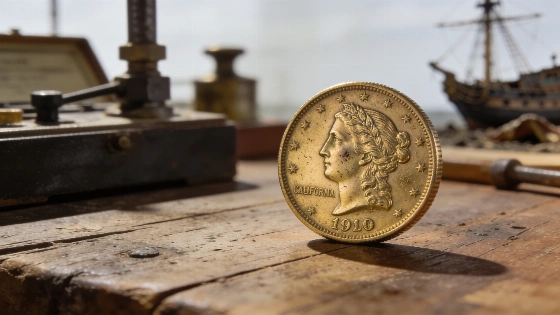
A legendary 1852 Wass Molitor Close Date $10 gold coin, tied to the California Gold Rush and a famous shipwreck, has sold for $354,375 at GreatCollections. The sale spotlights its extreme rarity and the tangled story of private gold coinage in San Francisco.
Collectors just saw a piece of California's private gold history set a new benchmark. The 1852 Wass, Molitor & Company $10 Close Date gold coin, once thought nearly impossible to own, brought in $354,375 at GreatCollections. This price reflects more than its technical grade. The coin's story runs through revolution, migration, and a shipwreck. The auction drew 74 bids from 16 people. Demand was fierce. Reuters and Yahoo News both confirmed the buzz.
For years, collectors believed only one of these coins existed. That changed after the S.S. Central America went down in 1857, taking a load of California gold with it. The wreck's recovery turned up four more coins. Even now, the total number of survivors is unclear. GreatCollections says six are confirmed. Earlier reports said the coin was unique before these finds. The coin just sold is the best known. PCGS graded it AU-58, and it carries a CAC Green sticker. Its pedigree runs through the A.C. Nygren and Louis E. Eliasberg Sr. collections. It's also the Red Book plate coin for this variety.
Private gold in a city flooded with bullion
San Francisco in the early 1850s was awash in gold dust and bullion. But there was a problem. People needed coins for daily life, and federal money was scarce. The United States Assay Office made only big, awkward coins. Into this mess stepped Count Samuel C. Wass and Agoston P. Molitor. Both were Hungarian exiles with deep mining and metallurgy skills. They fled the failed 1848 Hungarian Revolution and set up an assay office in San Francisco in 1851. Their reputation grew fast. They could process gold in two days. Others took a week or more.
By January 1852, Wass, Molitor & Co. started making $5 and $10 gold coins. Merchants and miners snapped them up. The coins had a bit less gold fineness than federal coins, but they were heavier. That made them popular in trade. PCGS cites old reports showing a $5 Wass, Molitor coin held about $5.04 in gold by U.S. Mint standards. The firm sometimes made $7,000 to $8,000 in coins per day. Their coins often traded above federal assay office coins. This was a time of wild swings in gold prices and exchange rates. The U.S. dollar's value was tied to gold. That link is still tracked by the Federal Reserve in its policy decisions.
The Close Date variety and its survival
The 1852 $10 coin from Wass, Molitor & Co. looks a lot like the federal Liberty Head Eagle. But Liberty's coronet shows the partners' initials: W. M. & CO. The reverse reused a die from Dubosq & Company's earlier $10 coin. By the time the Close Date variety was struck, the reverse die was badly cracked. It failed after only a few coins. That made the Close Date-catalogued as Kagin-5-extremely rare. Its key features: a short-neck Liberty and a tightly spaced 1852 date. Auction house statements call this the rarest $10 Wass, Molitor & Co. variety. They point to "excellent detail, strong originality, and remarkable preservation" as reasons for the record price.
For a long time, the Nygren-Eliasberg coin was thought unique. The S.S. Central America recovery changed that. Four more Close Date coins surfaced. Still, this variety is one of the great rarities of California private gold. GreatCollections lists six known. Greysheet lists eight. The true count is still debated. But its status as a trophy coin is not. The rarity stands out even more after 1854. That year, the federal mint opened in San Francisco. Private gold coinage faded fast. This shift echoes how central banks like the European Central Bank (ECB) now manage currency and stability across the euro area.
Historic pedigree and auction action
This coin's path through the hands of A.C. Nygren and Louis E. Eliasberg Sr. adds to its legend. When Bowers and Merena sold the Eliasberg gold collection in 1996, the Close Date $10 was Lot 360. At that time, it was still believed unique. Numismatic researchers Dr. Donald H. Kagin and David McCarthy have called this the only known Mint State coin of its type. Today, it sits in a PCGS AU-58 holder. The September 27, 2026 auction was part of GreatCollections' Centennial Collection of Territorial Rarities. That sale included eight PCGS-certified coins and drew 475 bids. The Wass, Molitor Close Date alone got 74 bids. The hammer price was $315,000 before buyer's premium. The final price: $354,375. That number shows both the coin's rarity and the strong demand for real assets. Global inflation indices like the U.S. Consumer Price Index (CPI) have stayed volatile. Investors are looking beyond government bonds and paper money.
Here are the coin's specs: made by Wass, Molitor & Company in San Francisco in 1852, $10 denomination, private and pioneer gold, Kagin-5 catalog number. The front shows Liberty with W. M. & CO. on the coronet and the date below. The back has a heraldic eagle and the words S.M.V. CALIFORNIA GOLD / TEN D. The edge is reeded. It's a business strike. This coin survived in high grade, with a clear pedigree and a direct link to both the Gold Rush and the S.S. Central America shipwreck. Few other territorial gold coins can match that.
Modern collectors often chase headline-grabbing new rarities. But coins like the Wass, Molitor Close Date $10 tell a deeper story. The Gold Rush was not just about sudden riches. It was about making do and private effort when official systems fell short. These coins traded at a premium. Their survival is rare. That's why collectors value them so highly. Even as modern coins grab attention, this sale proves that rarity, pedigree, and history still rule the top of the numismatic market. The Bank for International Settlements (BIS) keeps studying how gold and other reserve assets affect global financial stability. The lesson: old coins still matter.
Other recent events show rare coins still draw crowds. Stack's Bowers staged a $40,000 coin hunt across four US cities. But few modern stunts can match the layered history and real scarcity of the 1852 Wass, Molitor Close Date $10. This coin links continents, revolutions, and shipwrecks. All in one gold disc.
Private coinage and the limits of official money
The California Gold Rush showed how official US coinage fell short in fast-growing frontier towns. Federal mints could not keep up. Private assayers and coiners stepped in. They made gold coins that people used alongside, or even instead of, official money. These private coins did not always match federal standards. Trust, weight, and value mattered more. Wass, Molitor & Co. proved that skill and business sense could build a parallel money system, at least for a while. The region had plenty of gold, but not enough spendable coins. The story of these coins lives on. Not just in auction records, but in the ongoing interest in how money adapts to what people need.