
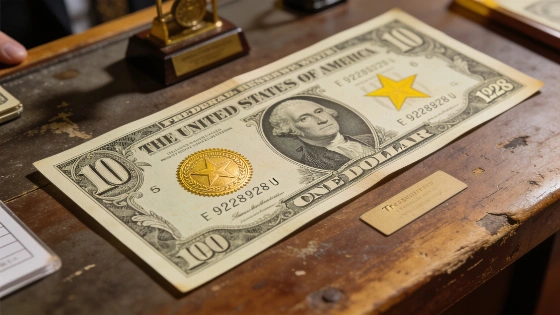
A 1928 $10 Gold Certificate Star Note in uncirculated condition has sold for $3,840, highlighting its scarcity and the impact of the 1933 gold recall on surviving US paper money. Collectors continue to pay steep premiums for these elusive notes.
Collectors saw a clear signal in March 2026. A 1928 $10 Gold Certificate Star Note, graded Choice Uncirculated 63, brought $3,840 at Stack's Bowers. The price wasn't just about age. It was about rarity, history, and condition. This note survived a vanished era of American money. The market took notice.
This isn't a typical piece of US paper money. The 1928 $10 Gold Certificate Star Note, listed as Friedberg #2400*, sits at a crossroads for collectors. It was the first small-size $10 gold certificate. It marked Alexander Hamilton's debut on this bill. It's also a replacement note, printed in sharply limited numbers. The yellow-gold Treasury seal and matching serials, plus signatures from W. O. Woods and Andrew Mellon, tie it to the early days of modern US currency. These details are confirmed in numismatic references and the JM Bullion numismatic guide.
Replacement notes and the star designation
Star notes fill a special role. They replace bills found defective during printing. The Bureau of Engraving and Printing made far fewer star notes than regular issues. That makes them tough to find, especially in top grades. Collectors know this. The price gap is huge. A standard 1928 $10 Gold Certificate in MS 63 usually sells for $480 to $1,000. A star note in the same grade jumps to $2,250 or more. Some high-grade examples reach $15,000. Even worn star notes rarely fall below $200. This premium comes straight from the small print runs and the tradition of replacement notes. US paper money catalogs and Federal Reserve records back this up.
Recent sales show these numbers hold. On big online platforms, high-grade star notes have listed for $2,388.88. Collectors are willing to pay for rarity and condition. The $3,840 result at Stack's Bowers isn't a fluke. It matches the market's hunger for these notes. The rare currency market is strong. At the Stack's Bowers summer 2026 auction, a 1928 $500 Gold Certificate brought $170,800, as reported by Greysheet. Pre-1933 gold-backed notes still draw big money.
Historical forces and survival rates
The story of the 1928 $10 Gold Certificate is tied to the early 1930s. The 1933 Gold Recall Order cut its production short. Americans had to turn in gold coins and gold-backed paper money. Millions of gold certificates were destroyed. No one knows exactly how many survived. Uncirculated star notes are now just a tiny fraction of what was printed. Most were redeemed or worn out. Few pristine notes remain. The Federal Reserve's move away from gold-backed currency in 1933-1934 changed the US money system. The Federal Reserve monetary policy archive documents this shift.
Choice Uncirculated 63 means a note never entered circulation. It might show a small handling mark or a slight margin shift. For the 1928 $10 Gold Certificate Star Note, this grade is rare. First-year design, replacement status, and uncirculated condition make each survivor a prize for advanced collectors. Few can find one.
Market data and collector impact
Market data from February 2026 proves the premium is real. The $3,840 sale at Stack's Bowers sits at the high end for MS 63 star notes, but it's not a record. The price reflects both the grade and the note's layered history. For comparison, a reported earlier sale of an 1852 gold coin at GreatCollections hit $354,375. Rarity and history drive collector markets for both coins and paper money.
The 1928 $10 Gold Certificate Star Note keeps its appeal for several reasons. It's a first-of-its-kind issue. It's a replacement note. It survived the government recall and mass destruction. For collectors of US gold certificates or replacement notes, Friedberg #2400* is more than a trophy. It's a benchmark for what makes American currency real and valuable.
Gold certificates once anchored US currency. They proved the Treasury held gold and could pay on demand. The 1928 series brought smaller notes and new designs. The 1933 recall ended gold-backed paper money for the public. Surviving notes became artifacts and collector prizes. Star notes, made in small runs to replace damaged bills, are even scarcer. Their rarity is built in. Today, these notes show what it meant when money was tied to gold-and how fast government policy could wipe out a whole class of currency. The Federal Reserve, International Monetary Fund, and Bank for International Settlements still track how currency systems change. Lessons from the gold standard era shape today's monetary policy frameworks.