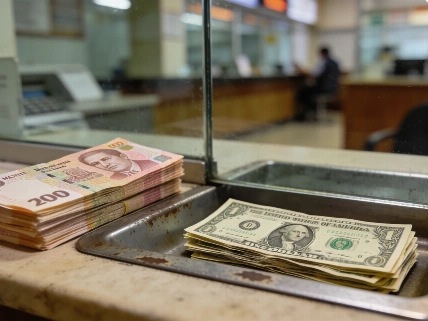


Japan's largest-ever currency intervention has failed to keep the yen from weakening, with the dollar-yen rate climbing back above 160. Analysts warn that without policy changes, further interventions may have only short-lived effects
The Japanese yen has once again weakened against the US dollar, with the USD/JPY exchange rate closing at 160.10 on Friday. This move comes despite Japan's most extensive foreign-exchange intervention to date, raising questions about the effectiveness of such operations when underlying economic forces remain unchanged. The yen's renewed slide has reinforced concerns among analysts that currency intervention alone cannot counteract persistent market pressures.
Record Spending, Limited Impact
Between 30 July and 26 August, Japanese authorities spent a record ¥15.4 trillion (approximately $96.5 billion) in an effort to support the yen. The intervention, which included coordinated action with US officials, initially pushed the dollar-yen rate down by nearly five yen. However, the effect proved temporary, as the exchange rate quickly rebounded above the 160 mark. According to a report from UniCredit, the central issue is not whether intervention can move the market in the short term, but whether it can overcome deeper factors such as the wide interest-rate gap between Japan and the United States, Japan's expansionary fiscal policy, and the economic strain from high imported energy costs.
Market Drivers and Policy Dilemmas
Japan's struggle to stabilize its currency highlights the limitations of using foreign-exchange reserves to defend the yen when global forces are working in the opposite direction. The US dollar remains strong, supported by higher US interest rates and resilient economic data, while the Bank of Japan has maintained a much looser monetary stance. UniCredit's analysis suggests that unless Japan signals a credible path toward tighter monetary policy-such as a rate increase by the Bank of Japan-future interventions may again deliver only brief relief before the yen resumes its decline.
Recent market data illustrates the challenge: on the same day the dollar-yen rate closed at 160.10, the euro-dollar rate stood at 1.1582 and the pound-dollar at 1.3534. The yen's depreciation has not occurred in isolation, but its scale and persistence have made it a focal point for international currency watchers. As noted in a related analysis of euro-dollar dynamics, concerns about US fiscal policy and Treasury markets can also influence major currency pairs, as seen in the recent revision of euro-dollar forecasts.
What Comes Next for the Yen?
With the yen back above 160 to the dollar, attention is turning to the Bank of Japan's next policy meeting in September. Some analysts believe that a modest rate hike could help restore confidence in the currency, but others caution that any tightening must be credible and sustained to have a lasting effect. Without a clear shift in policy, further interventions risk depleting reserves without achieving a durable change in market direction. The experience of the past month underscores the difficulty of defending a currency when fundamental economic conditions are not aligned with intervention goals.
Japan's recent intervention stands out for its scale, but it also highlights a broader lesson in currency management. When a country's monetary policy diverges sharply from its trading partners, and when external factors such as energy prices and global interest rates are unfavorable, even large-scale interventions may struggle to deliver more than temporary results. For policymakers, the challenge is to balance the desire for currency stability with the realities of global financial markets and domestic economic priorities.
Currency intervention is a tool that allows central banks to buy or sell their own currency in the foreign-exchange market, aiming to influence its value. However, its effectiveness depends on the underlying economic context. When intervention is not supported by changes in interest rates or fiscal policy, markets may view it as unsustainable, leading to rapid reversals once official support is withdrawn. The Japanese case illustrates how interventions can buy time, but lasting currency stability often requires broader policy adjustments and credible signals to investors.