A dramatic die break and rare lettering make the 1832 Large Letters Capped Bust Half Dollar a key variety for collectors and a physical record of early US Mint challenges
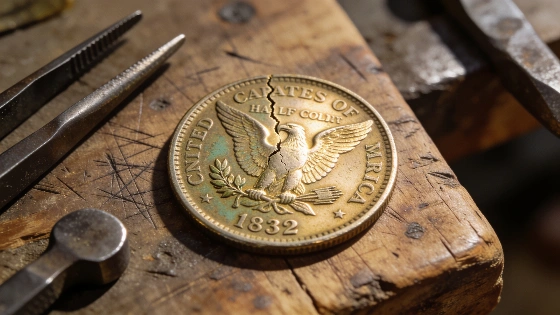
Collectors rarely get to see a coin that captures the moment a minting tool gives out. The 1832 Large Letters Capped Bust Half Dollar does just that. A jagged, raised crack runs across the eagle and olive branch on its reverse. This isn't damage from circulation. It's the mark of a die that broke under pressure at the Philadelphia Mint almost 200 years ago. The flaw is bold. It sets this coin apart from the millions struck that year. It also tells the story of a mint working at its limits. The Philadelphia Mint was the only US coin producer in 1832. It operated under early 19th-century monetary rules. The country used both gold and silver. Silver coins like this half dollar were vital for daily trade. That's clear in Federal Reserve research on early US money policy.
Most 1832 half dollars show the usual Small Letters reverse. The Large Letters variety is different. The letters on the back are taller-over 2 millimeters. Standard coins have letters 2 millimeters or less. But it's the die break, not just the letter size, that makes this coin a favorite in reference books and among specialists. Silver coins mattered for more than just US commerce. The dollar's value was tied to silver and gold. This link shaped global exchange rates, a relationship later tracked by the International Monetary Fund (IMF).
The die that would not quit
In 1832, the Philadelphia Mint struck 4,797,000 half dollars using John Reich's Capped Bust design. Each coin came from screw presses. Dies were made by hand. Every die pairing-called a "marriage"-could show its own quirks. Collectors use the Overton system to track these marriages. For 1832, there are 23 known die marriages. Only one, Overton-101, used the Large Letters reverse. As the die wore down, a crack formed near the eagle's right wing (on the viewer's left). With each strike, the crack grew. Early O-101 coins show a faint line. In the later O-101a state, the crack becomes a bold, raised scar. It connects to the olive leaves and spreads across the wing. More cracks and lumps appear around the leaves and the word OF. Each O-101a coin freezes the die's last days in metal. That's history you can hold.
This isn't a new die marriage. It's a later stage of the same dies. The "a" in O-101a marks the advanced breakdown. Every fissure on the coin matches a real crack in the steel die. The coin becomes a record of the Mint's tools under stress. The Mint kept using the failing die. That left behind a trail of coins showing the die's decline, strike by strike. The Mint's choice to keep pressing coins with a damaged die was shaped by the need to keep coins in circulation. Silver prices changed often. Treasury officials watched these swings closely. Today, the Federal Reserve tracks similar data in its policy reports.
Scarcity and market dynamics
The O-101a die state isn't rare by Overton's scale (it's rated R-1). But it's much less common than the Small Letters type. As of October 6, 2026, the PCGS Population Report lists 4,818 certified Small Letters 1832 half dollars. Only 373 Large Letters coins are listed. That's a ratio of nearly 13 to 1. The numbers aren't perfect. Resubmissions and other quirks can skew the data. Still, Large Letters coins show up far less often in certified groups. High-grade examples are even scarcer. Most early US coins saw heavy use. Few survived in Mint State. In today's currency world, this kind of rarity is like the limited runs of commemorative coins by central banks. These often sell for more in secondary markets, as shown in ECB exchange rate statistics.
Collectors often look for AU58 coins. CAC Grading says AU58 means only light friction on the high points, with most luster still there. An AU58 O-101a shows the dramatic die break and keeps much of the original detail. It's a strong choice for those who want something special without paying Mint State prices. But grade isn't everything. CAC checks for cleaning or other problems. A straight AU58 means the coin passed their standards.
Visual drama and auction results
Collectors pay up for coins with strong eye appeal. On September 4, 2026, Heritage Auctions sold a PCGS AU58+ O-101a Large Letters Half Dollar with CAC approval for $3,294. At the Mint State level, a PCGS MS64 O-101a brought $6,462.50 at Heritage in November 2014. In September 2021, Legend Rare Coin Auctions sold a PCGS MS64 CAC Large Letters coin for $8,518.75. These sales show that die state, surface quality, color, luster, pedigree, and certification all matter. Grade alone doesn't tell the whole story. Auction prices for rare US coins can swing with bigger economic trends. Changes in Treasury yields and Federal Reserve interest rates affect how much investors want hard assets when currencies get shaky.
The 1832 Large Letters Half Dollar isn't famous for a tiny mintage or a wild engraving mistake. Its appeal comes from being the only 1832 half dollar with the Large Letters reverse. It's also the only one that records a single die's slow breakdown. Early O-101 coins show the first cracks. Later O-101a coins capture the die's collapse. This variety lets collectors watch the Mint's machinery age, one coin at a time. That's rare.
Specifications and historical context
The 1832 Large Letters Capped Bust Half Dollar was struck in Philadelphia. There's no mintmark. John Reich designed it. The coin is 89.24% silver and 10.76% copper. It weighs 13.48 grams and measures 32.5 mm across. The edge reads "FIFTY CENTS OR HALF A DOLLAR." The total 1832 mintage is known-4,797,000 coins. But the number with the Large Letters reverse isn't. Mint records didn't track die marriages. Overton-101a is rated R-1 for rarity. The coin's silver content and weight were set by law. This was part of the government's push to standardize money and keep trust in the dollar. That idea still shapes central bank policy. The Federal Reserve's job is to keep prices stable and people employed.
Collectors who like the mix of minting tech and coin history might also look at other dramatic die errors. The Civil War Two Cent Piece with a hidden Indian Head cent portrait is one example. Both coins are proof of how the Mint's tools and methods changed over time.
The 1832 Large Letters Half Dollar is more than just a collectible. It's a piece of Mint history and a record of how far the equipment could be pushed. The raised cracks and big letters aren't just oddities. They show how early American coins were shaped by the tools at hand. In a market where rarity and visual drama matter, this coin proves that sometimes, the best stories are struck right into the metal.
Die states matter in early US coin collecting. A die state is the die's condition when a coin was struck. Dies start fresh and wear down. They develop cracks, lumps, and flaws. Every coin they strike shows these changes. Collectors prize late die states for their bold look and for what they reveal about minting and tool life. Knowing about die states explains why two coins from the same year and design can look-and be worth-so differently.