As the US Mint halts production of circulating pennies, the 1955 Doubled Die Lincoln cent continues to command record prices and redefine what a pocket coin can mean for collectors and currency history
One Lincoln cent just sold for $320,625. That got the coin world talking. The 1955 Doubled Die Obverse Lincoln cent, once just spare change, now stands as the coin every collector wants. It's not only about rarity. This is the story of a mistake anyone can spot, and the end of the penny as Americans knew it.
The last penny for daily use rolled out of the Philadelphia Mint on November 12, 2025. That ended 232 years of making cents for cash transactions. Collector versions will still be made, but the penny's run in everyday life is finished. On September 28, 2026, the U.S. Senate passed the Common Cents Act. The bill went to the president, sealing the penny's fate. The law keeps collector-only cents alive. All old pennies-about 114 billion-stay legal tender. The change will be slow, not sudden. That's by design, according to ConsumerAffairs and USA Today.
The new law also sets a federal rule for rounding cash totals to the nearest five cents if exact change isn't possible. Cash payments ending in 1, 2, 6, or 7 cents round down. Totals ending in 3, 4, 8, or 9 cents round up. This only affects cash. Card and electronic payments still go to the cent. The U.S. now joins Canada and Australia, where similar rules already work. Retailers and shoppers get a break from state-by-state confusion. The International Franchise Association says a single federal rule makes life easier for everyone, as reported by Franchising.com.
Currency policy is under the microscope. The Federal Reserve tracks how people use cash and coins, as shown in its official coin circulation reports. Stopping penny production won't move the dollar's exchange rate. But it does show how payment habits are changing. The European Central Bank has also noted fewer low-value coins in use across the euro area. Cashless payments are taking over. The world is moving on.
How a minting error became a national hunt
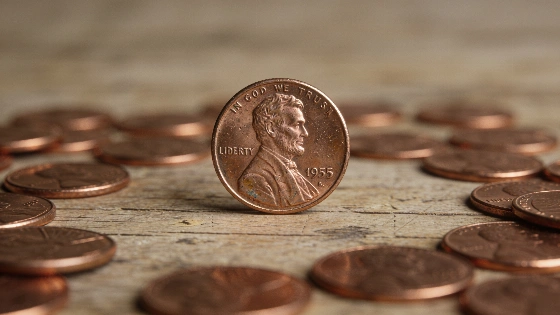
Most rare coins need a magnifier. Not this one. The 1955 Doubled Die's error jumps out. The date, LIBERTY, and IN GOD WE TRUST all look doubled. The cause? A misaligned hub at the Philadelphia Mint. NGC says the Mint ran two 12-hour shifts in 1955 to fight a cent shortage. The flawed die worked overnight. By the time anyone noticed, thousands of error coins had slipped into circulation.
About 40,000 of these coins were made. Mint workers caught 16,000. The rest-roughly 24,000-went out with normal cents. Today, Stack's Bowers puts the surviving number at just 3,000 to 4,000 in all grades. That's rare, but not impossible to find. The result? A hot market. The best coins are true trophies.
The error coin's journey is legendary. Some ended up as change in cigarette packs. That was thanks to vending machine prices in the 1950s. PCGS says most of the coins first showed up in Massachusetts and parts of New York. Many circulated for years before collectors caught on. Red, uncirculated examples are much scarcer than brown, worn ones. The coin's fame grew because anyone could check their change and hope for a jackpot. Dreams started in small change.
Market impact and the value of quality
The 1955 Doubled Die's price climb has been wild. On February 23, 2025, GreatCollections sold a PCGS MS65+RD CAC coin from the Stewart Blay/Red Copper Collection for $320,625. That set a public record. PCGS data from late September 2026 shows only 19 coins in MS65RD, three in MS65+RD, and none better in the Red category. Some may be resubmissions, but the top end is tight. Supply dries up fast.
You don't need six figures to join in. Heritage sold a PCGS MS64RD for $21,960 in January 2026. Another went for $18,300 in May. Stack's Bowers set a record for a PCGS MS64RB CAC at $14,640 in June 2026. Heritage sold a similar coin for $7,930 in August. Prices swing even for coins with the same grade. Why? Original surfaces, color, eye appeal, and the auction house all matter. CAC approval and a coin's history can help, but seasoned buyers know what makes a coin stand out.
Many collectors look for value in high-circulated grades. A CACG AU58 brought $3,416 in May 2026. An AU55 PCGS coin sold for $2,379 at Heritage's September 2026 ANA auction. These coins still show the dramatic doubling. They look great without the uncirculated price tag. That's the sweet spot for many.
Authentication and the risk of counterfeits
Fame brings fakes. The 1955 Doubled Die attracts counterfeits and misleading listings. The right term is "doubled die," not "double die." The doubling happens in the die, not from two strikes. Real FS-101 coins show strong, clear doubling on the date, LIBERTY, and IN GOD WE TRUST. The design elements are truly separated. Machine doubling looks flat and lacks this split. The reverse should show about a 5% die misalignment. PCGS points out fine vertical die-polishing lines near the left side of the T in ONE CENT. Third-party grading is a must. Fake coins have fooled many.
For scale, the Philadelphia Mint made about 330.58 million cents for circulation in 1955. There were also 378,200 Proof cents. The 1955 Doubled Die is a tiny slice-only about 24,000 released, with maybe 3,000 to 4,000 left today. The coin is 95% copper, 5% tin and zinc. It weighs 3.11 grams and measures 19.05 mm across. Abraham Lincoln is on the front. Wheat ears are on the back. No mintmark appears.
Legacy of a pocket-change icon
This coin did more than shake up the market. It changed how Americans saw their change. A mint error became a national treasure hunt. The coin's bold look and easy recognition made it the entry point for generations of collectors. Doubled dies became a major field of study. The story matters even more now. The penny's era in daily life is over, but millions of Americans still have jars and rolls of cents at home. Any one could hide a piece of this story. Check your change.
Other big U.S. coin errors have surfaced lately. One example is the 2004-S Proof Roosevelt dime with a major obverse indent. It stayed sealed in its original Mint set for over 20 years, as reported earlier. Finds like these keep collectors guessing about mint quality and the chance for rare coins in everyday places.
The 1955 Doubled Die's appeal isn't just about rarity or price. It's about hope. A simple coin, ignored for decades, can become a symbol of an era. As the cent leaves daily life, this penny's story proves even the smallest coin can make history.
Collectors and historians care about the difference between a doubled die and other types of doubling. A true doubled die comes from a misaligned die during its creation. Every coin from that die shows doubled design elements. Machine doubling happens during striking and looks flat, with no real split. Knowing this helps collectors spot the real thing. That's why coins like the 1955 Doubled Die get so much attention-and such high prices-in the numismatic world.