
The 1780 Courland thaler, struck under Peter Biron, marked the final assertion of the duchy's monetary independence before its absorption by Russia, offering collectors a rare glimpse into the region's complex currency history
In 1780, the Duchy of Courland and Semigallia-now part of western Latvia-issued a silver thaler that would become its last major coin before the region was absorbed by the Russian Empire. This coin, minted in Mitau and bearing the portrait of Peter Biron, stands as a tangible reminder of a small state's struggle to maintain its identity amid shifting European power dynamics.
Courland's climate and geography were challenging, with harsh winters and poor soil limiting agricultural output. Despite these constraints, the duchy developed its own legal system, maintained a small army, and even launched merchant ventures reaching as far as West Africa and the Caribbean. Its strategic location between the Baltic Sea and Lithuania made it a focal point for larger powers, including Poland, Sweden, and Russia.
From Vassal State to Russian Annexation
Originally under the control of the Livonian Order, Courland became a vassal of the Polish-Lithuanian Commonwealth in 1561. This arrangement granted some autonomy but left the duchy vulnerable to external influence. By the early 18th century, Russia had emerged as the dominant force in the region. Peter I orchestrated dynastic ties by marrying his niece Anna Ioannovna to the Duke of Courland, but the duchy's independence continued to erode.
Ernst Johann Biron, a local nobleman who rose to prominence at Anna's court, became Duke of Courland in 1737 with imperial backing. However, his rule was largely symbolic, as real power remained in St. Petersburg. After a period of exile following Anna's death, Biron was restored to the ducal throne by Catherine II in 1763, only to transfer authority to his son Peter Biron in 1769.
Peter Biron and the 1780 Thaler
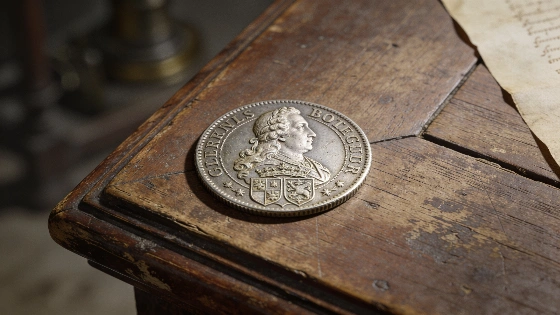
Peter Biron, born in 1724, inherited the title but preferred life in more comfortable estates outside Courland. Nevertheless, he left a lasting mark by authorizing the 1780 silver thaler. The obverse of the coin features Peter's right-facing portrait with the Latin inscription "D. G. PETRUS IN LIV. CURL. ET SEMGAL. DUX," meaning "By the grace of God, Peter, Duke in Livonia, Courland and Semigallia." The reverse displays two heraldic shields-one with a Lithuanian horseman, the other with a Polish eagle-beneath a ducal crown, symbolizing Courland's vassal relationship to the Polish-Lithuanian Commonwealth. The reverse legend, "MON. NOVA ARG. DUC. CURL. AD NORMAM TAL. ALB. 1780," translates as "New silver coin of the Duchy of Courland, according to the standard of the Albert thaler."
The 1780 thaler is notable for being a one-year type and is directly linked to the last independent duke. Major numismatic references list it as KM 32, Davenport 1624, and Kopicki 4104, with rarity levels ranging from R1 to R2 depending on the catalog. Exact mintage figures are unknown, as surviving records from the period are incomplete, but auction results indicate strong collector demand. In May 2026, an XF example sold for €2,747, while a PCGS MS61 specimen achieved $5,124 at Heritage. These figures reflect the coin's status as both a historical artifact and a sought-after collectible.
The End of Courland's Sovereignty
By the late 18th century, Courland's independence was largely nominal. Russia's influence had grown overwhelming, while the Polish-Lithuanian Commonwealth weakened. In 1795, during the Third Partition of Poland, Peter Biron formally ceded his rights to Catherine II, ending the duchy's existence as a separate entity. Courland became a Russian governorate, with Mitau remaining its administrative center until World War I. After the Russian Revolution, the old administrative structures disappeared, and the region's monetary history entered a new phase.
Peter Biron spent his final years on estates in Silesia and Bohemia, never returning to rule in the Baltic. His 1780 thaler remains a symbol of a vanished state, capturing the tension between sovereignty and absorption by a larger empire. The coin's design and rarity continue to attract collectors and historians interested in the complexities of European currency transitions.
For those interested in how rare coins can reflect broader monetary and political shifts, the story of the Courland thaler offers a parallel to other historic issues, such as the unique 1887 Liberty Head Half Eagle, which was struck only in Proof format and explored in detail in this analysis of America's only proof-only $5 gold coin.
Understanding Vassal Currencies and Collector Value
The Courland thaler's significance lies not only in its rarity but also in its role as a vassal currency. Unlike fully sovereign issues, vassal coins often display the symbols and legends of their suzerain powers, reflecting a delicate balance between local identity and external control. Collectors value such coins for their historical context as much as their physical characteristics. The 1780 thaler, with its dual heraldry and Latin inscriptions, encapsulates the complexities of late 18th-century European monetary politics, where small states navigated survival between empires. Its continued presence in auctions and collections underscores the enduring interest in coins that mark the end of an era.