
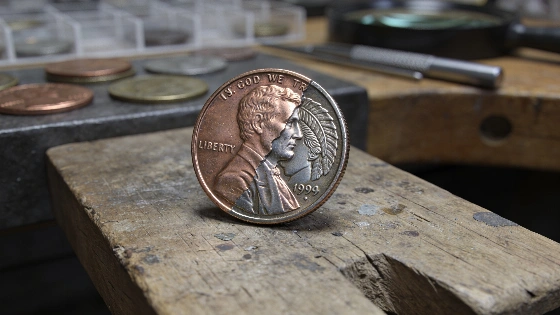
A one-of-a-kind 1906 Liberty Head nickel die cap, mistakenly struck on an Indian Head cent planchet, has emerged as the only known U.S. type coin die cap off-metal, combining exceptional condition with a remarkable collector pedigree
In the world of U.S. coin collecting, few mint errors attract as much attention as die caps-coins that have been struck multiple times, causing the metal to wrap dramatically around the die. Among these, the recent appearance of a 1906 Liberty Head nickel obverse die cap, uniquely struck on an Indian Head cent planchet, stands out as a singular event in American numismatic history. This coin is the only documented example of a U.S. type coin die cap produced on an off-metal planchet, making it a centerpiece for collectors and historians alike.
The error occurred when a copper planchet, intended for an Indian Head cent and weighing 3.1 grams, was accidentally fed into the press set up for Liberty Head nickels. Instead of being ejected after the first strike, the planchet remained in the collar and was repeatedly struck, gradually enveloping the obverse die and forming a dramatic die cap. The result is a coin that not only displays the design of a Liberty Head nickel but also preserves the copper color and physical characteristics of a cent, creating a striking visual and technical anomaly.
Tracing a Unique Pedigree
The coin's provenance is as notable as its error. It was first acquired in 2002 by Fred Weinberg, a respected figure in the mint error community, who purchased it raw as part of a larger collection. The coin was quickly authenticated and certified by NGC as MS 66 BN, with further certifications by PCGS and NCS confirming its status and condition. Mark Lighterman, now president of the American Numismatic Association (ANA), became its next owner, adding it to a collection that already included other legendary off-metal errors, such as the unique 1851 $20 Liberty Head struck on a large cent planchet. The coin later changed hands again, joining another private collection alongside a similarly rare 1896 Liberty Head nickel obverse die cap flip-over double strike.
Die caps of this caliber are exceptionally rare. Over the past five decades, only a handful of U.S. type coin die caps have surfaced, including examples on large cents, Indian Head cents, two cent pieces, Barber dimes, and quarters. However, none have matched the off-metal status of the 1906 Liberty Head nickel die cap, which remains the only known instance where a type coin die cap was struck on a planchet intended for a different denomination.
Rarity and Market Context
Mint error coins, especially those involving die caps and off-metal strikes, command significant premiums in the collector market due to their scarcity and the technical complexity involved in their creation. The 1906 Liberty Head nickel die cap's combination of dramatic appearance, unique off-metal status, and impeccable provenance has made it a reference point for advanced collectors. Its journey through the hands of leading specialists and institutions has only added to its allure.
For context, the U.S. Mint produced both Liberty Head nickels and Indian Head cents in 1906, with the nickel struck in copper-nickel alloy and the cent in bronze. The standard weight for a Liberty Head nickel was 5 grams, while the Indian Head cent planchet weighed 3.1 grams. The error coin's weight and composition confirm its origin as a cent planchet, while its repeated striking by nickel dies created a hybrid artifact that bridges two denominations. Such errors are not only rare but also provide insight into the operational realities and occasional lapses of early 20th-century U.S. Mint production.
While the 1906 Liberty Head nickel die cap is unique in its off-metal status, other rare U.S. coin errors have also captured the attention of collectors. For example, the 1887 Liberty Head Half Eagle is notable as the only $5 gold coin in U.S. history struck exclusively in Proof format, a distinction that has similarly elevated its status among numismatic rarities. For a deeper look at how such unique coins shape American monetary history, see this analysis of the 1887 Liberty Head Half Eagle and its exceptional status.
Understanding Die Cap Errors
Die cap errors occur when a coin fails to eject from the striking chamber and is struck repeatedly, causing the metal to flow and wrap around the die. Over time, the cap can become so pronounced that it takes on a thimble-like shape, often obliterating the reverse design and leaving only traces of the original planchet. Off-metal die caps, where the planchet is not the intended metal for the denomination, are even rarer, as they require both a planchet mix-up and a failure in the ejection process. These errors are highly sought after for their visual impact and the technical story they tell about mint operations.
Collectors and researchers value such coins not only for their rarity but also for the light they shed on the minting process, error detection, and quality control practices of the era. The 1906 Liberty Head nickel die cap on a cent planchet remains a benchmark for both error collecting and the study of U.S. coin production anomalies.
Die cap errors illustrate the intersection of mechanical process and human oversight in coin production. When a planchet of the wrong metal enters the press and is not ejected after the first strike, the repeated blows cause the metal to deform and wrap around the die, sometimes resulting in dramatic and visually striking shapes. These errors are rare because modern minting processes include multiple safeguards to detect and remove off-metal planchets and stuck coins. However, in earlier periods, such as the early 20th century, less automated equipment and higher production volumes increased the likelihood of such anomalies escaping detection. As a result, surviving die cap errors-especially those involving off-metal planchets-offer a tangible record of the complexities and occasional unpredictability of historical coin manufacturing.