
A rare set of two US presidential presentation coins, each with original White House documentation and provenance, has emerged as a unique record of political and numismatic diplomacy spanning two administrations
Two coins, each struck under the authority of a different US president and presented to the same congressman, have surfaced as a single, fully documented set-an occurrence with no known public or institutional parallel. The pairing, preserved with original White House letters and mailing envelopes, offers a direct line from the highest levels of American government to the hands of a single recipient, Congressman Robert G. Stephens Jr.
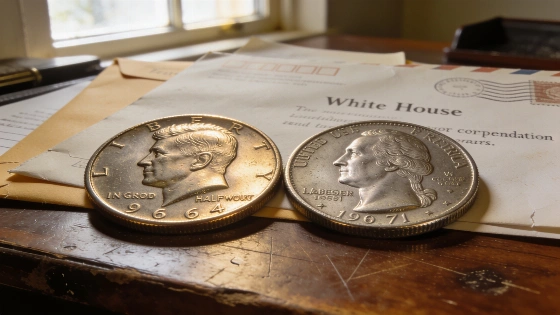
Unlike most numismatic artifacts, which often lose their context over decades, this set remains intact from the moment of presidential gifting to the present. The coins-a 1964 Kennedy half dollar from President Lyndon B. Johnson and a 1971-S Eisenhower silver dollar from President Richard Nixon-are accompanied by formal correspondence confirming their status as first strikes. The documentation, including a notarized letter of provenance, leaves no doubt about their journey or authenticity.
Presidential Coin Diplomacy in Action
Presidential coin presentations are not routine. They are deliberate acts of statecraft, often reserved for moments of national significance or for honoring key political figures. In this case, both coins were sent to Congressman Stephens, who represented Georgia in the US House of Representatives from 1961 to 1977. The Kennedy half dollar, minted just months after John F. Kennedy's assassination, was distributed by President Johnson as a symbol of national mourning and transition. The Eisenhower dollar, the first circulating US dollar coin since 1935, was issued under Nixon, who had served as Eisenhower's vice president.
Each coin arrived with a White House letter: Johnson's, dated March 24, 1964, identified the Kennedy half dollar as among the first issued; Nixon's, dated August 6, 1971, confirmed the Eisenhower dollar's status as a first strike and noted a similar coin was presented to Mamie Eisenhower. Both coins were delivered in their original US Treasury packaging, with envelopes addressed directly to Stephens.
Unmatched Provenance and Documentation
What sets this set apart is the completeness of its documentation. Both coins remained in Stephens' estate until 2018, when they were acquired by numismatic researcher Dr. Darryl A. Gomez. The transfer is supported by a notarized letter from estate representatives, ensuring an unbroken chain of custody. For collectors and historians, this level of provenance is rarely seen-most surviving presidential coin gifts are incomplete, missing either the coin, the letter, or the envelope, and often lack certified documentation.
Fewer than 50 complete Johnson-Kennedy sets and fewer than 25 Nixon-Eisenhower sets are believed to exist in any form. However, no public record or institutional collection has documented both types preserved together, sent to the same recipient, and supported by original letters, envelopes, and notarized provenance. This elevates the set from rare to unique, providing a tangible narrative of presidential appreciation and political continuity.
Historical Context and Numismatic Significance
The Kennedy half dollar was authorized by Congress and rushed into production in early 1964, replacing the Franklin half dollar as a tribute to the slain president. Its release became a national event, with ceremonial first strikes distributed to members of Congress and foreign dignitaries. The Eisenhower dollar, meanwhile, marked the return of the US dollar coin to circulation and honored both President Eisenhower and the Apollo 11 moon landing. Nixon's administration oversaw its creation, and the first strikes were similarly distributed as tokens of recognition.
For context, the Smithsonian's National Numismatic Collection and the Eisenhower Presidential Library each hold individual examples of such presentation coins, but neither institution has reported a matched, dual-presidency set with full documentation. The rarity of this pairing is underscored by the fact that presidential coin gifts are typically scattered, lost, or separated from their original paperwork over time. As reported earlier, even historically significant coins often lose their provenance, making complete sets with ironclad documentation exceptionally valuable to researchers.
Numbers and Verification
According to available records, fewer than 50 complete 1964 Johnson-Kennedy half dollar presentation sets and fewer than 25 complete 1971 Nixon-Eisenhower silver dollar sets have been documented. Both coins in this set are accompanied by their original White House letters and mailing envelopes, with the chain of custody verified by a notarized letter from the Stephens estate. The Kennedy half dollar was issued in March 1964, while the Eisenhower dollar was released in August 1971, marking two distinct moments in US numismatic and political history.
While presidential coin presentations are sometimes referenced in numismatic circles, the survival of both coins, both letters, both envelopes, and certified provenance in a single set is unprecedented. This level of documentation allows for precise historical research and eliminates the uncertainty that often clouds the origins of collectible coins.
Presidential Coin Gifts as Political Artifacts
Presidential coin gifts are more than collector's items-they are artifacts of political messaging and ceremonial diplomacy. The Kennedy half dollar and Eisenhower dollar, each representing a different era and administration, together form a narrative arc that reflects the use of coinage as a tool of statecraft. Their preservation in a single, fully documented set demonstrates how coins can serve as both currency and historical record, bridging the gap between monetary policy and political symbolism.
Unlike most numismatic rarities, which are valued for their metal content or mintage, this set's significance lies in its unbroken provenance and the story it tells about presidential power, congressional recognition, and the ceremonial language of American governance. The fact that no similar dual-presidency set has been identified in public or institutional collections only heightens its importance for collectors, curators, and historians seeking to understand the intersection of currency and politics.
Presidential coin presentations occupy a unique space in US numismatic history. Unlike commemorative coins produced for general sale, these artifacts are distributed directly by the White House, often to mark pivotal events or honor specific individuals. Their value is not determined by rarity alone, but by the completeness of their documentation and the clarity of their provenance. In the world of currency collecting, a fully documented presidential coin gift is a rare find; a matched pair from two administrations, preserved with every original element, is virtually unheard of.