A unique 1861-O Liberty Seated Half Dollar, struck as the US fractured in 1861, links three governments and challenges long-held beliefs about Civil War-era coin production at the New Orleans Mint
In early 1861, as the United States descended into civil war, the New Orleans Mint became a focal point of monetary and political transition. Control of the mint shifted rapidly-from the federal government to the State of Louisiana, and then to the Confederate States of America. Despite the upheaval, coin production continued almost uninterrupted, with workers striking 1861-O Liberty Seated Half Dollars under three different authorities. This continuity, using the same dies and machinery, makes the 1861-O half dollar a rare witness to a turbulent chapter in American currency history.
One particular 1861-O Liberty Seated Half Dollar, graded Specimen-63 by PCGS and set to be auctioned by Stack's Bowers Galleries in September 2026, stands out for its exceptional preservation and mysterious origins. Classified as a State of Louisiana Issue and rated Rarity-8, this coin is believed to be one of only four or five surviving Specimen or Branch Mint Proof examples. Its selection as the plate coin for the 2025 edition of John W. Dannreuther's reference on United States Proof coinage underscores its numismatic importance. Yet, the coin's die pairing and production characteristics raise unresolved questions about when, how, and under whose authority it was struck.
Coin Production Amid Secession
The timeline of the New Orleans Mint's control is well documented. Louisiana voted to secede from the Union on January 26, 1861, and assumed possession of the mint on January 31. Federal employees were allowed to remain, and the mint's leadership-including Superintendent William A. Elmore and Chief Coiner Dr. Benjamin F. Taylor-continued operations. The Confederate government did not formally take over until April 1, 1861. During this period, the mint produced a total of 2,532,633 half dollars dated 1861-O: 330,000 under the United States, 1,240,000 under Louisiana, and 962,633 under the Confederacy. Each coin bore the same date and design, making it nearly impossible to distinguish their origins without detailed die analysis.
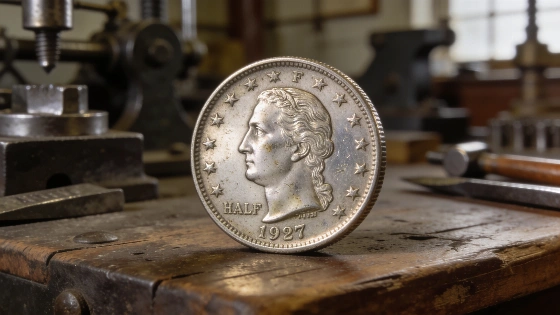
The featured Specimen-63 coin displays characteristics that set it apart from regular circulation strikes. Its surfaces show original toning, with powder-blue halos at the edges and reddish-gold iridescence toward the center. The fields are highly reflective, suggesting the dies were specially polished, while the design elements retain a frosted texture, creating a subtle cameo effect. The strike is unusually sharp, with nearly full detail across the design, and a partial wire rim is visible on both sides. These features indicate deliberate preparation, likely for presentation or ceremonial purposes, rather than routine minting.
Numismatic Debate: United States or Louisiana?
Die analysis is central to the ongoing debate about the coin's true origin. Numismatist Bill Bugert's research divides 1861-O half dollar die marriages into those used by the United States (W-01, W-02), Louisiana (W-03 to W-08), and the Confederacy (later pairings). The current Specimen-63 coin was struck from the W-01/JD-1 dies, typically associated with federal production. However, Stack's Bowers and other researchers argue that at least some Specimen coins were likely produced under Louisiana authority, possibly to mark the state's takeover of the mint. This theory is supported by other known Specimens, such as the Robert LeNeve and E. Horatio Morgan coins, which use dies attributed to Louisiana and have documented connections to the state's history.
Yet, the W-01/JD-1 Specimens complicate this narrative. Only two such coins are known, and they differ in die state, suggesting they may have been struck at different times. This raises the possibility that Specimen coins were produced during more than one period, perhaps both under federal and state control. The lack of surviving documentation leaves the precise circumstances unresolved, and as Dannreuther notes, "There are numerous unanswered questions about this mysterious issue."
Confederate Coinage and Presentation Pieces
The timing of the mint's transition is crucial. On April 1, 1861, Confederate Treasury Secretary Christopher G. Memminger requested designs for a distinctly Confederate half dollar, leading to the creation of a new reverse featuring a Confederate shield and agricultural motifs. Only four original Confederate half dollars were produced, pairing the new reverse with the federal obverse. This sequence suggests that if presentation pieces were needed by the Confederacy, they would have used the new design, not the standard United States motif. As a result, many numismatists believe that the special 1861-O Specimens with the original design were likely struck before the Confederacy's formal takeover, possibly to commemorate Louisiana's brief period of independent control.
Despite the lack of definitive archival evidence, the theory that Louisiana officials ordered a small number of specially prepared half dollars remains compelling. However, the use of federal dies and the existence of multiple die states among Specimens mean that the full story is still incomplete. The rarity of these coins is striking: Stack's Bowers estimates that only four or five Specimen or Branch Mint Proof 1861-O half dollars are known to exist, compared to millions of regular issues. The current SP63 coin is only the fourth such example the firm has auctioned in the past 15 years.
Facts and Figures: 1861-O Half Dollar
The 1861-O Liberty Seated Half Dollar was struck in 90% silver and 10% copper, with a standard weight of 12.44 grams and a diameter of 30.6 mm. The total mintage of 2,532,633 coins was divided among three authorities: 330,000 by the United States, 1,240,000 by Louisiana, and 962,633 by the Confederacy. The featured Specimen-63 coin is classified as Rarity-8, indicating extreme scarcity. PCGS lists it under number 6422, and NGC assigns it ID 27TM. While regular 1861-O half dollars remain available in many grades-helped by Civil War-era hoarding and the recovery of coins from the SS Republic shipwreck-Specimen coins are in a different league of rarity and historical significance.
The story of the 1861-O half dollar echoes other moments when rare coins have illuminated the intersection of politics and currency. For example, the gathering of all 11 government-owned 1933 Double Eagles at a major coin event, as covered in this report on historic American coinage, demonstrates how numismatic artifacts can offer unique insights into monetary history and legal authority.
Understanding Specimen and Proof Coinage
Specimen and Branch Mint Proof coins occupy a special place in numismatics. Unlike regular circulation strikes, these coins are produced with extra care-often using specially polished dies and planchets, and sometimes struck multiple times to enhance detail and surface quality. Their purpose can range from official presentations and diplomatic gifts to ceremonial commemorations of institutional milestones. In the case of the 1861-O half dollar, the combination of technical features and historical context suggests a deliberate effort to mark a significant transition, even if the exact motivation remains uncertain. For collectors and historians, such coins are not just rare objects but tangible evidence of the complex interplay between currency, politics, and identity during periods of upheaval.