
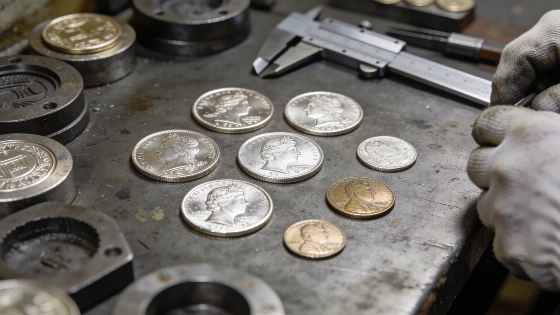
As silver prices climb and production costs surge, mints across Europe and beyond are slashing mintages, raising prices, and experimenting with new alloys to keep commemorative coins viable for collectors.
Collectors who once saw silver commemorative coins as affordable keepsakes are facing a new landscape. Silver prices have jumped, pushed up by industrial demand, global uncertainty, and its growing reputation as an investment metal. By September 2026, silver in Europe was trading at about 1.79 euros per gram, or 55.60 euros per troy ounce. This has upended the economics of modern coin programs. Mints now have to choose: raise prices, cut silver content, or risk losing collectors. The European Central Bank is watching commodity-driven inflation, which has added to the volatility in precious metals markets.
Germany's recent changes to its silver coin program show how tough these choices have become. After months of debate, the Federal Ministry of Finance decided to lower the silver content of standard Brilliant Uncirculated coins from .925 to .500. Christmas coins will drop from .999 to .625. The €20 "Elly Heuss-Knapp" coin came out in September 2025, but the "125 Years of the Wuppertal Suspension Railway" coin was postponed, and already minted €25 Christmas coins were held back. The ministry had to pick between dropping silver or raising prices. Earlier attempts to switch to base metals-like the move to "Magnimat" in the 1970s and copper-nickel for €10 coins in 2011-led to a collapse in collector interest. The Bundesbank's monetary policy has stayed loose, but rising costs have forced the ministry to act.
Europe's diverging strategies
Austria has kept its silver content high but passed the extra cost on to buyers. The Austrian Mint's €5 commemorative coins, once available in standard circulation, are now only sold as premium "hand-lifted" versions. By the end of 2025, a 7.78 g silver coin cost €24.60-almost €100 per ounce, far above the metal's market value. Standard versions are now copper, making silver coins a luxury for dedicated collectors. The Austrian National Bank reports steady demand for bullion, but numismatic premiums have grown sharply.
Switzerland's Swissmint has also stuck with high-purity silver (.999) and substantial coin weights, but prices have climbed. The 2026 "Lake Geneva" 20-franc coin is priced at 65 francs (uncirculated) and 110 francs (proof), up from 25 and 79 francs for the previous year's "Pioneers of Swiss Aviation" coin. Silver coins remain, but only at a steep premium. Recent market listings show the BU version of the 2026 "Lake Geneva" coin offered at 94.95 euros, a significant markup over its metal value, reflecting strong collector demand and the impact of high silver prices (market listings).
Swissmint's premium approach is clear in its upcoming gold commemorative: the "120 years of the Swissmint building" coin, with a face value of 50 francs, 0.900 gold alloy, 11.29 g weight, 25 mm diameter, and a limited mintage of 4,000 pieces. The proof coin will be available for 1,265 francs starting 17 September 2026, according to official Swiss government communications. This fits with the Swiss National Bank's recent data, which highlights high precious metal prices and a strong franc (SNB statistical portal).
Other countries have moved even faster. The United States Mint and the Royal Mint in the UK now adjust retail prices in real time as silver's market value changes. The American Eagle Silver Proof went from $95 at issue in 2024 to $173, while the Morgan/Peace Reverse Proof rose from $215 to $375. This keeps product lines stable but widens the gap between metal value and retail price, making collectors think twice before buying. The Federal Reserve's rate decisions and the Bank of England's inflation outlook continue to shape precious metals demand and currency values.
Minting fewer coins and chasing scarcity
Some mints have responded by sharply reducing mintages. The Czech "Český lev" 1 oz silver coin saw its mintage cut from 16,500 in 2024 to 5,500 in 2025, with the price rising from 2,790 CZK to 3,190 CZK. The result was a quick sellout, shifting the focus from silver content to scarcity as the main selling point. But if scarcity becomes the only draw, long-term confidence in the market could suffer.
France and Austria have taken a segmentation approach, offering several versions of the same coin at different price points and silver contents. France's Monnaie de Paris issues €10 coins in "Qualité courante" (13 g, Ag .333) for €13, alongside proof versions (22.2 g, Ag .999) for €131. This lets both entry-level and advanced collectors take part, but adds complexity and makes direct comparisons harder.
Innovation is another route. Canada, Australia, and private distributors like CIT are betting on technical enhancements-color, high relief, luminescent effects, holograms-to boost perceived value. Here, silver is just the base; design and technology drive the price. The "Bayer Thaler" series, for example, offers both a classic bullion version for investors and a high-relief collector edition for numismatists.
Retreat and hybridization
Not all mints are fighting to keep silver coins alive. In Scandinavia, state coin programs are shrinking or disappearing. Danmarks Nationalbank has stopped selling commemorative coins online and cut back on new issues, while Sveriges Riksbank has made silver nearly irrelevant in its commemorative program. Some smaller markets are outsourcing or scaling back state coin programs, citing high metal prices, falling demand, and changing collector habits. The era of widely available, state-issued silver commemoratives is fading in parts of Europe, not with a bang, but with a slow retreat.
Hybrid products are filling the gap. Bullion coins are now offered in proof or limited-edition versions, blurring the line between investment and collecting. The United States Mint and the Perth Mint have adopted this model, aiming to attract both investors and collectors while boosting margins. The distinction between collector and bullion coins is becoming less clear as mints adapt to new realities.
Data and consequences
Recent figures show the scale of change. In Germany, mintages for regular silver coins ranged from 500,000 to 630,000 pieces in Brilliant Uncirculated and 63,000 to 65,000 in proof, spread across five mints. The 2025 €20 silver coins in proof were listed at €42.95, up from €38.95, while €25 Christmas coins reached €45.95. In Austria, the price for a 7.78 g silver coin hit €24.60 by the end of 2025. Switzerland's 2026 20-franc silver coin is priced at 65 francs (uncirculated) and 110 francs (proof), compared to 25 and 79 francs for the previous year's issue. The American Eagle Silver Proof rose from $95 in 2024 to $173, and the Morgan/Peace Reverse Proof from $215 to $375. These numbers show that silver coins are no longer a mass-market product-they are becoming exclusive, high-priced collectibles. The IMF and Bank for International Settlements have both noted the impact of commodity price shocks on consumer price indices and discretionary spending, which is now visible in the numismatic sector.
As reported earlier, collector interest can drop quickly when a coin's material or status changes. Germany's experience with base-metal commemoratives in the 1970s and 2011 led to a sharp fall in demand, not just for the coins but for related accessories. Even after returning to higher silver content and a €20 denomination, the collecting area never fully recovered. The new .500 silver alloy is unlikely to reverse this trend, and the €25 Christmas coins have not replaced the €20 series in collectors' eyes.
What silver means for collectors
The future of silver commemorative coins now depends on how much collectors are willing to pay for less silver, more design, or greater scarcity. If silver prices keep rising, retail prices for proof coins could reach €100 or more, and mintages may keep falling. The German plan now involves four different alloys for various denominations and finishes, complicating production and likely pushing proof prices even higher. The days of issuing silver coins at face value may soon be over for most mints.
Silver's role in commemorative coins is not just about metal value-it is about trust, tradition, and the collector's sense of value. When that balance tips too far toward cost-cutting or exclusivity, the risk is not just fewer coins, but a shrinking community of collectors. The current wave of innovation, segmentation, and hybridization may keep the market going, but it cannot replace the broad appeal that silver coins once had. For now, silver remains central to the identity of modern commemorative coins, but its future as a mass-market medium is uncertain.
Commemorative coins sit between currency and collectible. Their face value is often symbolic, while their real worth depends on metal content, design, mintage, and collector demand. When the metal price rises above face value, mints must choose between reducing silver content, raising prices, or limiting production. Each option has trade-offs: lower silver content can erode trust, higher prices can shrink the market, and lower mintages can create artificial scarcity. The evolution of commemorative coins reflects broader changes in how societies value tradition, artistry, and tangible assets in a digital world.