A landmark auction will bring over 250 rare Walking Liberty half dollars from the Mack C. Chase Collection to market for the first time in over a decade, offering collectors a unique chance to acquire top-graded US coins with historic significance
Some of the rarest and highest-graded Walking Liberty half dollars in private hands will return to the auction spotlight in 2026, as Stack's Bowers Galleries prepares to sell the Mack C. Chase Collection. The event is expected to draw intense interest from collectors and investors, with several coins unseen on the market for more than a decade.
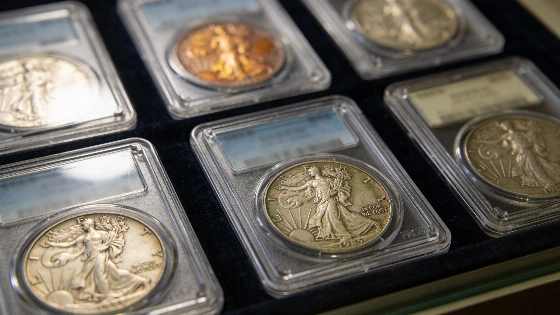
The collection's depth is immediately evident: more than 250 lots, including multiple "Top Pop" (top population) and condition census coins, will be offered at the firm's Summer 2026 Global Showcase Auction, an official partner of the ANA World's Fair of Money. Among the highlights are a 1916 MS-67 (PCGS) CAC, a 1916-D MS-67 (PCGS) CAC, a 1916-S MS-67 (NGC), and a 1920-S MS-67 (NGC)-the single finest known for that date. The offering also includes a 1940 MS-69 (NGC) CAC, a 1942 Proof-69★, and a 1937 MS-68 in an old green tag holder, all representing the upper echelon of US coin grading.
From Oil Fields to Numismatic Rarity
Mack C. Chase's journey from rural New Mexico oil fields to assembling one of the most comprehensive Walking Liberty half dollar collections is a story of both economic mobility and personal passion. Born in Texas and raised in New Mexico, Chase began working at age 14 and eventually became a leading figure in the state's oil and gas sector. His business success enabled him to pursue coin collecting at a level few can match, but he remained discreet about his acquisitions, quietly building a set that rivals the best in the field.
Unlike many collectors who focus solely on the highest grades, Chase's approach was methodical and inclusive. For many key dates, his collection features not just the finest known examples but also additional coins in lower grades, broadening access for a range of bidders. This strategy ensures that both seasoned specialists and newer collectors will find opportunities at the upcoming auction.
Market Impact and Collector Stakes
Walking Liberty half dollars, minted from 1916 to 1947, are among the most widely recognized US silver coins. Their design, circulation history, and scarcity in high grades have made them a mainstay of American numismatics. The Chase Collection's reappearance is significant: many of its coins have been off the market for 10 to 15 years, and several are housed in older-generation grading holders, which are often prized for their perceived grading standards and collector cachet.
Stack's Bowers Galleries, established in 1933, has a track record of handling major US coin collections. According to the firm's president, Brian Kendrella, the scope and quality of the Mack Chase Collection will place it among the most important Walking Liberty offerings in recent memory. The auction is expected to set new benchmarks for key dates and grades, especially for coins like the 1919-D MS-65 (PCGS) and the 1921-D MS-66 (PCGS) CAC, both of which are rarely available in such condition.
For context, the Walking Liberty half dollar series has seen strong demand in recent years, with top-graded coins often commanding six-figure prices at auction. In 2023, a 1919-D MS-66 example sold for over $200,000, reflecting the premium attached to condition rarities. The upcoming sale will test whether the market can absorb a large influx of high-end material, or if select coins will set new price records.
Historic Value and Collector Context
The Walking Liberty half dollar's appeal extends beyond its silver content. Designed by Adolph A. Weinman, the coin circulated through major events including World War I, the Great Depression, and World War II. For collectors like Chase, these coins are tangible links to American economic history. The series' most elusive dates-such as the 1921-D and 1921-S-are especially coveted in mint state, and the Chase Collection's examples are expected to draw global attention.
Interest in rare US coins has grown alongside broader trends in collectibles and alternative assets. As seen in recent coverage of Civil War-era half dollars, the intersection of monetary history and collector demand continues to drive both scholarship and market activity.
Stack's Bowers will provide full lot details and bidding information on its website ahead of the auction. Prospective buyers should note that coins in older holders may carry additional premiums, and that provenance from a major collection can influence both price and long-term value.
Understanding Condition Rarity in US Coins
In US numismatics, "condition rarity" refers to the scarcity of a coin in a particular grade, rather than its overall mintage. For series like the Walking Liberty half dollar, millions were struck, but only a tiny fraction survive in top mint-state grades. Grading services such as PCGS and NGC assign numerical grades from 1 (poor) to 70 (perfect), with each incremental point above MS-65 representing a significant jump in value. Collectors and investors often pay steep premiums for coins at the top of the grading scale, especially when population reports confirm their rarity. The presence of coins in older holders can further affect desirability, as grading standards and market perceptions have evolved over time.