A scarce $5 national banknote from Mingo Junction, Ohio, exposes the dramatic rise and fall of a steel town whose fortunes were tied to the American industrial era and the fate of its local banks
Steel once roared in Mingo Junction, Ohio. Today, the only sound is the wind rattling through empty storefronts and the hollow shell of a bank that once issued some of the rarest national currency in the United States. The collapse of the town's steel industry did not just erase jobs-it erased the very institutions that printed its money, leaving behind a handful of surviving banknotes and a landscape of abandonment.
What triggered this unraveling? A single Series of 1882 $5 note, signed in turquoise ink by W.D. Armstrong and John Quinn, now stands as a relic of a vanished economic order. The First National Bank of Mingo Junction, which opened in 1901, issued a total of $527,000 in national currency over 33 years. By 1934, the bank was shuttered, its charter replaced, and its notes became collector's items rather than instruments of commerce.
From Industrial Powerhouse to Economic Ruin
Mingo Junction's transformation from a thriving industrial hub to a near-ghost town was neither sudden nor unique. The town's fortunes were built on steel, with the Mingo Iron Works established in 1869, leveraging local coal, limestone, river access, and railways. By the early 20th century, the steel mill's output exceeded a million tons annually, attracting thousands of workers from across Europe and fueling a vibrant local economy. Commercial Street, once lined with shops, banks, and theaters, became the heart of the community.
But the late 1970s marked the start of a relentless decline. Foreign competition, outdated facilities, and rising costs battered the American steel industry. Ownership of the mill changed hands repeatedly-from U.S. Steel to Wheeling-Pittsburgh Steel, Severstal, and RG Steel-each transition accompanied by layoffs and shrinking payrolls. As the mill's workforce dwindled, so did the town's population, which peaked at over 5,000 in 1970 but has since dropped to just above 3,000.
By the time the First National Bank closed in 1934, the writing was already on the wall. Its successor, the Mingo National Bank, issued a final round of notes before the national currency era ended. Today, only four large and thirteen small notes from the original bank are known to survive, underscoring their scarcity and the scale of the town's economic contraction.
Currency as Witness to Decline
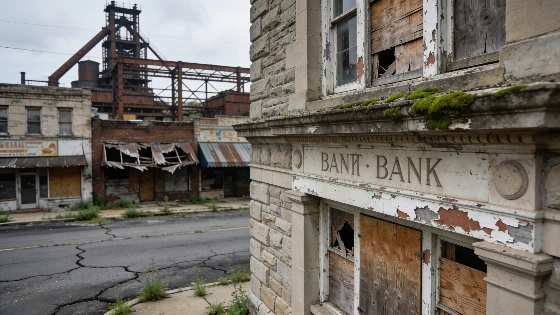
The physical decay of Mingo Junction is visible on every block. The once-grand First National Bank building is now sealed and abandoned, its windows clouded by dust and time. Commercial Street, captured in a 1925 postcard as a bustling corridor, is now a row of derelict facades and collapsed structures. The "AVALON" building, once a lively bar and apartment house, stands gutted and empty, a visual echo of the town's lost prosperity.
For collectors, the banknotes of Mingo Junction are more than historical curiosities. They are tangible evidence of a financial system that rose and fell with the fortunes of American industry. At the Memphis International Paper Money Show two decades ago, a Series of 1882 $5 note from Mingo Junction drew attention not just for its rarity, but for the story it told about a community's rise and collapse. The census of surviving notes remains sparse, making each example a direct link to a vanished era.
In the broader context of American currency history, Mingo Junction's story is not isolated. The fate of its banks and their notes parallels the experience of other industrial towns whose monetary legacies are now preserved only in collections and archives. As reported earlier, the currency issued by local institutions often outlasts the communities that created them, serving as a record of both ambition and decline.
Steel, Film, and the Ghosts of Prosperity
Mingo Junction's industrial landscape even found its way into popular culture. The steel mill and Commercial Street were featured in the 1977 film The Deer Hunter, standing in for a Pennsylvania town but unmistakably rooted in Ohio's rust belt. Yet cinematic fame did little to halt the town's downward spiral. Today, the mill's rusting frame looms over empty streets, and the business district is a patchwork of boarded-up storefronts and collapsed roofs. The economic base has evaporated, leaving few jobs and fewer reasons for young people to stay.
Despite the decay, the town's population has not vanished entirely. But with almost no local businesses and a gutted commercial core, Mingo Junction now functions as a living museum of industrial decline. The remaining residents navigate a landscape where the past is more visible than the future, and where the most valuable local assets are the rare banknotes that once circulated in everyday trade.
Between 1901 and 1934, the First National Bank of Mingo Junction issued a total of $527,000 in national currency, including Series of 1882 and 1929 notes. As of 2026, only four large and thirteen small notes from this bank are confirmed in collector hands, highlighting their rarity. The town's population peaked at over 5,000 in 1970 but has since declined to just above 3,000, mirroring the collapse of its industrial base and financial institutions.
The story of Mingo Junction's currency is a case study in how local economies, banks, and even physical money are intertwined. When the steel mill thrived, the bank flourished and issued notes that powered commerce. As industry faltered, the bank closed, and its notes became artifacts. The fate of these banknotes is inseparable from the fate of the town itself-a reminder that currency is not just a medium of exchange, but a witness to economic transformation and decline.
National banknotes like those from Mingo Junction were part of a system in which local banks, under federal charter, issued their own currency backed by U.S. government bonds. This arrangement, which lasted from the 1860s until the 1930s, allowed communities to finance growth and commerce with locally branded money. However, the system's reliance on the fortunes of individual banks meant that economic shocks-such as the collapse of a dominant industry-could quickly render both the banks and their notes obsolete. Today, surviving national banknotes are prized by collectors not only for their rarity but for the stories they tell about the rise and fall of American towns and the industries that sustained them.