
A 1945-P Jefferson nickel has surfaced with both a prominent doubled die reverse and a curved clip error, offering collectors a rare intersection of two distinct minting mistakes on a single wartime coin.
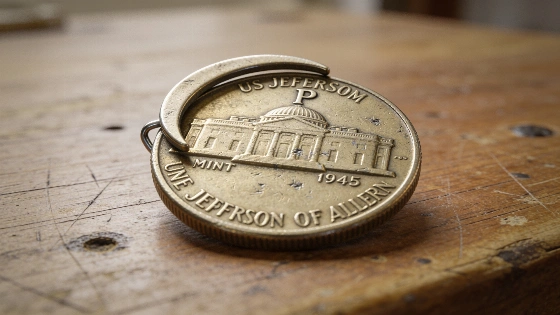
A single 1945 Jefferson nickel from the Philadelphia Mint brings together two of the era's most notable minting mistakes. Graded MS63 by CAC, this coin shows the FS-801 Doubled Die Reverse-one of the most recognized varieties in the Jefferson series-and also left the Mint with a 5% curved clip, where a crescent of metal is missing from the edge. The coin weighs 4.75 grams, lighter than the standard 5.00 grams for wartime nickels, due to the missing metal. It's an unusual case where two unrelated errors ended up on the same coin.
Most collectible coins are known for a single error or variety. Here, two separate mistakes-one in making the die, one in preparing the blank-happened to overlap. The FS-801 doubled die is known for strong doubling on the reverse lettering, especially in "MONTICELLO" and "FIVE CENTS." The curved clip comes from a blanking press cutting too close to a previous punch, leaving a visible gap before the coin was struck. According to the Federal Reserve, coin production and distribution are key to keeping cash moving, especially during wartime when metal shortages can affect both supply and demand.
Wartime Metal and the First Philadelphia "P"
This coin's story starts with World War II. As nickel was needed for military use, Congress approved a new alloy for the five-cent coin: 56% copper, 35% silver, and 9% manganese. This mix, introduced in late 1942, helped save nickel for armor and other military needs. To mark these emergency-issue coins, the Mint added a large "P" above Monticello's dome-the first time Philadelphia's mintmark appeared on US coins. From 1943 to 1945, all three mints made these silver-alloy nickels, but only a few ended up with two major errors on the same piece. The European Central Bank has noted that changes in coin metal can affect how people use and save coins, especially during uncertain times.
In 1945, the Philadelphia Mint struck over 119 million five-cent coins. The number with the FS-801 doubled die is unknown, as Mint records don't track varieties. The FS-801 is one of only three major doubled dies in the classic Jefferson nickel series, along with the 1939 Doubled Die Reverse and the 1943 Doubled Die Obverse. Collectors spot the FS-801 by the clear doubling on the lower reverse, especially on the right side.
How Two Errors Collided
The doubled die error happened during die production, not when the coin was struck. In the 1940s, making a working die required several impressions from a master hub. If the die and hub were misaligned between impressions, the die would show two offset images, which then appeared on every coin it struck. The FS-801 is a clear example, with visible doubling. The Bank for International Settlements has pointed out that reliable coin production is important for public trust, especially when errors can affect both collector value and how people view currency.
The curved clip error happened earlier, during blank production. Sometimes, metal strips in the blanking press didn't move forward enough, so the punch overlapped a previous hole, leaving a blank with a crescent-shaped gap. This incomplete blank then went through the rest of the minting process. By chance, one such blank was paired with the FS-801 doubled die, creating a coin that records two separate failures-one in die making, one in blank preparation.
CAC Grading confirms the coin's weight of 4.75 grams, showing the missing metal from the clip. The diameter is the standard 21.2 mm, and the edge is plain, but the missing crescent is easy to see. The coin's certification number is 98359027, and its Mint State 63 grade means it shows no signs of circulation, though some marks are allowed at this level.
Collector Impact and Market Context
This coin appeals to two groups: collectors who look for doubled dies, and those who focus on planchet errors. The FS-801 is already a main target for Jefferson nickel collectors, while clipped planchets are valued for showing clear minting mistakes. Having both on one uncirculated coin is rare, since most wartime nickels were made for daily use, not for saving.
Other US coins with dramatic minting errors have also drawn attention. For example, the 2026 Liberty Dime from Philadelphia has shown unusual die breaks and spalling, offering a modern example of how production flaws can define a coin's reputation.
The official specs for the 1945-P wartime nickel are: 56% copper, 35% silver, 9% manganese, 5.00 grams standard weight, and a 21.2 mm diameter. The FS-801 is catalogued as FS-801, CONECA DDR-001, and NGC VP-001. The total mintage for 1945-P is 119,408,100, but the number of FS-801 coins-and especially those with a curved clip-is not recorded.
Understanding Doubled Dies and Planchet Errors
Doubled dies and planchet errors are different in origin. A doubled die is a die-making mistake that affects every coin struck from that die, while a planchet error is unique to the individual blank. When both happen on the same coin, it's not a single failure but two separate breakdowns in the minting process. This distinction matters to collectors and researchers, as it shows how complex coin production can be and how errors can overlap by chance. The International Monetary Fund has noted that reliable coin and currency production supports broader monetary stability, especially during times of material shortages or supply chain problems.
The 1945-P FS-801 doubled die reverse is already a highlight for Jefferson nickel collectors. Its wartime silver alloy and the first "P" mintmark tie it to the economic and material pressures of World War II. The addition of a curved clip turns this coin from a notable variety into a physical record of two separate minting mistakes-one in the die shop, one on the blanking floor. With millions of 1945-P nickels still around, this piece stands out not for its age or metal, but for the rare overlap of two errors that almost never appear together.
While most collectors focus on one type of error or variety, coins like this 1945-P nickel show how the Mint's production lines can produce results that don't fit easy categories. The meeting of a major doubled die and a planchet error on a single coin is unusual, and it's a reminder that even in controlled settings, chance and mechanical failure can leave a lasting mark on currency.
In US coin production, the FS-801 doubled die reverse is a classic case of hub misalignment, while the curved clip is a straightforward blanking press error. Both are well-documented, but their combination is rare. Collectors and researchers value coins like this not just for their scarcity, but for what they reveal about the mechanics and unpredictability of mass production. The 1945-P nickel with both errors is a physical example of how routine coinage can sometimes produce unexpected results when different systems fail at once.