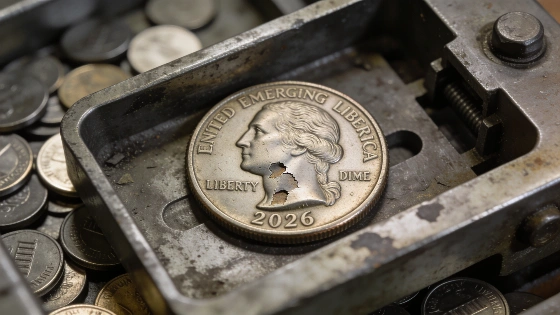
Philadelphia's 2026 Emerging Liberty Dime is showing rare die events-wave-like formations, spalling, and interior breaks-offering collectors and researchers a close-up look at how modern coin dies behave under extreme pressure
Collectors examining the 2026 Emerging Liberty Dime from the Philadelphia Mint are encountering a series of die events rarely seen in modern U.S. coinage-wave-like surface formations, incipient spalling, and pronounced interior die breaks. These flaws, concentrated in a small area beneath Lady Liberty's neck and the date, are not just cosmetic quirks. They are physical evidence of how modern coin dies respond to the stresses of high-relief design and rapid production, and they are already sparking debate among numismatists and minting engineers alike.
What sets these dimes apart is not just the return of Liberty to the obverse for the first time since 1945, but the way the coin's geometry is pushing the limits of current die technology. The base of Liberty's neck sits off-center and forms the highest peripheral relief on the coin, forcing the die face to curve sharply between the neck and the rim. This creates a steep, elevated channel on the die, which in turn concentrates pressure and shear forces during each strike. The result: a localized zone where metal flow, stress, and fatigue converge, producing visible and measurable die events.
Wave Patterns and Spalling: Anatomy of a Modern Die Flaw
Under magnification, the first and most distinctive flaw appears as a raised, wave-like formation ending in a sharp, step-like shoulder. A ledge follows the trough of the wave, and high-resolution scans at 2000x reveal the structure in detail. This is not an isolated phenomenon. A nearly identical wave event has been documented on the 2026-P Mayflower Compact Quarter, which shares similar design features-abrupt changes in curvature, high relief near the periphery, and lower-relief elements near the rim.
These wave events are not random. In some cases, nearly identical pairs have been found in the same roll, indicating that the flaws are produced by successive strikes from the same die. The most plausible explanation is that the combination of high-relief design and steep die curvature is forcing the metal to flow in ways that exceed the die's tolerance, creating a wave that terminates against a vertical wall where the relief drops off. This is a direct consequence of the coin's geometry and the physical limits of the die steel.
The second major flaw is incipient spalling-large, elliptical, flake-like areas where the die surface is beginning to break down. These patches often connect to fine cracks and resemble early-stage spalling seen in material fatigue studies, where microcracks and shallow flaking signal the onset of more serious die failure. The third, and most severe, flaw is the appearance of freestanding interior die breaks, where repeated stress creates subsurface shear zones that eventually crack through to the surface.
Philadelphia vs. Denver: Minting Differences and Measurable Data
Not all 2026 Emerging Liberty Dimes are created equal. Philadelphia Mint coins show a steeper elevation-up to 45 microns higher-than their Denver counterparts. This difference in die crown height and design relief is not trivial. According to a United States Mint study, such variations can affect how well the coin's design fills during striking, and may explain why Philadelphia coins are more prone to these concentrated die events. While earlier speculation suggested Denver might use higher-crown dies, new scan data points to Philadelphia as the outlier. The full implications for production quality and die longevity remain under investigation.
For context, the 2026 Emerging Liberty Dime is not the only U.S. coin to attract attention for its physical quirks. At the 2026 World's Fair of Money in Pittsburgh, all 11 government-owned 1933 Double Eagles will be displayed together, highlighting how rare coinage events can become central to both collector interest and the study of minting technology. As reported earlier, such gatherings offer a unique window into the evolution of American coin production.
Data from recent cross-sectional scans show that the area beneath Liberty's neck on the Philadelphia dime forms a deeper channel than on Denver coins, with the elevation difference measurable at up to 45µm. This geometric disparity is significant enough to alter the way metal flows during striking, increasing the risk of localized die fatigue and visible surface events. The United States Mint's own research confirms that differences in die crown height and relief can materially affect coin fill and the likelihood of die failure.
What These Die Events Mean for Collectors and Minting Practice
For collectors, the 2026-P Emerging Liberty Dime is more than a commemorative issue. It is a live experiment in the limits of modern die engineering, offering a rare chance to observe how design choices and production variables interact in real time. The presence of wave-like formations, spalling, and interior die breaks on circulating coins is a reminder that even with advanced materials and precision manufacturing, the physical realities of metal and pressure still dictate the outcome.
Minting engineers and researchers are likely to scrutinize these dimes for years to come, using them as case studies in die fatigue, metal flow, and the trade-offs inherent in high-relief coin design. The fact that nearly identical flaws appear on both dimes and quarters from the same year and mint suggests that the underlying issues are systemic, not isolated accidents. For the U.S. Mint, the lesson is clear: pushing the boundaries of design can yield visually striking coins, but it also exposes the process to new forms of mechanical stress and failure.
Understanding the mechanics of die failure is essential for anyone interested in the intersection of art, engineering, and currency. Die events like those seen on the 2026 Emerging Liberty Dime are not just technical curiosities-they are the physical record of how a nation's money is made, and how even the smallest design decision can ripple through the entire production process. As the numismatic community dissects these flaws, the real story is not about perfection, but about the complex, often unpredictable relationship between design ambition and manufacturing reality.
Die events such as wave formations, spalling, and interior breaks are rooted in the physics of coin striking. When a coin design features high-relief elements near the periphery, the die must accommodate rapid changes in curvature, which concentrates stress in specific zones. Over time, repeated strikes can cause the die steel to fatigue, leading to microcracks, surface flaking, and eventually larger breaks. These flaws are not unique to the 2026 Emerging Liberty Dime, but the coin's design and production choices have made them unusually visible and instructive. For both collectors and minting professionals, understanding these mechanisms is key to appreciating the challenges and trade-offs of modern coin production.